Get Full Government Meeting Transcripts, Videos, & Alerts Forever!
Get email alerts on the Surgical Smoke topic
No spam. Unsubscribe anytime.
Nurses, perioperative staff press committee to require smoke evacuation in operating rooms statewide
Summary
Nurses, perioperative professional groups and patient‑safety advocates told the Joint Committee on Public Health that surgical smoke is an occupational hazard that should be addressed by statute.
Nurses, perioperative professional groups and patient‑safety advocates told the Joint Committee on Public Health that surgical smoke is an occupational hazard that should be addressed by statute.
Several witnesses urged lawmakers to enact House Bill 24‑42 and Senate Bill 14‑82, which would require hospitals and freestanding ambulatory surgical facilities to adopt policies ensuring use of surgical smoke evacuation systems.
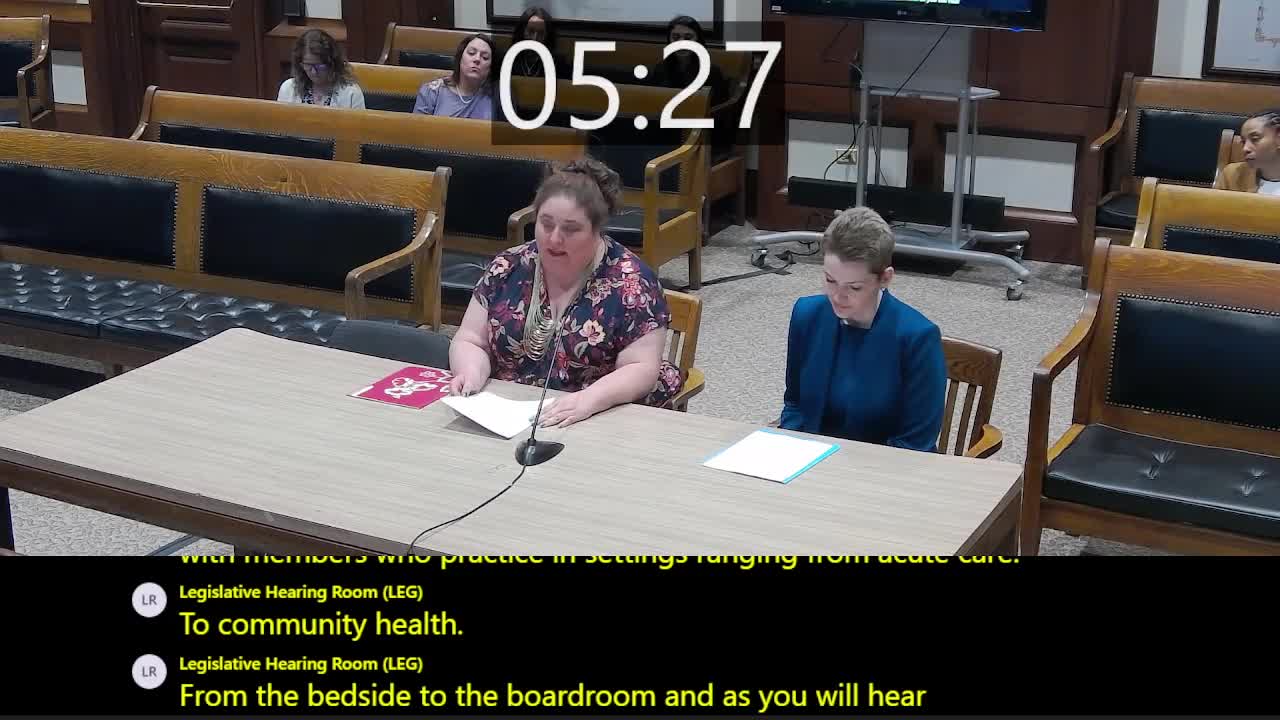
Frontline testimony: “This is my bag. These are my inhalers, my allergy pills, my steroid creams, steroid pills, and nasal sprays,” said Andrea Dyer, an operating‑room nurse, holding up medicines she said she uses after shifts. “This is what I had to carry just to go to work every day, just to be able to breathe in 1 day in the OR.” Dyer and other nurses described chronic cough, wheeze, eye irritation and other symptoms they linked to repeated exposure to smoke produced when tissue is cauterized or vaporized.
Scientific and occupational evidence: Speakers cited studies and professional guidance documenting that surgical smoke contains hazardous chemicals — including formaldehyde, benzene and carbon monoxide — along with particulate matter and viral and cellular fragments. AORN, the Association of Perioperative Registered Nurses, and the American Nurses Association‑Massachusetts urged the committee to require consistent use of smoke evacuation equipment rather than rely on voluntary adoption.
Workforce and operations: Witnesses said many facilities already possess smoke‑evacuation equipment but that usage is inconsistent. Cammie Daniello, executive director of the American Nurses Association Massachusetts, cited a membership survey showing less than half of respondents said the equipment was “always used” and urged legislation to ensure consistent use. Advocates said mandatory policies would also help recruitment and retention in operating rooms, where staff repeatedly report exposure.
Policy models and timing: Supporters noted that more than a dozen states have enacted similar protections for surgical staff; others are considering legislation this year. Testimony highlighted the relative ease of retrofitting or using available evacuation systems and emphasized that masks alone do not remove the fine particles contained in surgical smoke.
No vote was taken at the hearing. Proponents urged the committee to favorably report the bills and said that a statutory requirement would standardize practice and protect both staff and patients.