Get Full Government Meeting Transcripts, Videos, & Alerts Forever!
Get email alerts on the Water Fluoridation topic
No spam. Unsubscribe anytime.
Heated testimony for and against water fluoridation proposals at public‑health hearing
Summary
Dentists, public‑health advocates and residents offered opposing evidence and personal stories on a set of bills (S.1517, H.2548 and several related measures) that would ban or restrict municipal water fluoridation or require warnings.
The Joint Committee on Public Health heard extended testimony both supporting and opposing several bills that would ban, restrict, or require warnings about community water fluoridation (including S.1517, H.2548, S.1518, H.2549, S.1630, S.1575 and H.2449). The witnesses included leaders of the Massachusetts Dental Society and pediatric dentists, as well as residents and advocacy groups urging removal of fluoride from public water supplies.
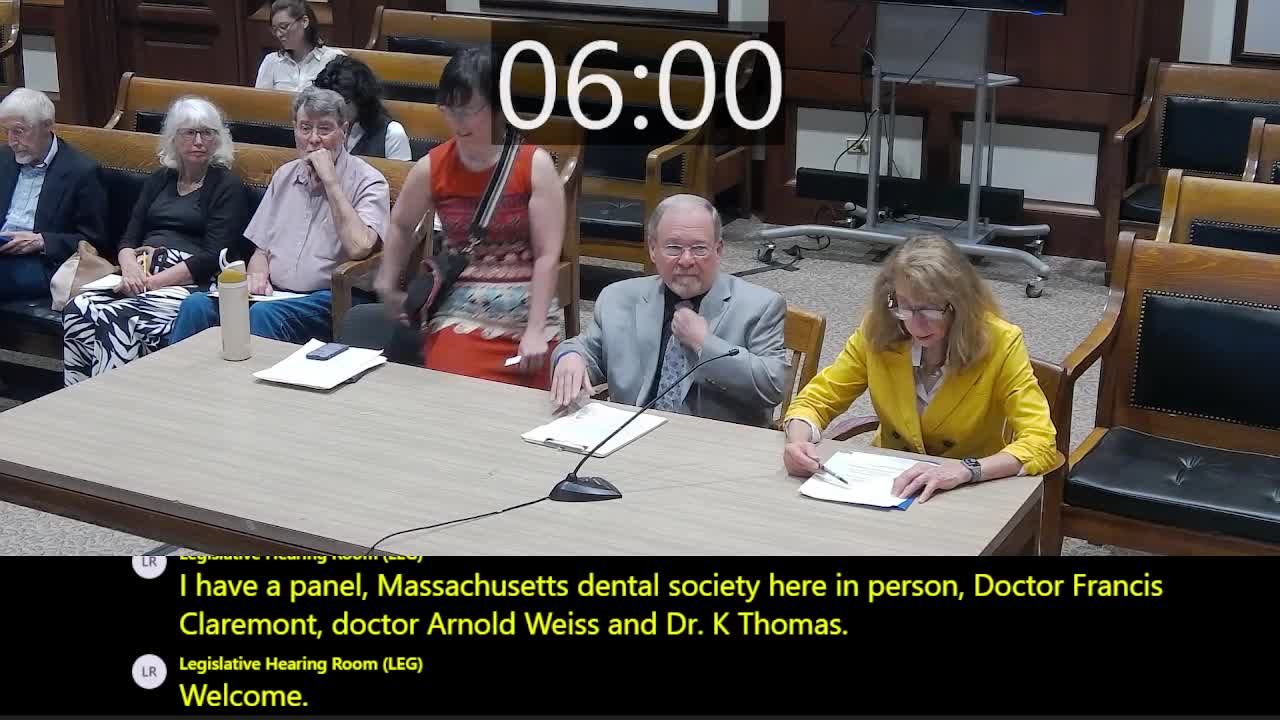
Opponents of bans, including Dr. Francis Claremont, chair of the Massachusetts Dental Society’s Committee on Government Affairs, argued that municipal water fluoridation is a long-standing public-health tool with decades of evidence showing prevention of tooth decay. “I routinely witnessed young children with rampant decay…ten years after water fluoridation had got its foothold in the community, it was common for me to find no decay in my patients,” Claremont said, citing clinical experience and the Centers for Disease Control’s recognition of fluoridation as a major twentieth‑century public‑health achievement.
Pediatric dentist Dr. Arnold Weiss and other dentists told the committee that fluoridation reduces tooth decay for children and adults and promotes equity for those with limited access to dental care. The Massachusetts Dental Society and allied dental groups urged the committee to reject bills that would remove fluoride from community water.
Supporters of the ban and warning bills described recent scientific reviews and a federal court decision. Karen Spencer, a Leominster resident, cited a September 2024 federal court ruling she said found 0.7 mg/L fluoridation poses “an unreasonable risk of reduced IQ in children.” Other witnesses pointed to a 2023 National Toxicology Program review and called for local control or outright bans, arguing systemic fluoride ingestion poses risks to thyroid function, the microbiome, bone health and neurodevelopment. Deirdre Healy, a Worcester resident who opposed fluoridation, noted Worcester has never been fluoridated and said the city’s dental health is acceptable.
Why it matters: The testimony highlighted a core policy trade-off: proponents of continued fluoridation framed it as an inexpensive, populationwide preventive intervention benefiting underserved communities; opponents argued risks from systemic ingestion outweigh benefits and that topical fluoride (toothpaste, varnish) is the safer option.
Technical and legal points: Witnesses debated dose, exposure pathways and the chemical forms used in water treatment. Several speakers said the fluoridation chemicals used in water systems are industrial byproducts and raised contamination concerns. Dental and public-health groups questioned the interpretation of recent studies and the robustness of claims linking fluoridation at the current level (0.7 mg/L) to neurodevelopmental harm.
Next steps: Several proponents and opponents said they would submit further written evidence. The committee did not take a vote during the hearing. Testimony included requests for statutory clarifications to allow municipalities a clear opt‑out pathway and for public warnings on fluoridated systems.