Get Full Government Meeting Transcripts, Videos, & Alerts Forever!
Get email alerts on the Electromagnetic Sensitivity topic
No spam. Unsubscribe anytime.
Advocates urge Joint Committee to add electromagnetic sensitivity to state disease registry bill
Summary
Testifiers at the Joint Committee on Public Health hearing urged lawmakers to amend House Bill 2,413 to add electromagnetic sensitivity (EHS/EMS) to the Commonwealth's Maven illness registry, arguing it would improve data collection, clinical guidance and public education.
Testimony at the Joint Committee on Public Health on H.2413 centered on whether the Commonwealth should add electromagnetic sensitivity (also called EHS, EMS or microwave illness) to the state’s Maven illness registry. Proponents said adding the condition would allow officials to track cases and direct medical education and public outreach.
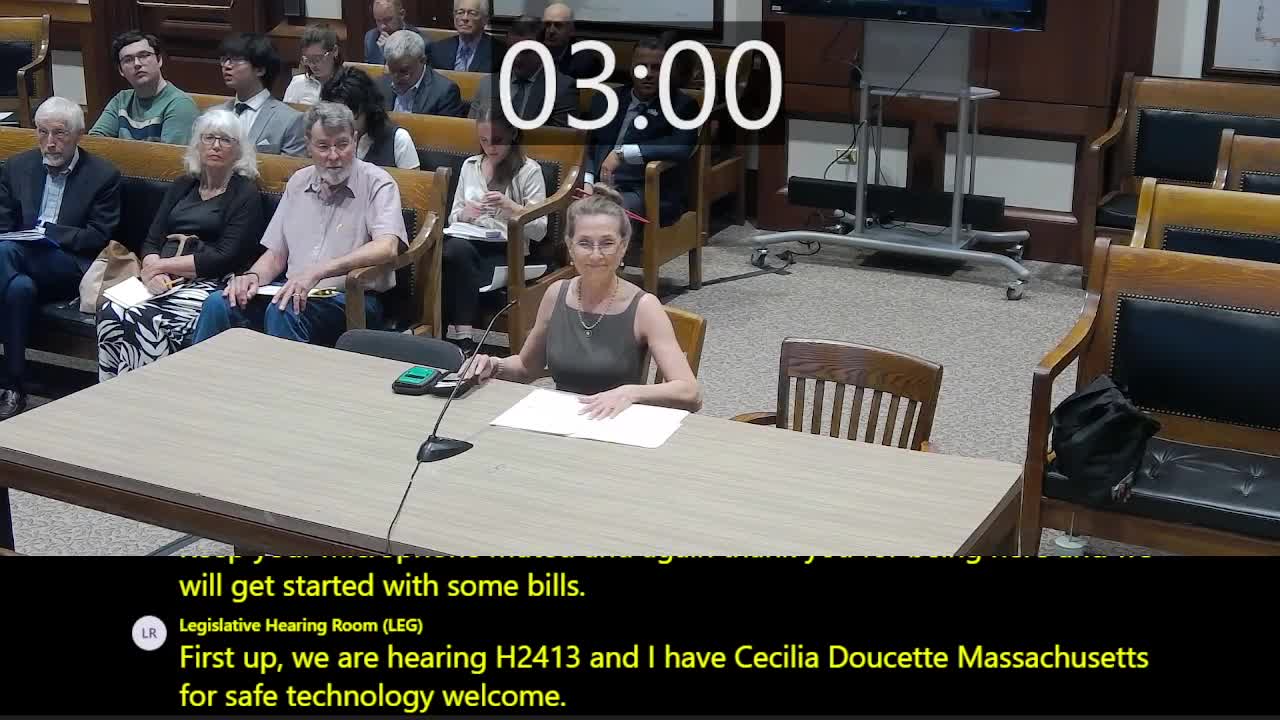
Cecilia Doucette, director of Massachusetts for Safe Technology and the nonprofit Safer Screen Time, told the committee that “this device was tested at a distance from the body…so if you’re holding it with the antennas radiating, you are exceeding the Federal Communications Commission’s limits for public radiation exposure,” and urged inclusion of electromagnetic radiation syndrome in Maven so the state can “gather decision making data to protect all of us, and especially our children.”
Why it matters: Supporters said the registry would produce data needed for public-health planning and clinician education. Multiple speakers described patients who struggle to obtain diagnosis and care when providers are unfamiliar with the condition, and argued a formal count and expert committee—both parts of H.2413—would reduce stigma and improve access to informed care.
Advocates cited tools and curricula already in use: Doucette referenced training available through Safer Screen Time and the Massachusetts Breast Cancer Coalition’s K–12 materials; testimonial witnesses said an EMF medical conference offers clinician training and continuing education credits. Courtney Gilardi, testifying virtually, said she and her daughters were diagnosed with electromagnetic sensitivity and described the difficulty of obtaining consistent medical recognition. “This bill is not just about counting those with a medical condition. It’s about creating a committee to address this problem,” she said.
Speakers from multiple organizations also asked the committee to ensure the bill’s language requires distribution of published diagnostic and treatment guidance to physicians and boards of health so clinicians have access to standardized information. Patricia Burke of Safetec International told lawmakers the Commonwealth lacks population data on harm from smart meters and other sources and said “decision makers should also have hard data about the number of Massachusetts residents who’ve already been harmed,” pointing to the state’s large rollout of digital electric meters.
Careful framing: Testimony included medical and advocacy claims about harms and referenced federal agencies. Speakers cited Federal Communications Commission statements and described scientific literature and conferences; they also requested that the committee avoid framing the registry as a policy action beyond data collection and expert review. Committee chairs prefaced the hearing by emphasizing that the session was for public testimony and that “no decisions will be made today” and bills reported out would still require committee vote to advance.
Next steps: Supporters said they will submit written testimony and scientific sources to the committee. H.2413, as filed, calls for data collection and formation of an expert committee; witnesses asked lawmakers to ensure the bill’s language requires active dissemination of clinical guidelines and inclusion of EHS/Electromagnetic Radiation Syndrome as a reportable condition or entry in Maven.