Get Full Government Meeting Transcripts, Videos, & Alerts Forever!
Get email alerts on the Labor Privilege Captive Audience topic
No spam. Unsubscribe anytime.
Business groups, unions clash over bills on captive‑audience meetings and union privilege
Summary
The committee heard competing testimony on legislation that would curb employer captive‑audience meetings and create privilege protections for union communications. Business groups warned of federal preemption and litigation; unions and worker advocates urged state protections to preserve worker rights.
Bills addressing employer communications and worker‑union confidentiality drew sharply contrasting testimony at the Joint Committee on Labor and Workforce Development hearing.
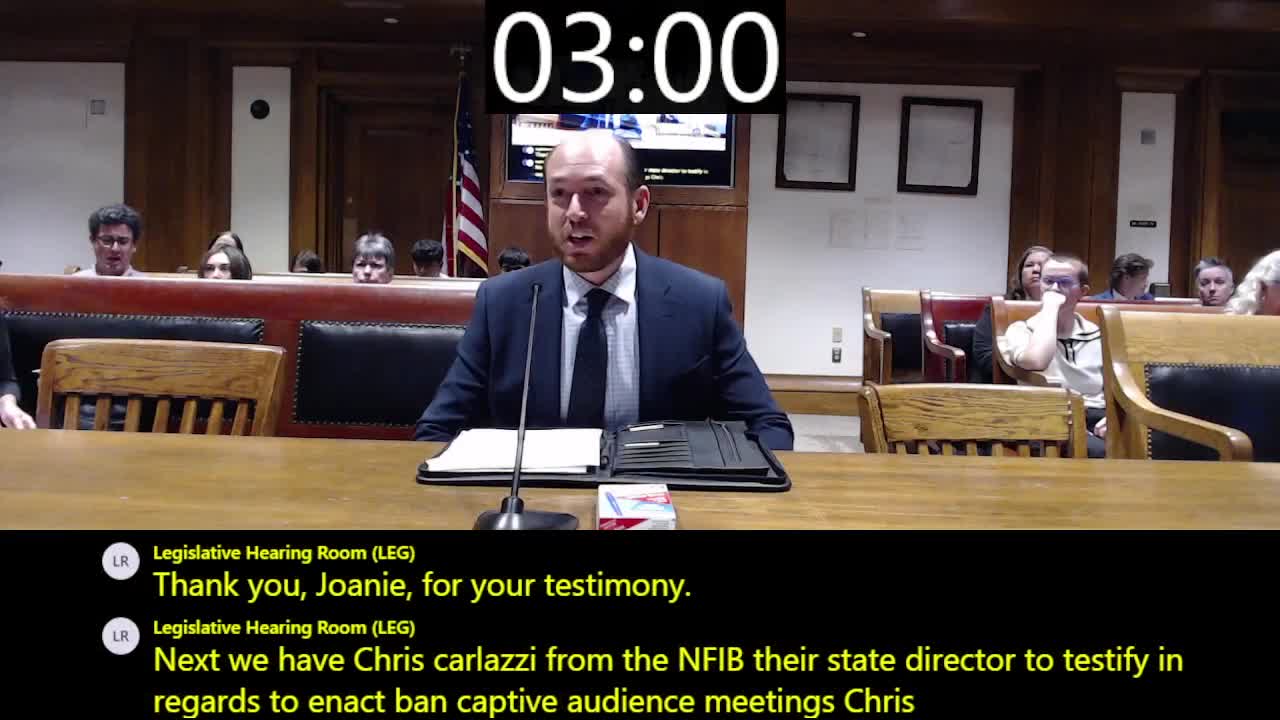
Christopher Carlozzi, state director of the National Federation of Independent Business, urged the committee not to advance House Bill H2183 (a ban on captive‑audience meetings), saying the bill "violates employers' constitutionally protected free speech rights" and risks preemption by federal law. Carlozzi argued federal precedent and pending appeals make the legal landscape uncertain and recommended waiting for federal courts to rule.
By contrast, labor and worker‑safety advocates asked the committee to act to protect workers. Lindsey Kenny, legislative director for the Massachusetts AFL‑CIO, supported H2087/S1328, which would establish a privileged status for confidential communications between labor organizations and represented individuals, saying workers need secure channels to raise safety and representation issues without fear of reprisal.
SEIU Local 509 urged legislation (H2097/S1331) to protect collective bargaining continuity if the National Labor Relations Board narrows coverage for certain private‑sector groups; the SEIU bill would allow the state Division of Labor Relations to certify units in the event of adverse federal decisions to avoid disruptive decertifications.
Business groups noted ongoing litigation in other states over similar captive‑audience laws and warned that Massachusetts could face comparable federal challenges. Ryan Kearney, general counsel for the Retailers Association of Massachusetts, said employers must be able to present business impacts to employees and that the state should refrain from creating statutory conflicts until the federal posture is clear.
Union advocates said workers who are not covered by the NLRA or who work remotely deserve protections under state law. Eric Thurm of the National Writers Union urged the committee to consider H2090, which would apply Massachusetts employment law to workers who perform labor remotely for in‑state employers, noting remote work can leave employees isolated and vulnerable.
Ending: The committee heard opposing legal analyses and asked parties on both sides to provide briefs or relevant court decisions; no vote was taken at the hearing.