Get Full Government Meeting Transcripts, Videos, & Alerts Forever!
Get email alerts on the Parking Cash Out topic
No spam. Unsubscribe anytime.
Supporters tell committee parking cash‑out would lower vehicle miles traveled, ease congestion
Summary
Backers of Senate Bill S1346 said parking cash‑out — giving employees the cash value of employer‑subsidized parking if they decline it — can cut vehicle miles traveled, reduce emissions and be implemented with minimal cost to employers. Business groups urged caution about implementation details.
Parking cash‑out legislation drew broad support and technical questions at the Joint Committee on Labor and Workforce Development hearing, with advocates saying the policy would reduce driving, lower emissions and shift commutes to transit, walking and biking.
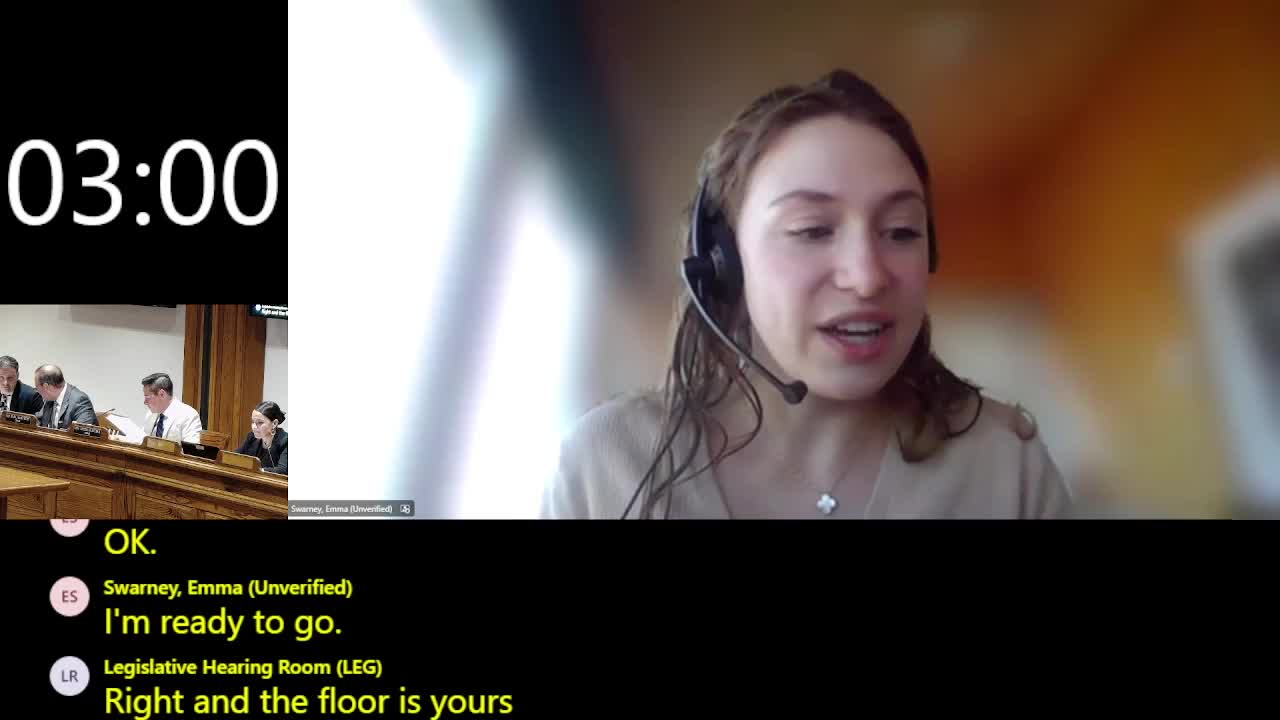
Proponents told the committee Senate Bill S1346 would require employers who subsidize parking to offer employees the cash equivalent or another commute benefit if they decline the parking. "Parking cash out simply requires employers offering employees a parking subsidy, the choice between parking and an equally valued alternative benefit if they choose not to drive," said Emma Swamy, a data scientist at StreetLight Data, who testified in support of S1346 and said she helped draft the bill while a MassDOT Rappaport Public Policy Fellow.
Supporters said existing studies and federal modeling show measurable benefits. Swamy cited a Federal Highway Administration estimate that a cash‑out policy could reduce total vehicle miles traveled by about 10%, cut vehicle hours of delay, prevent thousands of metric tons of CO2 emissions and reduce traffic fatalities in dense corridors. Tony Jordan, president of the Parking Reform Network, called the policy "logical, economical, fair, and most importantly, effective," noting academic and agency studies showing sizable mode shifts when employees are offered cash alternatives to parking.
Sponsor testimony emphasized the bill is an incentive change, not a mandate to prohibit parking. State Senator John Keenan, a sponsor of S1346, said the measure "flips the incentive structure" and "levels the playing field" by ensuring employees are not financially penalized for choosing transit, biking or walking.
Committee members and witnesses discussed implementation details the bill must clarify. Representatives asked how employers should price the cash alternative when on‑site parking is worth substantially more than a transit pass or bike share. Witnesses pointed to provisions in the draft bill that use local commercial parking or a defined monthly floor (for example, a monthly minimum) to set comparisons where a market price is not available, and to lead time and exemptions for small employers and collective bargaining situations.
Business voices urged caution about legal and practical issues. Christopher Carlozzi of the National Federation of Independent Business did not testify on this bill specifically at the hearing but other business commenters in the record and committee exchanges noted concerns about administrative complexity for small employers and the need for clear tax treatment of cash benefits versus non‑cash commuter benefits.
Proponents said the policy is designed to be revenue‑neutral for employers and to deliver public benefits. "Employers can easily comply with this law, with this policy in a revenue neutral manner," Swamy said, giving the example of substituting the cash value of a parking space for a transit pass of equivalent value in some cases.
The committee took testimony from municipal and transit policy advocates and declined to take immediate action at the hearing. Sponsors asked the committee to report S1346 favorably for further consideration and technical refinement.
Ending: Committee staff invited written testimony through the posted deadline and said they would receive additional technical input from MassDOT and affected employer groups before drafting any committee recommendation.