Get Full Government Meeting Transcripts, Videos, & Alerts Forever!
Get email alerts on the Apprenticeship Public Projects topic
No spam. Unsubscribe anytime.
Unions, Apprentices and Trades Back Bill Requiring Apprentices on Public Projects over $1M
Summary
Labor leaders, apprentices and building‑trades unions urged the Joint Committee to advance bills that would phase in requirements for registered apprentices to perform a share of work hours on public construction projects costing more than $1 million.
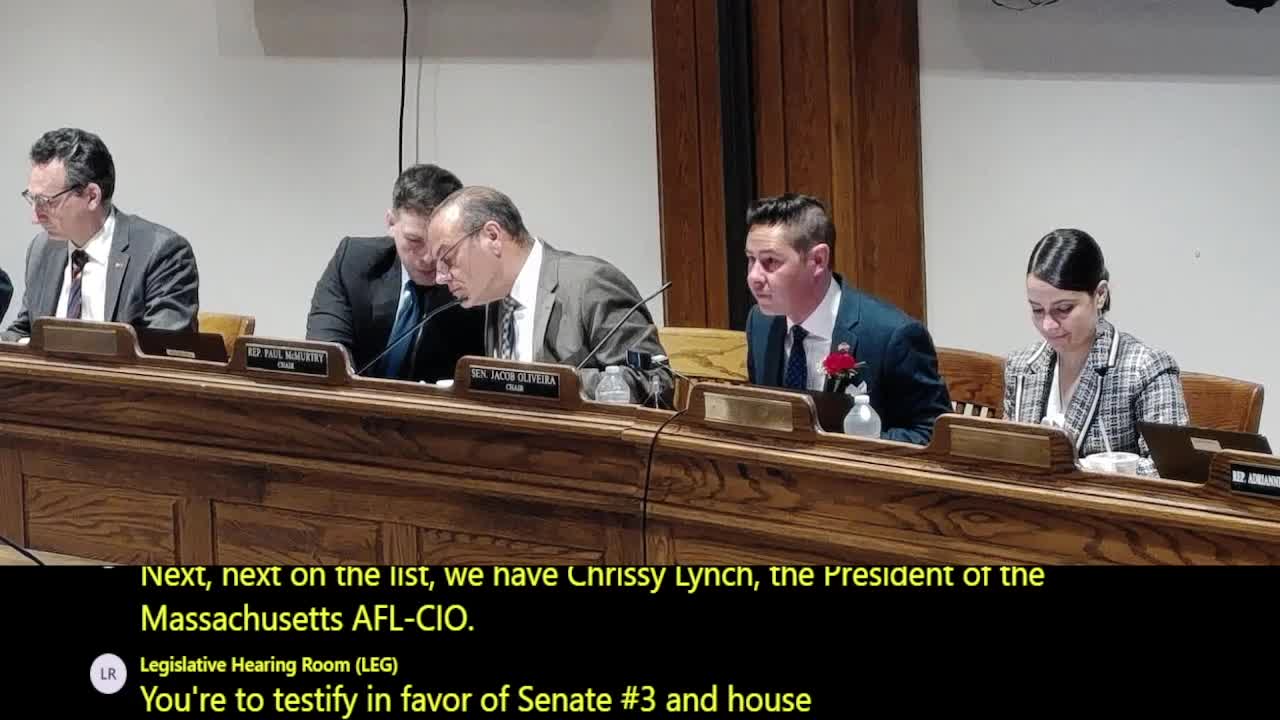
Unions and construction‑trade apprentices told the Joint Committee on Labor and Workforce Development on Thursday that requiring a share of on‑the‑job hours for registered apprentices on public projects would build a stronger, local skilled workforce and protect public investments.
“Apprenticeships are the other four‑year degree,” Chrissy Lynch, president of the Massachusetts AFL‑CIO, told the committee, urging support for Senate 1303 and House 2085 to expand apprenticeship access on public construction work.
Frank Callahan, president of the Massachusetts Building Trades, described legislation that phases in an apprentice hours requirement — a graduated scale beginning at 5 percent and increasing to 15 percent — for public construction projects above $1 million. He said the change would ensure apprentices gain the on‑the‑job hours they need to progress through multi‑year registered apprenticeships.
Apprentices and journeypersons testified about the training model and safety needs. Renee Leona Dozier, a licensed journeyman master electrician, urged maintaining current electrical licensure ratios, saying untrained work has led to fires and loss of life. Several apprentices described that classroom instruction must be paired with job hours to complete training and obtain licenses.
Apprentices said the proposed phased requirement would create opportunity for local workers, improve recruitment and retention, and address retirements and workforce shortages. Kari Brown, a second‑year electrical apprentice, said the measure “creates real opportunity, especially for people from underrepresented communities.” Madison McAllister, a first‑year IUPAT apprentice, said the union pathway offered a stable career alternative to low‑wage jobs.
Supporters framed the bills as consistent with the Commonwealth’s existing prevailing‑wage and procurement policies: when public dollars pay for construction, they said, the projects should advance workforce development and training. No formal vote was taken; witnesses asked the committee for a favorable report and urged alignment of public construction procurement with registered apprenticeship participation.
Ending: Proponents said the requirement would be a practical mechanism for turning public projects into training sites that produce the next generation of skilled tradespeople while preserving safety standards and licensure requirements.