Get email alerts on the Hdip Reform topic
No spam. Unsubscribe anytime.
Advocates ask committee to reshape HDIP into mixed‑income program
Summary
Housing advocates urged the committee to reform the Housing Development Incentive Program (HDIP) so it supports mixed‑income projects and includes affordability requirements; witnesses said current HDIP awards largely subsidize higher‑rent units in gateway cities while voucher programs face freezes.
Witnesses from the Massachusetts Law Reform Institute, Homes for All Massachusetts, and progressive advocacy organizations asked the Joint Committee on Housing to revise the Housing Development Incentive Program (HDIP) so it supports mixed‑income developments rather than primarily subsidizing market‑rate units.
Main arguments: Judith Liben of Massachusetts Law Reform Institute said HDIP currently funnels state subsidies to market‑rate developments in gateway cities and does not require affordability; she told the committee the program distributed large sums in recent years (testimony recited $54 million in 2024 and $18 million in 2025, and total figures cited in testimony) while the administration paused issuing some voucher programs because of budget constraints.
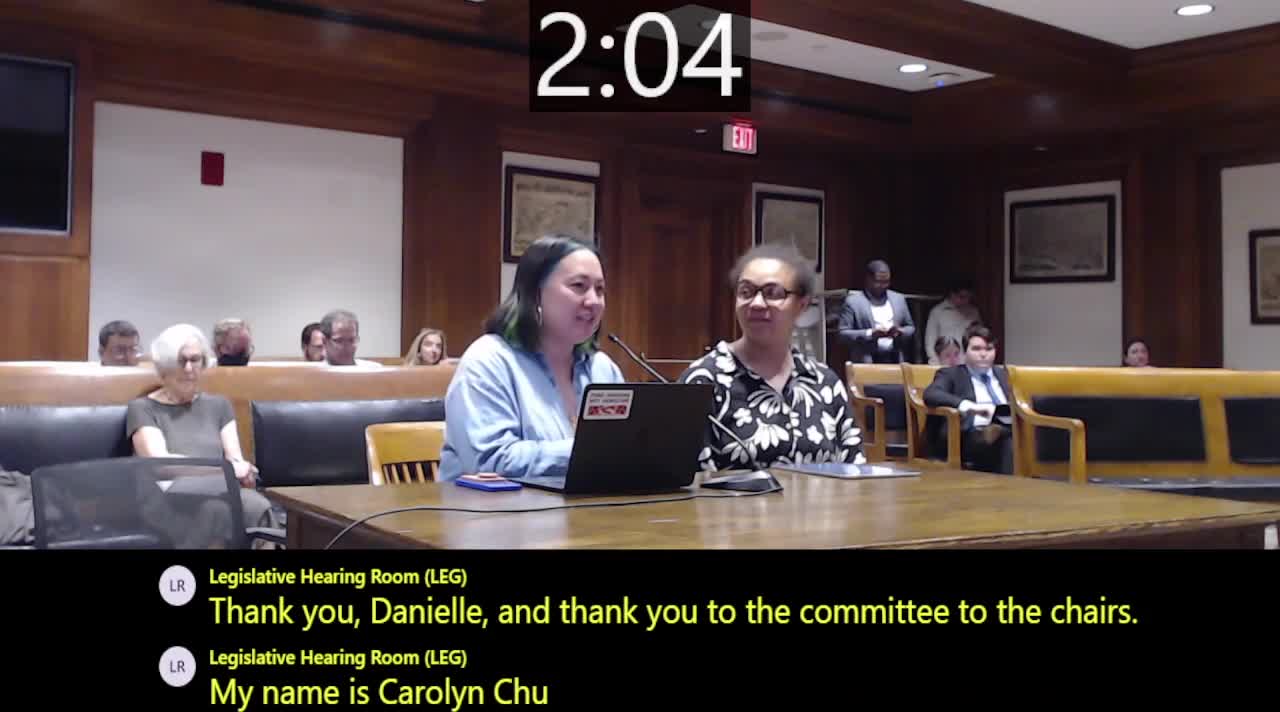
Policy change requested: S.971 (as presented) would make HDIP a mixed‑income program, attaching affordable units to HDIP awards and requiring the program to support households with very low incomes in some portion of projects. Danielle Summer Quieta and Carolyn Chu from Homes for All Massachusetts supported that approach and asked for HDIP reform that prioritizes affordable units and accountability for public subsidy.
Context and limits: Testimony contrasted large HDIP awards with voucher freezes and argued state subsidy should be reoriented to benefit lower‑income households. Witnesses asked for a favorable report; the hearing transcript records no committee vote or final action.
Ending: Advocates called for programmatic accountability to ensure public dollars support a range of incomes and protect residents across gateway cities.
AI generated
The text on this page is AI generated. Summaries, highlights, analysis, and video transcripts are all produced from the original source material.
AI can make mistakes, so if you spot one, and we will fix it for everyone.
Note: the source content is unaltered by us. Any content source we link to, be it a video, an audio recording, or a document, is presented exactly as its publisher released it. That publisher is usually a government body, sometimes an individual official or another organisation.