Get Full Government Meeting Transcripts, Videos, & Alerts Forever!
Get email alerts on the Campus Decarbonization Geothermal topic
No spam. Unsubscribe anytime.
Experts urge explicit BRIGHT Act support for geothermal (thermal) networks to decarbonize campuses
Summary
Designers, campus sustainability leaders and decarbonization advocates told the Joint Committee that the BRIGHT Act should explicitly include geothermal (thermal) networks as an approved decarbonization option, arguing networks offer high efficiency, long‑term savings and community linkage potential.
A panel of subject matter experts briefed the Joint Committee on Higher Education on geothermal (thermal) networks and urged the bill sponsors to name those systems explicitly in H.54 to maximize emissions reductions and long‑term operating savings.
What geothermal networks are: panelists described the technology as circulating water through an underground loop to move thermal energy between buildings, bedrock and other thermal resources. In that design, heat pumps inside buildings provide heating and cooling without combustion, while a campus‑scale loop provides thermal storage, efficiency and resilience.
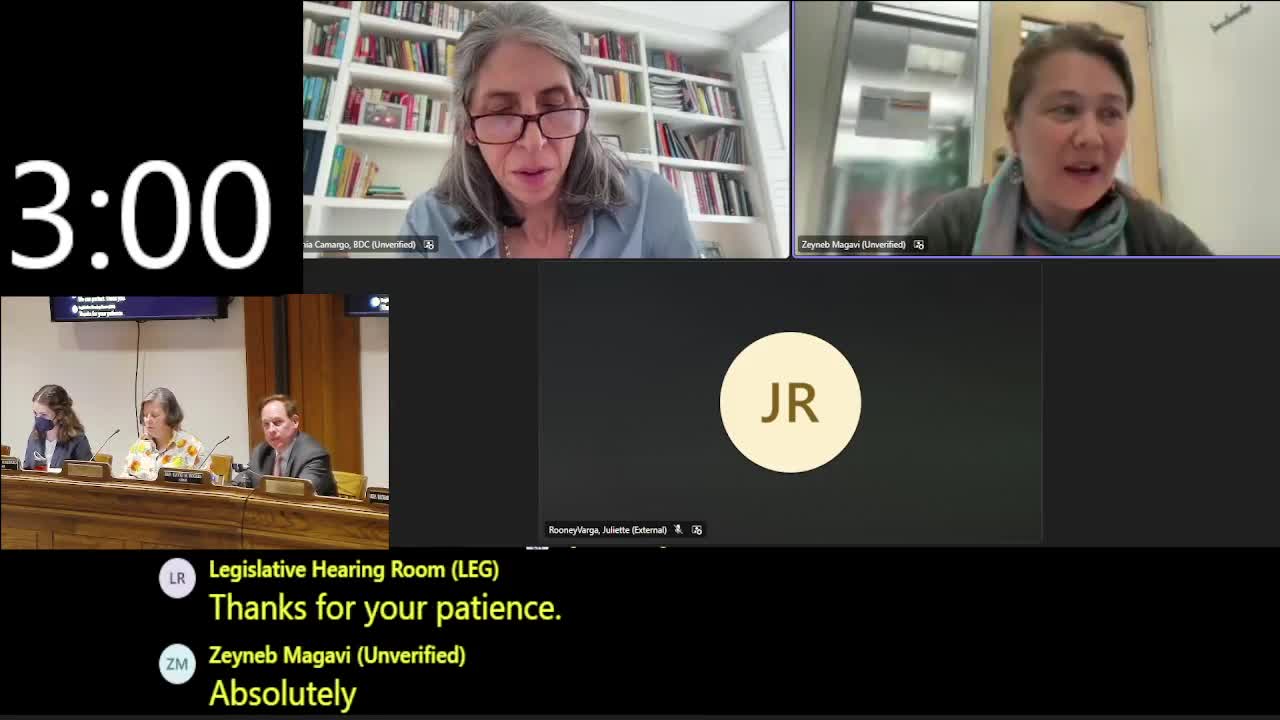
Panel testimony and examples: Zena Maghavi (HEAT) called geothermal networks “the most efficient combustion‑free heating and cooling ever documented,” and recommended the committee ensure H.54 explicitly authorizes networks as an eligible decarbonization investment. Juliette Rooney Varga (UMass Lowell) said UMass Lowell already has designs, permitting work and borehole testing done for a campus‑anchored geothermal network and argued the campus could pilot a replicable, scalable model tied to community benefits. Joan Fitzgerald (Northeastern University) noted successful installations elsewhere — including district installations and public housing pilots — and said the same trades and crews that install conventional pipe can be trained to install geothermal loops, creating inclusive job pathways. Panelists cited examples where campus or community geothermal investments produced paybacks in roughly a decade and emphasized the systems’ low operating costs and reduced grid demand versus other electrification approaches.
Cost profile and financing implications: witnesses emphasized geothermal networks have higher upfront costs and long payback periods (panelists cited typical ROI estimates of roughly 8–12 years) but deliver durable operating savings and lower electricity demand. They told the committee the BRIGHT Act’s capital financing structure is a strong match for geothermal’s upfront financing needs and urged explicit statutory language so campuses can use BRIGHT funds to finance network construction.
Ending: the panel asked the committee to include geothermal/thermal networks as an eligible decarbonization approach in H.54, noting that doing so would let campuses pursue the most efficient and resilient heating/cooling options and could connect campus investments with nearby communities and workforce‑training opportunities.