
Unified Government committee approves FY2025 Annual Action Plan, forwards fast-track request to full commission
Get AI-powered insights, summaries, and transcripts
Subscribe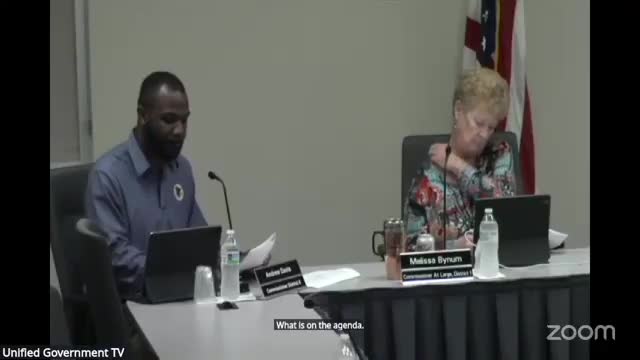
Summary
The Neighborhood and Community Development Standing Committee approved and fast-tracked the FY2025 Annual Action Plan, covering HUD entitlements (CDBG, HOME, ESG), a developer-rebate program to spur affordable housing, and increased funds for childcare, storefront facades, emergency home repair and homeless services.
The Neighborhood and Community Development Standing Committee voted 4-0 Aug. 4 to recommend approval and fast-track the Unified Government’s FY2025 Annual Action Plan to the full Board of Commissioners. Director Kaye Sharp presented the plan, which shapes the use of HUD entitlement grants for the 2025 fiscal year and must be submitted to HUD by Aug. 16.
Director Kaye Sharp said the Unified Government’s proposed HUD allocations for fiscal 2025 are $2,132,228 in Community Development Block Grant (CDBG) funding, $695,189.98 in HOME Investment Partnerships Program (HOME) funding and $194,076 in Emergency Solutions Grant (ESG) funding. Those figures reflect modest decreases from 2024: a 3.5% reduction in CDBG, a 6.2% reduction in HOME, and a 3.7% reduction in ESG, Sharp said.
Sharp said HOME program dollars have accumulated over the consolidated-plan period, and the plan presented to the committee aggregates the 2025 allocation with roughly $3.1 million in HOME funds that have built up; she presented a total figure of $3,724,488 budgeted to improve access to affordable housing. To spur production, Community Development will launch a developer rebate program that Sharp said should attract for‑profit builders: the plan offers a base rebate of $35,000 per new home with increased rebates for universal-design features; Sharp said she expects the rebate to top out informally around $50,000 for units that include accessibility upgrades. The department told commissioners it has identified four for‑profit developers willing to participate and set a goal of completing 100 new affordable homes in FY2025 and a broader target of adding 158 new housing units (single-family, duplex, triplex, fourplex) tied to HOME and other funds.
Planned FY2025 spending also includes $650,000 for storefront façade improvements on Minnesota Avenue, $331,234 to support microenterprise (50 small businesses), and an increase in funding for the warming center and related homeless services: Sharp said the warming center and related CDBG support will be funded at about $630,000, and a separate existing emergency-shelter allocation through ESG is listed at $194,076. Sharp said the Willowgill center’s total $316,000 cost — formerly partially paid from the general fund — will be covered by CDBG this year.
Sharp asked the committee to increase the childcare allocation in the draft plan from $100,000 to $200,000; under the amended motion approved by the committee, $200,000 is budgeted to assist new and existing child-care providers with modifications and equipment. The plan also calls for a pilot program to address illegal dumping and upcycle materials into public art projects.
Committee members asked for clarification on funding sources and program mechanics; Sharp responded with line-item details, administrative allocations ($426,445 CDBG admin; $74,171 HOME admin) and timing for HOME‑ARP funds, which remain available through 2030. Commissioner Andrew Davis moved to accept the plan with the childcare increase and to fast-track the item to the full commission’s Aug. 7 meeting; the committee approved the motion 4-0 by roll call (Hill — aye; Townsend — aye; Bynum — aye; Davis — aye).
Sharp said staff will accept calls about programs at Community Development (phone provided in presentation) and will continue outreach to child-care providers and neighborhood groups as projects move to implementation.