Get Full Government Meeting Transcripts, Videos, & Alerts Forever!
Get email alerts on the Nuclear Decommissioning Waste topic
No spam. Unsubscribe anytime.
Health and fishing groups ask legislature to block evaporation or ocean discharge of Pilgrim’s radioactive wastewater
Summary
Physicians, lobstermen and local residents urged the joint committee to block Holtec's plans to evaporate or discharge radioactive wastewater from Pilgrim's decommissioning and asked lawmakers to advance House Bill 4040 or stronger measures that stop aerosolization or ocean disposal.
Residents, physicians, commercial fishing representatives and local advocates urged the Joint Committee on Environment and Natural Resources to advance legislation that would prevent the airborne evaporation or ocean discharge of radioactive wastewater generated during decommissioning of the Pilgrim Nuclear Power Plant.
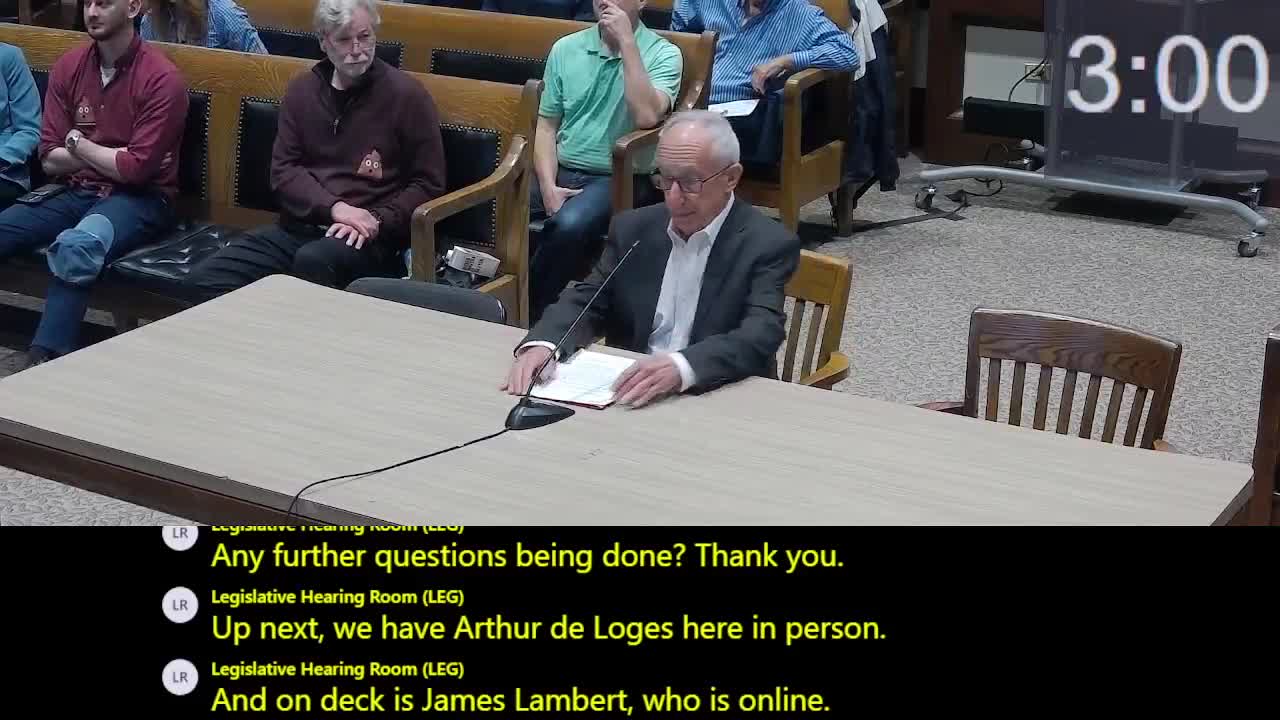
Arthur Deslojas said Pilgrim, under Holtec's ownership, sought to evaporate contaminated pool water and that the community had successfully blocked a direct liquid discharge into Cape Cod Bay in earlier legal actions. "The Pilgrim Nuclear Power Plant, planned to discharge 1,000,000 gallons of radioactive wastewater into Cape Cod Bay," Deslojas said, and he added that community groups and members of Congress had urged Holtec to adopt more transparent, community‑involved disposal plans.
Dr. Bridal Lundberg, an infectious disease physician and chair of the Massachusetts Medical Society's environmental and occupational health committee, said there is a "notable lack of data and transparency" about ongoing releases during decommissioning and described a failed federal grant effort to fund health studies. She said the Massachusetts Medical Society and the American Medical Association call for scientific studies of health effects of proposed decommissioning disposal methods prior to implementation.
Beth Cassoni, executive director of the Massachusetts Lobstermen's Association, said the association "does not support Holtec's request to dump or evaporate any radioactive water into our oceans or atmosphere" and warned of irreversible economic and ecological harms to the commercial fishery and tourism in Cape Cod Bay.
Other witnesses, including members of the State Nuclear Decommissioning Citizen Advisory Panel, urged a permanent prohibition on aerosolized discharge and argued legislation should be explicit, not limited to short study moratoria. James Lambert, a member of the advisory panel and a lawyer experienced in nuclear oversight, said the bill as drafted focuses on spent fuel pool water while much contaminated water also resides in reactor cavities and other plant systems, and he urged clearer language and an immediate stop to evaporation.
Supporters pointed to municipal referenda and votes in local communities opposing evaporation and asked the committee to adopt statutory protections and require independent study before any airborne or marine disposal occurs. Committee members invited written amendments and technical language clarifications; no action was taken on the bill at the hearing.