Get Full Government Meeting Transcripts, Videos, & Alerts Forever!
Get email alerts on the Private Wells topic
No spam. Unsubscribe anytime.
DA, Lawmakers Press for State Program to Test Private Wells and Offer Filtration Vouchers
Summary
Representatives, the state district attorney and public‑health advocates told the Joint Committee that hundreds of thousands of Massachusetts residents rely on private wells and that an enacted law to require testing at time of property transfer plus a voucher/loan program for remediation would protect public health.
Lawmakers heard testimony from district attorneys, public‑health experts, nonprofit advocates and municipal officials who urged enactment of legislation to require private‑well testing and to establish financial assistance for households that discover contamination.
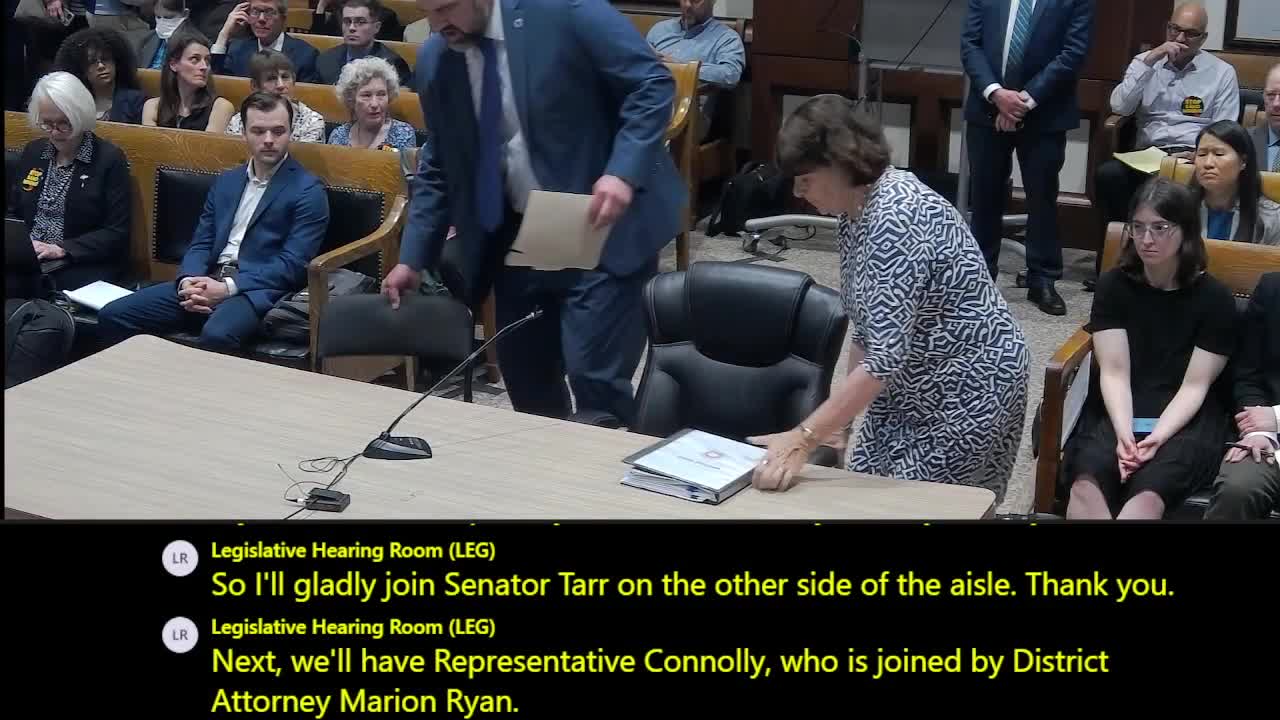
Representative Connolly, sponsor of House Bill 9 18, told the committee the bill would create an advisory panel and begin to address long‑standing environmental justice concerns related to sand mining and water contamination, then turned to co‑sponsor District Attorney Marion Ryan and partners supporting a voucher program for filtration equipment.
District Attorney Marion Ryan summarized a proposed DEP‑run voucher program to provide free or subsidized point‑of‑use filtration systems for households with PFAS above the state’s maximum contaminant level. "It is actually worse if you buy the device and then you can't afford to change the filters in that device," Ryan said. She described a voucher framework that would provide two devices in five years and cover recommended six‑month filter replacements for low‑income households.
Physicians and public‑health witnesses described contaminants found in private wells (PFAS, arsenic, uranium, bacteria and nitrate) and the health risks to children and pregnant women. "Children are uniquely susceptible to the negative health effects of contaminated drinking water," said Dr. Bridal Lundberg, who testified for the Massachusetts Medical Society.
RCAP Solutions and other technical groups told lawmakers that Massachusetts lacks statewide minimum standards for private‑well testing. Several speakers recommended requiring well tests at point of property transfer so future owners do not unwittingly drink contaminated water and to give buyers a chance to finance remediation.
Local board of health members and municipal officials reported that small towns lack the staffing and technical expertise to run broad testing programs or to enforce complex remediation. Witnesses proposed a combination of requirements at sale, DEP health‑based standards for well contaminants, and a low‑interest loan or voucher fund to cover remediation costs for lower‑income households. Written testimony and testimony at the hearing described sample costs for common interventions and suggested expanding an existing MassHousing septic repair loan program to include well remediation assistance for eligible households.
Committee members asked for cost estimates and implementation details; witnesses said per‑household remediation costs vary widely by contaminant but that many home‑level filters and point‑of‑use solutions are relatively low cost compared with whole‑house systems. Supporters requested the committee report H.900/S.585 favorably to start a state program of testing, standards and financial help.