
Piper district joins Carnegie Foundation's Future of High School Network; $100,000 grant awarded
Get AI-powered insights, summaries, and transcripts
Subscribe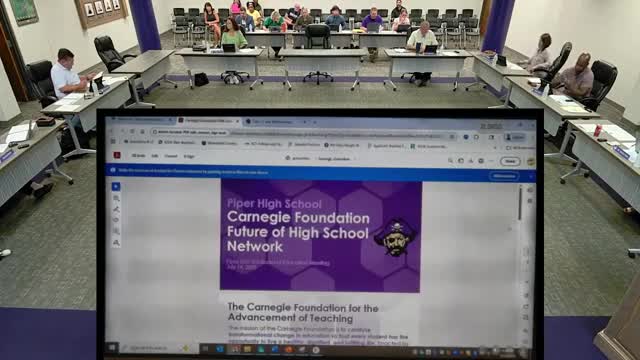
Summary
District leaders told the Board of Education that Piper USD 323 was selected as one of 24 systems nationwide to join the Carnegie Foundation's Future of High School Network and will receive $100,000 across two years to pilot competency-based high school models.
The Piper Board of Education heard a presentation July 14 on the district's selection for the Carnegie Foundation's Future of High School Network and a $100,000 grant to support the work over two years. Dr. Winn, the district presenter, said Piper was one of 24 systems chosen from hundreds of applicants and will receive $50,000 installments in 2025 and 2026.
The district's participation is framed as an opportunity to move toward competency-based instruction and to revisit the district's portrait of a graduate. Dr. Winn told the board the network is intended to replace time-based credit measures (the "Carnegie Unit") with assessments of what students know and can do. "The Future of High School Network is about building a new model for the American high school," he said, quoting Timothy Knowles, president of the Carnegie Foundation, to summarize the network's goals.
Board members asked how competency-based models would align with standardized testing and state requirements. Dr. Winn said there was no simple answer but noted Kansas Commissioner of Education Randy Watson is exploring postsecondary-aligned assessments and that the district will work with the network over the next two school years to develop pilot approaches. He also identified two first-year priorities: building infrastructure for competency-based instruction at the high school and aligning assessment and feedback to the district's portrait of a graduate.
The district will participate in monthly virtual collaboration with other network schools, host at least one site visit in November from a network school, and report back to the board as work progresses. Dr. Winn said the grant will support the district's participation but that the work is intended to be integrated with existing Professional Learning Community (PLC) efforts rather than a stand-alone project. The presentation concluded with a short question-and-answer exchange about timeline, assessment alignment and why Piper's small, nimble structure helped its application stand out.
Board members and district staff framed the selection as validation of ongoing local work and as an opportunity to influence national practice; no formal board action was required on the presentation itself. The district indicated it will return with periodic updates and specific implementation proposals as it develops pilot projects and metrics for competency-based credit.