
Senate Judiciary hearing urges reauthorization, expansion of federal counter‑drone authorities
Get AI-powered insights, summaries, and transcripts
Subscribe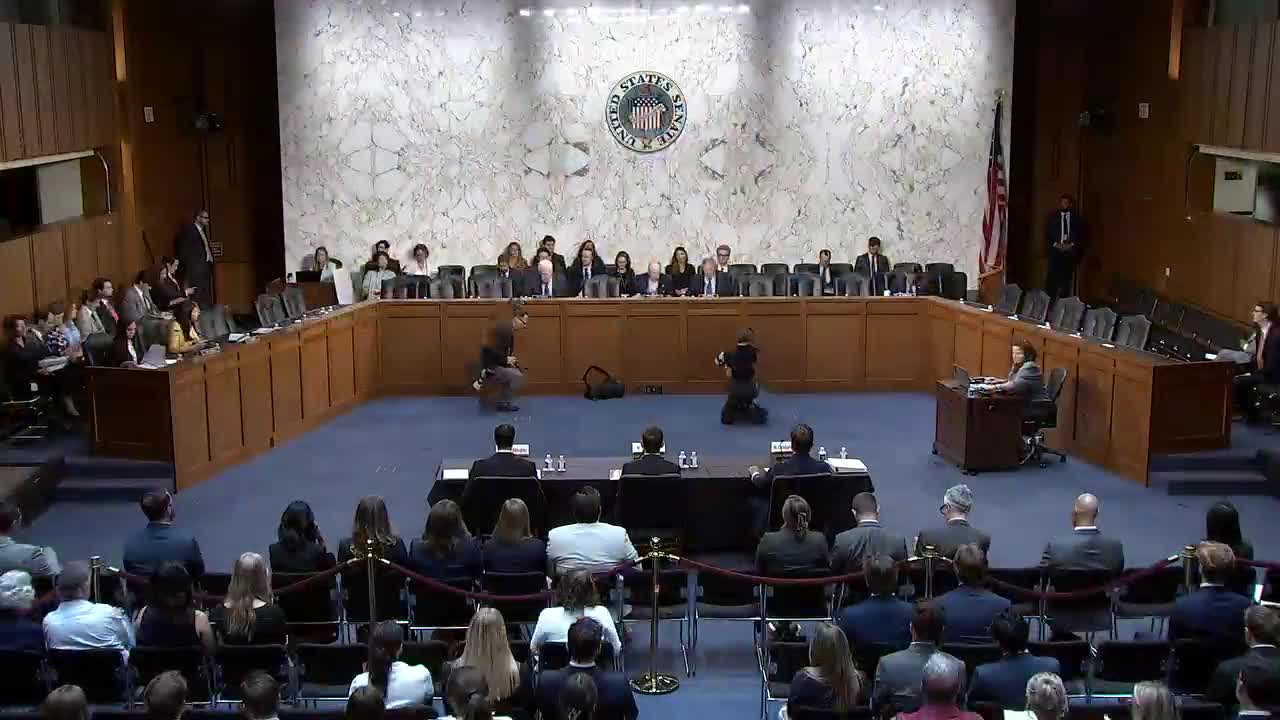
Summary
Sen. Chuck Grassley, chairman of the Senate Judiciary Committee, opened a hearing saying Congress must act before existing counter‑drone authorities lapse, noting that "these authorities have been extended temporarily 8 times since they were originally signed into law in 2018," and that "Congress must ensure that these authorities don't lapse."
Sen. Chuck Grassley, chairman of the Senate Judiciary Committee, opened a hearing saying Congress must act before existing counter‑drone authorities lapse, noting that "these authorities have been extended temporarily 8 times since they were originally signed into law in 2018," and that "Congress must ensure that these authorities don't lapse."
The central message from three federal witnesses was direct: reauthorize the 2018 Preventing Emerging Threats Act and expand its reach so trained state, local, tribal and territorial law enforcement — and certain federal components now outside the statute’s explicit list — can use advanced detection and, where appropriate, mitigation tools. "Under that authority and with the necessary coordination and approvals, the FBI has conducted 80 missions, detecting over 1,200 UAS in violation of federal law," said Michael Torphy, supervisory special agent and unit chief in the FBI's critical incident response group. Steve Willoughby, acting director of DHS’s counter‑UAS program office, told senators that "in the last 6 months of 2024, over 27,000 drones were detected within 500 meters of The US southern border, operating nearly 60,000 unique flights." Christopher Hardy, chief of the Office of Law and Policy in the Department of Justice’s National Security Division, told the committee, "We must retain our existing authority."
Why it matters: witnesses and senators said the technology is proliferating quickly and is now used for routine commerce and criminal activity alike. Torphy and Willoughby described uses that range from illicit smuggling into the United States and into prisons, to hostile surveillance of critical infrastructure and mass gatherings, and to interference with emergency response and commercial aviation. The witnesses warned that short, repeated temporary renewals make long‑term planning, training and purchases difficult and urged a durable reauthorization and clearer legal framework so nonfederal partners can be certified, trained and equipped.
Most important evidence and proposals
- Scope and scale: Torphy said the FBI has supported 80 missions that detected over 1,200 unlawful UAS flights; Willoughby said DHS has performed nearly 1,500 deployments of counter‑UAS equipment to protect covered facilities or assets. Senators repeatedly cited a federal statistic that there are roughly 90,000 special events in the United States each year, a number witnesses said federal teams cannot cover.
- Legal gaps: Hardy and other witnesses identified gaps in the criminal code and civil statutes. Hardy listed categories Congress should address — weaponization of drones, knowingly flying into protected airspace, interfering with aircraft and critical infrastructure, using drones to transport contraband into prisons, and tampering with drone identification — and said current penalties are often inadequate. He also said certain detection technologies implicate laws like the Wiretap Act and the Aircraft Sabotage Act under some uses, creating legal uncertainty for state and local adoption.
- State and local authority: All three witnesses favored expanding detection authority to approved nonfederal partners. Torphy said detection alone would help build a threat picture and that the FBI is prepared to train and certify state and local partners. Willoughby and Torphy both stressed that federal capacity is limited and that state and local agencies are the primary first responders for most events and local threats.
- Aviation and public‑safety tradeoffs: Senators and witnesses discussed the need to coordinate with the Federal Aviation Administration (FAA) and to protect the national airspace system. Willoughby said every deployment is coordinated with the FAA and that legal changes must preserve aviation safety and civil‑liberties protections.
- Criminal‑code reforms and prosecutions: Witnesses supported a coordinated approach to create clearer criminal prohibitions for weaponized drones, video surveillance of sensitive defense sites, and other misuse. Senator J. Cruz framed the urgency strongly, saying, "The current state of the law means that a Texas sheriff today has fewer tools to stop a hostile drone than the cartel lieutenant does launching it from across the river." Torphy and Hardy said federal prosecutors have pursued cases but that statutory gaps remain.
Examples and incidents cited
- Border and smuggling: Willoughby told the committee that in the last half of 2024 over 27,000 drones were detected near the southern border and that agents have seized thousands of pounds of narcotics delivered via UAS.
- Prisons and contraband: Witnesses said drones increasingly carry drugs, phones and weapons into correctional facilities; DOJ and FBI have supported prosecutions and technology deployments inside federal prisons and want state and local authority to match those capabilities.
- Airports and emergency response: Officials cited more than 3,000 reported drone events near U.S. airports since 2021 and recent crashes and evasive actions that disrupted manned aircraft. They also described incidents in which drones collided with firefighting aircraft and hampered emergency response.
What Congress might weigh
Witnesses and senators sketched a menu of congressional options: reauthorize the 2018 law on a longer term to permit strategic planning and budgeting; explicitly add other federal components (for example, the Transportation Security Administration and Immigration and Customs Enforcement are mentioned by witnesses) and enable mutual support between federal entities; permit approved nonfederal entities to use detection systems and, with training and certification, certain mitigation tools; and update the criminal code to cover weaponization, deliberate incursions into protected airspace and video surveillance of sensitive sites.
Committee context and next steps
Chairman Grassley opened and closed the hearing urging prompt congressional action before the statutory authority sunsets on Sept. 30. Senators from both parties pressed witnesses about resources, training, civil‑liberties safeguards and aviation safety. Witnesses agreed to provide follow‑up classified and unclassified briefings where appropriate. The committee entered letters from New York Gov. Kathy Hochul and from the Council of Governors that also called for extension and expansion of authorities. The chairman said written questions are due for the record within one week and requested witness responses within two weeks.
Ending
Witnesses emphasized that counter‑UAS work requires a layered approach — technology, training, statutory clarity and interagency coordination — and asked Congress to give law enforcement a durable legal framework and a role for trained state and local partners. The committee will consider legislative options that preserve FAA safety and civil‑liberties protections while attempting to close statutory gaps that, lawmakers were repeatedly told, leave too many events and facilities without operational counter‑drone protection.