Get Full Government Meeting Transcripts, Videos, & Alerts Forever!
Get email alerts on the Elder Protections EOEA Jurisdiction topic
No spam. Unsubscribe anytime.
Legal aid group asks committee to expand elder‑abuse investigatory authority to custodial settings
Summary
Prisoners Legal Services testified for House Bill 786 / Senate Bill 466 to allow the Executive Office of Elder Affairs to investigate abuse or neglect of elders in custodial or nontraditional residential settings, citing an oversight that can leave older people without an adult protective service responder.
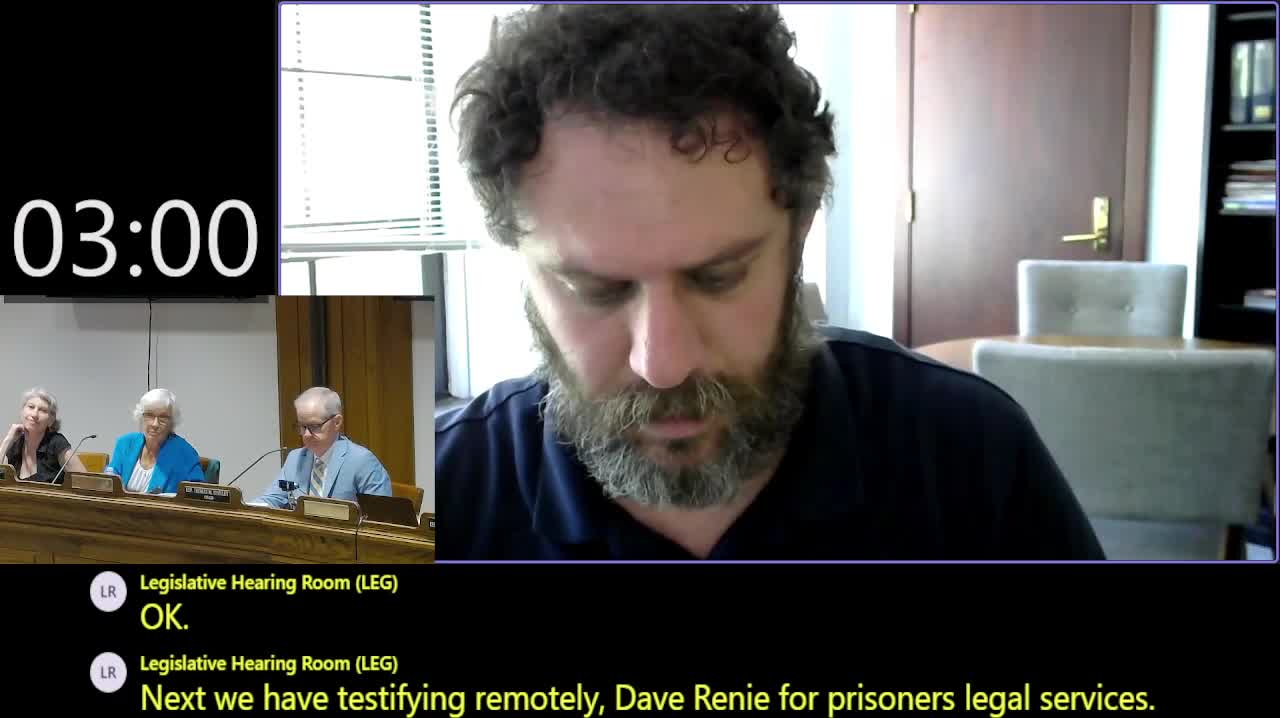
David Rainey of Prisoners Legal Services urged the Joint Committee on Elder Affairs to expand the Executive Office of Elder Affairs' jurisdiction so it can investigate abuse and neglect of elders held in custodial or nontraditional settings.
Rainey, executive director of Prisoners Legal Services, told the committee that adult protective service authority in Massachusetts is divided among several agencies and that elders in custodial settings — prisons, jails, certain treatment facilities, group homes and other nontraditional residential placements — can fall through jurisdictional gaps. "There is no investigatory authority for... custodial settings," he said, describing circumstances in which the Executive Office of Elder Affairs had not interpreted its statute to cover those settings and DPPC (the Disability and Protection Commission) loses jurisdiction when an individual turns 60.
Rainey asked that the bill give EOEA explicit authority to investigate negligence or abuse in custodial contexts so mandated reporters who break confidentiality can see follow‑up and investigation from a protective agency. He said the issue grew out of his prior work supporting survivors in custody and repeated contacts with EOEA legal staff.
Committee members asked for clarification about which facilities would be affected. Rainey described the range of settings he had in mind, from correctional facilities to certain Department of Mental Health and substance‑use treatment centers and some types of congregate shelters and group homes.
No formal committee action was recorded; the sponsor asked the committee to advance the bill for further consideration and drafting.