
Senators and advocates press for broader retirement coverage; Sanders introduces 'Pensions for All'
Get AI-powered insights, summaries, and transcripts
Subscribe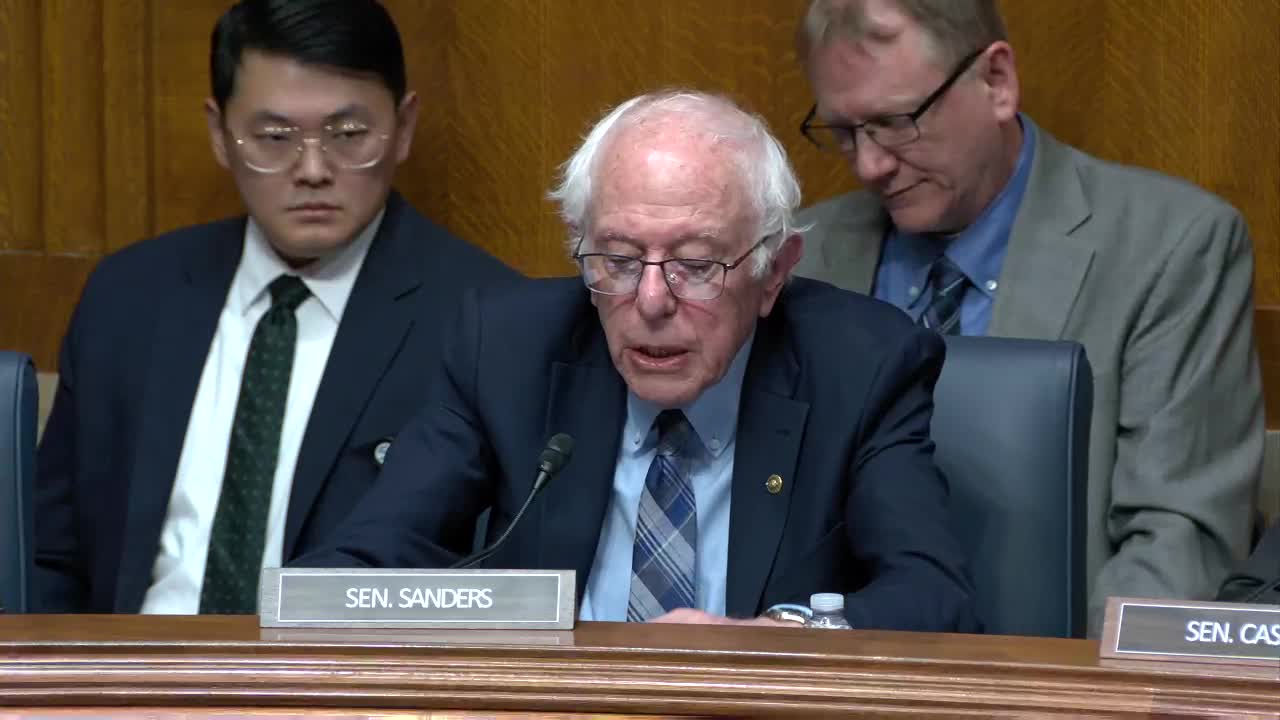
Summary
At the Senate HELP hearing, Sen. Bernie Sanders and retirement advocates called for a return to defined‑benefit security through new federal legislation and state auto‑IRA programs; the Pension Rights Center and others urged portable, universal options while senators discussed policy tradeoffs and budget implications.
Senator Bernie Sanders (I‑Vt.) used his allotted time at the Senate Health, Education, Labor, and Pensions Committee hearing to highlight retirement security shortfalls and to introduce the Pensions for All Act, legislation he said would restore defined‑benefit coverage to tens of millions of private‑sector workers.
"Today I introduced the Pensions for All Act," Sanders said, telling the committee that the bill would provide defined‑benefit pensions for more than 56,000,000 workers who lack employer‑guaranteed retirement income. He argued defined‑benefit plans helped create the American middle class and urged bipartisan action to expand coverage.
Karen Friedman, executive director of the Pension Rights Center, testified in support of policies that expand pension coverage and protect retirement income. Friedman described the Pension Rights Center's counseling work and data showing that many older Americans lack adequate savings. "The average monthly Social Security benefit in 2025 is less than $24,000 per year," Friedman said, and she urged consideration of proposals that include universal coverage, secure lifetime income and employer contributions.
Senators asked about state‑level auto‑IRA programs that auto‑enroll workers who lack employer plans. Delaware's "Delaware Earns" and other state programs were cited as expanding coverage for workers, including independent contractors. Friedman said roughly 20 states have implemented or considered similar state‑facilitated retirement programs and emphasized the need for employer and government matching contributions to reach adequacy.
Discussion also touched on Social Security solvency and the distribution of retirement tax subsidies. Sanders reiterated proposals to lift the payroll tax cap on taxable earnings to increase Social Security revenues and expand benefits, while other senators described federal retirement tax preferences that currently favor higher earners.
Witnesses and members agreed on the scope of the problem — many workers lack employer‑sponsored coverage or adequate savings — though they differed on remedies. Friedman said state auto‑IRAs, the Pensions for All Act and other approaches should be evaluated against principles of universal coverage, adequacy and portability.
Committee members from both parties, including Senators John Hickenlooper and Tina Smith (via remarks), expressed interest in bipartisan solutions. Senators also flagged the interaction between retirement proposals and other ongoing legislative priorities, noting budget constraints and the need for implementation detail.
No formal legislative action was taken at the hearing. Senators signaled further work on reconciling state programs, federal incentives (including the savers credit), and models for portable retirement accounts that would follow workers across jobs and gig assignments.