Get Full Government Meeting Transcripts, Videos, & Alerts Forever!
Get email alerts on the Community Institution Stabilization topic
No spam. Unsubscribe anytime.
Witness tells committee S303 would give towns tools to preserve community institutions when owners leave
Summary
Vincent L. Dixon told the Joint Committee June 5 that S303 would create definitions and a process — including right-of-first-refusal, community‑institution landmark status, and a special community trustee — to help municipalities keep businesses, churches and other institutions operating after an owner or steward stops operating the site.
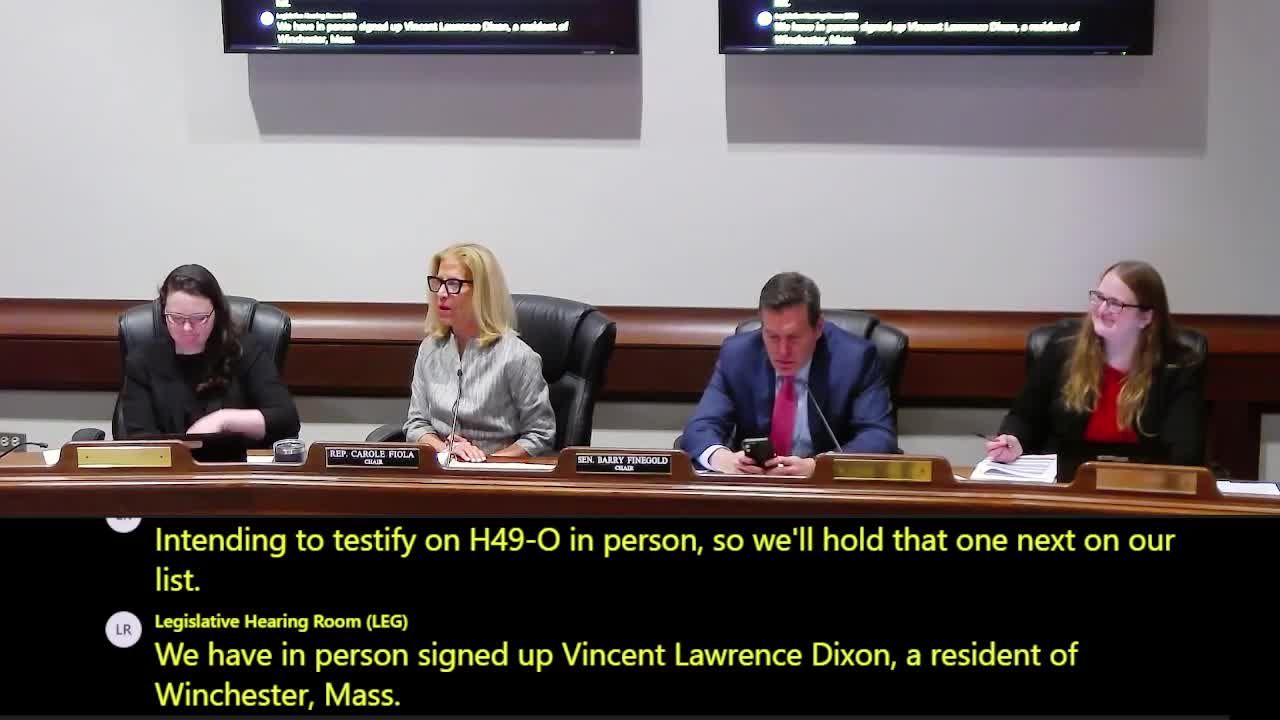
BOSTON — Vincent Lawrence Dixon of Winchester urged the Joint Committee on Economic Development and Emerging Technologies on June 5 to give municipalities additional tools to preserve longstanding local businesses and community institutions when owners cease operations.
Dixon testified in support of S303, the “Act for Community Institution Stabilization,” saying the bill would add “a caution light that is community friendly” and would not “prevent transfers of property or changes in purpose” but would provide a public process and options such as clear definitions of a right of first refusal, community‑institution landmark status, and appointment of a special community trustee.
Dixon cited examples in Boston, Cambridge and other towns where vacant or semi‑abandoned properties hurt downtowns and where retiring or departing stewards sometimes blocked future community uses: “There have been too many examples of supervising authorities... deciding to close a viable organization, facility, and or building, and not only not permitting its continued function, but seeking to prevent others... from even having the opportunity to continue the commerce or service that is a hallmark of the location and the community.”
He emphasized the bill’s intent to be flexible and responsive to local officials, and said the proposal would require public hearings and processes consistent with constitutional protections. Dixon said the measure is not an eminent‑domain tool but a more targeted, local mechanism to preserve economic activity, housing and services.
Committee members asked clarifying questions about who might serve as a special community trustee and whether that trustee could be an interested local party; Dixon said trustees would not be outside speculators and that the bill should safeguard local involvement and public hearings.
No formal committee action was taken on S303 at the hearing.