Get Full Government Meeting Transcripts, Videos, & Alerts Forever!
Get email alerts on the Worker Ownership topic
No spam. Unsubscribe anytime.
Mass. hearing spotlights bills to expand worker ownership, including right-of-first-refusal and $1M capital‑gains carve‑out
Summary
The Joint Committee on Economic Development and Emerging Technologies heard more than a dozen witnesses June 5 urging passage of bills that would give employees the first chance to buy businesses and exempt up to $1 million in capital gains for qualifying sales.
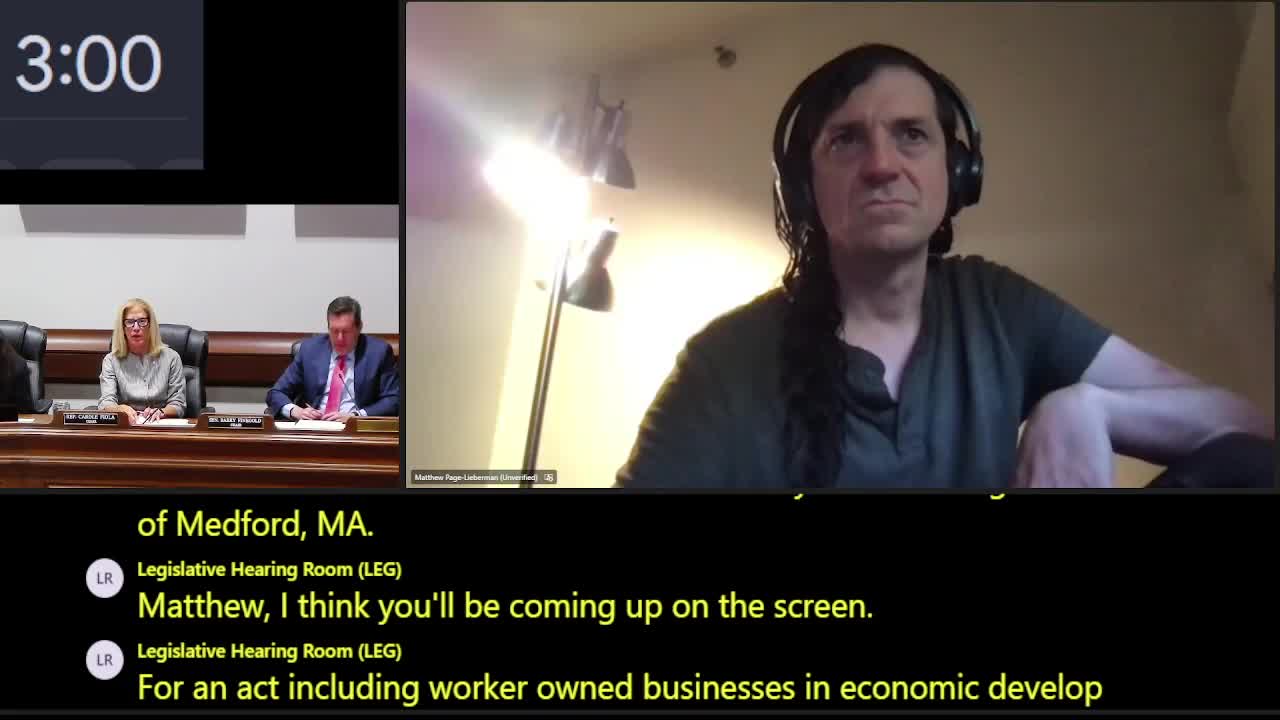
BOSTON — The Joint Committee on Economic Development and Emerging Technologies heard more than a dozen witnesses June 5 urging lawmakers to pass bills that would make it easier for employees to buy the companies where they work.
Supporters said the legislation — filed as H491 and as a companion pair H503 (House) / S305 (Senate) — would preserve neighborhood businesses, protect jobs and give retiring owners a clear pathway to sell to employees. Alex Papali of the Center for Economic Democracy summarized key provisions during the hearing: “there's a 30 day window for initially for the owner to give advance notice of the sale... after that... it starts a 6 month, 180 day clock ticking,” giving employee groups time to organize and match market offers.
The bills include a right-of-first-refusal for employee groups to buy a business on substantially equivalent terms and a state tax exemption for capital gains up to $1 million on qualifying sales. “We're targeting small businesses in the state specifically,” Papali said, noting that roughly 80 percent of Massachusetts businesses have revenues under $1 million and that only about 20 percent of listed small businesses sell in the open market.
Why it matters: Witnesses — including cooperative founders, technical‑assistance providers and lenders — told the committee employee ownership can stabilize local economies and preserve services when owners retire or close. Caleb Zadek, a founding co-owner of Circus Cooperative Cafe in Cambridge, said employees who organized after a previous employer closed were able to keep jobs and business continuity: “Please vote yes on this act promoting entrepreneurship through employee ownership and turn this win‑win bill into a law.”
Business experience and technical supports: Multiple witnesses described existing financing and assistance networks. Sarah Acefa, a board member of the Dorchester Food Co‑op, said her store has 17 employees, “half of whom are worker owners,” and more than 2,100 household member‑owners. Stacy Cordero of the Boston Center for Community Ownership and Virginia Berman of LEAF, a community loan fund, described cases where employee groups salvaged businesses when owners lacked succession plans. Kevin O'Brien and Adam Trott described conversions across manufacturing, trades and retail sectors.
Questions and clarifications: Committee members pressed witnesses on how often conversions succeed and why the $1 million exemption was chosen. Representative Kenneth Sweezy asked about business survival after conversion; Papali pointed to research showing employee‑owned firms tended to be more resilient during the COVID‑19 downturn, noting collective decisions sometimes preserved payrolls. On the tax break, Papali said the $1 million threshold targets smaller businesses and limits state revenue impact while making an employee sale more attractive to owners.
Implementation concerns raised by members included time needed for employees to assemble financing and the need for more outreach so owners and advisors know the option exists. Witnesses repeatedly urged the committee to pair statutory changes with education and technical assistance so employee groups can move quickly when an owner signals intent to sell.
Process notes: Committee chair Representative Carol Faiola reminded the room that written testimony would be accepted through Thursday, June 12 at 4 p.m. A motion to adjourn at the end of the hearing was made, seconded and approved by voice vote.
Next steps: No floor votes on the bills were taken at the hearing; the committee will review written submissions and may schedule further action.