Get Full Government Meeting Transcripts, Videos, & Alerts Forever!
Get email alerts on the Professional Licensure Interior Design topic
No spam. Unsubscribe anytime.
Committee hears bill to license commercial interior designers, proponents and trade groups back redraft
Summary
The Joint Committee on Consumer Protection and Professional Licensure took testimony on legislation to create a licensure path for commercial interior designers.
The Joint Committee on Consumer Protection and Professional Licensure took testimony on legislation to create a licensure path for commercial interior designers, supporters said, while preserving scope limits that protect public safety.
Proponents said House Bill 324 and Senate Bill 254 would recognize commercial interior design as a distinct profession, establish a board of registration, require demonstrated education and experience and the nationally accredited NCIDQ examination, and allow registered commercial interior designers to perform nonstructural work and, in some cases, meet firm-ownership requirements for public contracting.
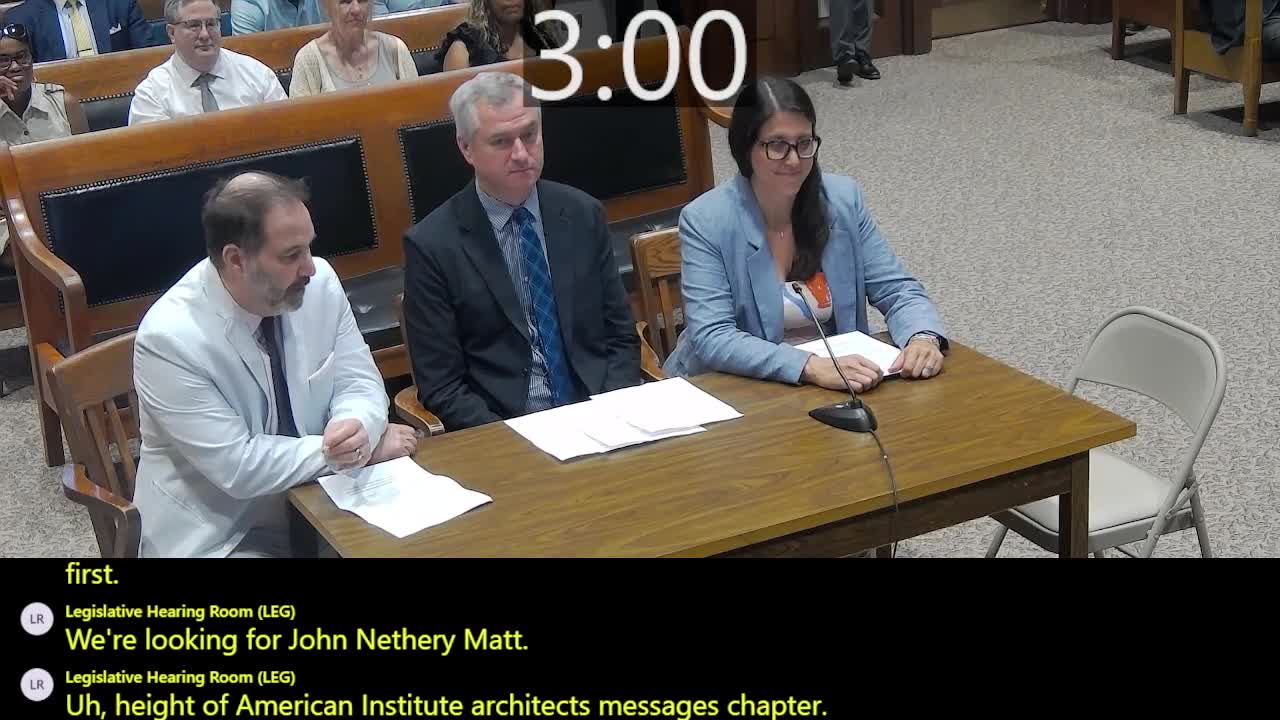
"I'm here today to ask for you to favorably report on an act relative to advancing the profession of commercial interior design," said Amanda Vigneault, a certified interior designer and vice president of advocacy for IIDA New England. She described commercial interior designers as specialists in planning and designing interior environments with health, safety and welfare in mind.
Matthew Hyatt, a registered architect and past president of IIDA New England, told the committee the measure is not an attempt to equate interior designers with architects. "We are not seeking to equate certified interior designers with architects," he said, adding that the bill would allow qualified interior designers to lead permitting for nonstructural commercial projects and remove a barrier to firm ownership on some state projects.
John Nunnery, executive director of AIA Massachusetts, said his organization — historically opposed to earlier versions — supports the redrafted bills alongside the American Council of Engineering Companies in Massachusetts and the Massachusetts Federation of Building Officials. "This consensus is a result of collaboration, compromise, and shared commitment to clarity, consistency, and public safety," Nunnery said, and he emphasized the bill's mirrored language from the architectural licensing statute to create consistent definitions.
Educators and practitioners also testified about workforce and retention impacts. Stephanie Maboldrick, an assistant professor at UMass Dartmouth, noted the state has five CID-accredited programs and said some graduates leave for states that recognize interior design. Felice Silverman, an interior designer who said she has been a 50% owner of a firm but was forced to accept minority ownership to pursue certain public work, said passage would allow full ownership and improve access to public contracts for women-owned firms.
Senator Joan Lovely, who has carried similar measures, told the committee the Senate passed the bill in the prior session and that bill language is still being refined.
The bill’s supporters repeatedly emphasized scope limits: registered commercial interior designers would not be permitted to practice architecture or engineering or alter structural or primary building systems. Witnesses asked the committee to advance the redraft for further consideration and to request follow-up materials on workforce diversity and business ownership impacts.
The committee took no final vote on the bills at the hearing.