Get Full Government Meeting Transcripts, Videos, & Alerts Forever!
Get email alerts on the Abuser Registry Day Habilitation topic
No spam. Unsubscribe anytime.
Families, advocates press committee to expand ‘Nikki’s Law’ to MassHealth day habilitation programs
Summary
Witnesses urged the Joint Committee on Children, Families and Persons with Disabilities to extend the state's abuser registry to MassHealth-funded day habilitation programs so caregivers found guilty of abuse cannot be rehired in those settings.
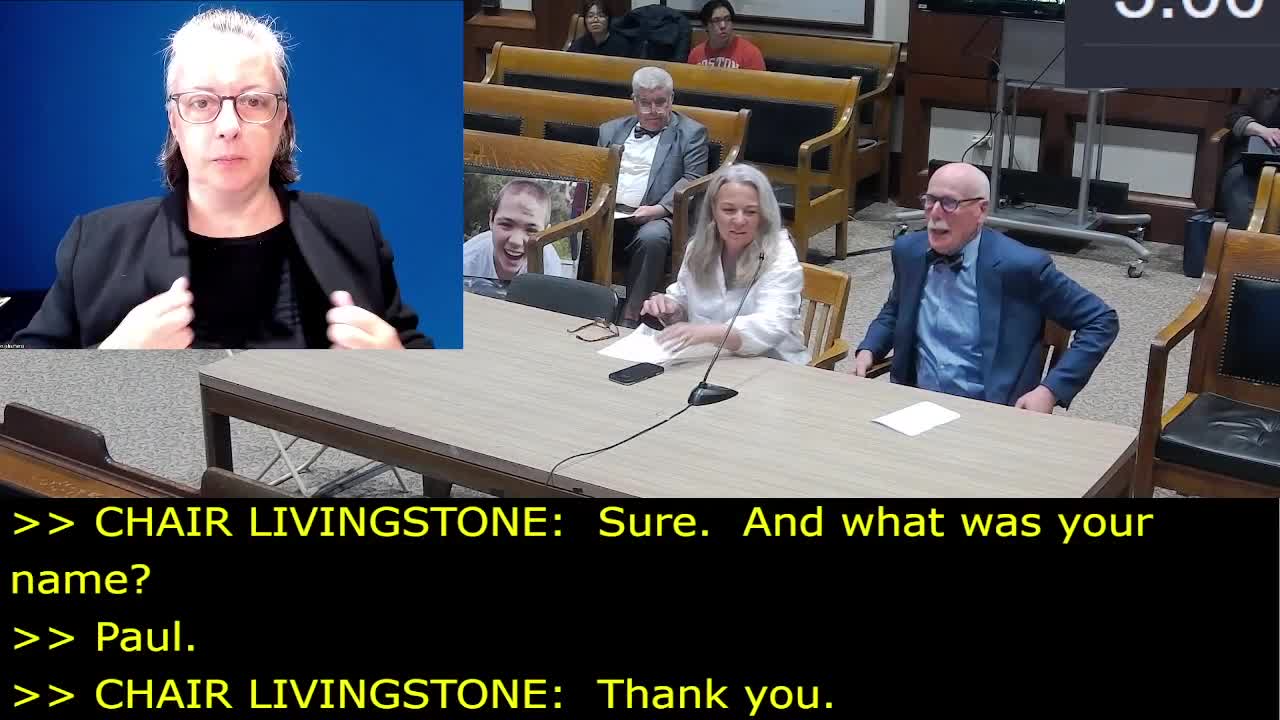
Cheryl Ryan Chan, the mother of a man identified in testimony as Nikki, urged the Joint Committee on Children, Families and Persons with Disabilities to expand the state's abuser registry to include MassHealth-funded day habilitation programs, saying the existing law leaves people vulnerable during daytime services. "If we do not continue to expand the protections that Nikki's law provides, we have failed to complete the critical mission of simply exercising our responsibility to protect those who need protection," Chan said.
Supporters, including Senator Moore and Paul Joyce, described how the registry enacted in 2020 has already removed people from direct-care roles and argued day habilitation settings are not covered under the current law. "At last count, there were 148 individuals on the register... we've had 112,000 searches," Paul Joyce said, citing registry usage and arguing those protections should apply to day programs as well.
Advocates and family members described patterns they said made day habilitation settings vulnerable: participants transported into community locations, small escort groups, and staffing arrangements that can create unobserved contact. Chan described repeated abuse she said her son suffered while at a day program and asked lawmakers to close what she called the "dangerous gap" between DDS-funded services (covered by the registry) and MassHealth day habilitation (not currently required to check the registry).
Multiple witnesses described the registry and the Disabled Persons Protection Commission (DPPC) as functioning resources that require statutory expansion rather than new agencies or additional appropriations. Nancy Alterio, executive director of the DPPC, told the committee the commission supports bills that would add day habilitation providers to mandatory checks and update DPPC's enabling statute, and that DPPC has investigated thousands of reports annually.
Testimony from families emphasized safety and prevention. "This is not a bill about services and supports. This is a bill about souls," Chan said. Other family speakers described cases in which camera footage and DPPC investigations led to substantiated findings and placement on the registry, and asked the committee to extend those checks to all day habilitation providers funded through MassHealth.
The hearing produced no formal vote. Sponsors and supporters asked the committee to report the bills favorably so the Legislature can consider amendments that would require MassHealth day habilitation providers to consult the abuser registry before hiring or contracting staff.
The committee is scheduled to receive additional written testimony and materials filed by witnesses for the record.