Get Full Government Meeting Transcripts, Videos, & Alerts Forever!
Get email alerts on the State Budget topic
No spam. Unsubscribe anytime.
Senate adopts FY2026 budget conference report, passes General Appropriations Act
Summary
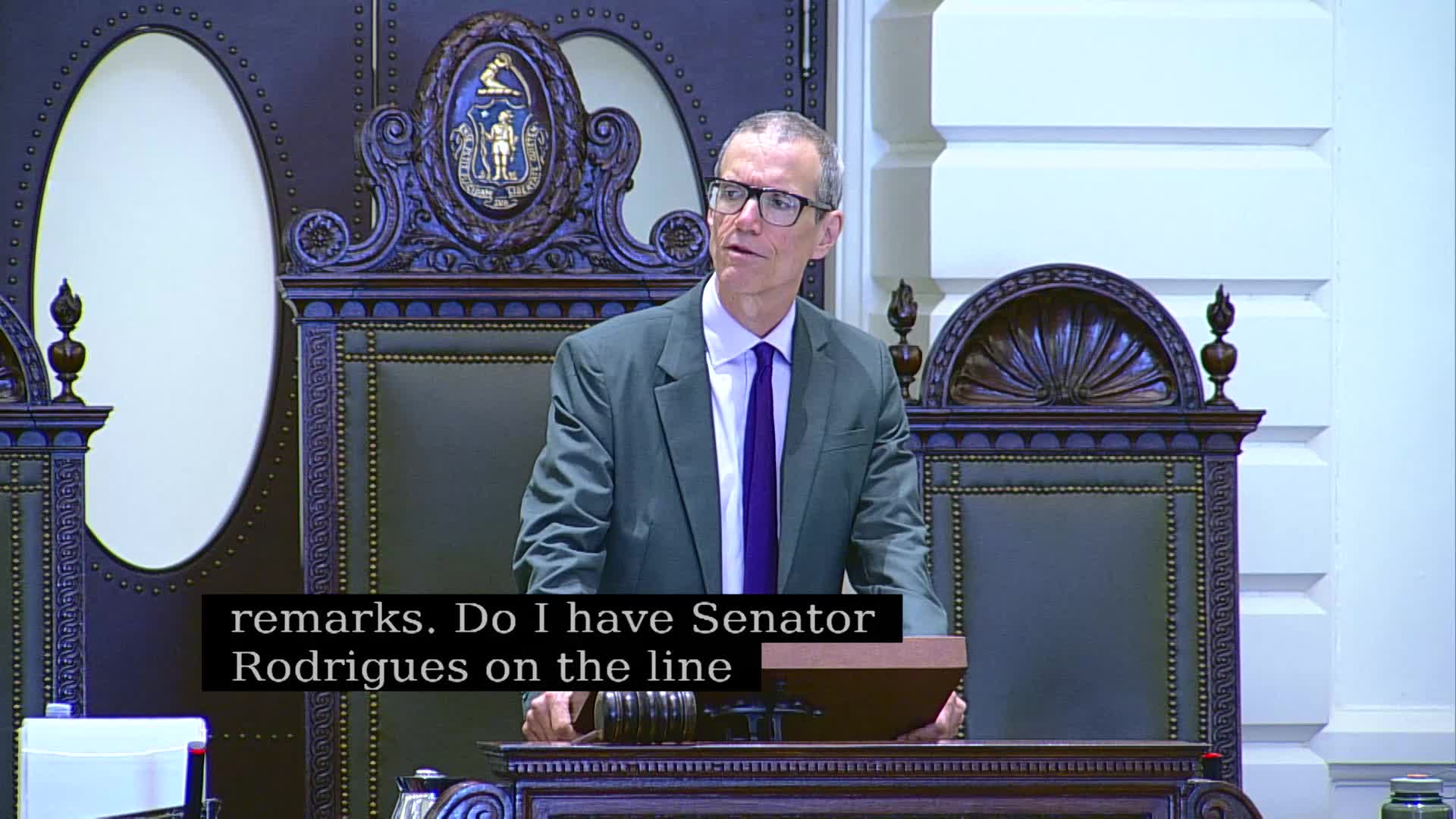
The Massachusetts Senate on the floor voted to accept the conference committee report on the fiscal year 2026 budget and then passed the General Appropriations Act (House No. 4240), sending the bill to the governor.
The Massachusetts Senate on the floor voted to accept the conference committee report on the fiscal year 2026 budget and then passed the General Appropriations Act (House No. 4240), sending the bill to the governor.
Senator Roberts, chair of the Senate Committee on Ways and Means, told colleagues the document under consideration "is on time, balanced, and responsible," and emphasized it "does not raise taxes or fees on Massachusetts residents or businesses." He said the report totals roughly $61.01 billion in top-line spending and reduces appropriations by about $400 million from earlier Senate proposals to reflect economic uncertainty and possible federal actions.
The conference report directs one-time and targeted resources to several priorities. It includes a proposed $33 million deposit to the stabilization ("rainy day") fund, uses $599 million in excess capital gains to pay down unfunded pension liability, and relies on other one-time sources (including $260 million from the Student Opportunity Act fund and $350 million reclaimed from unspent appropriations) to balance the plan, Roberts said. The report also increases the dedicated annual transfer of fair-share surtax revenue to the Commonwealth Transportation Fund from $250 million to $550 million.
Why it matters: The conference agreement funds major statewide programs and signals the Senate's fiscal choices heading into the new fiscal year. Key investments named in the report include full funding of the Student Opportunity Act (chapter 70 state aid), expanded reimbursements for special-education circuit breaker costs, $470 million for MBTA operations (supplemented by other recently adopted fair-share funding to total approximately $1 billion for transit in FY26), and a $180 million allocation for universal free school meals.
During floor debate, senators raised questions about the assumptions behind revenue projections, the use of one-time funds, and the long-term trajectory of state spending. Senator Tarr and the minority leader from Gloucester pressed for more detail on why spending was reduced relative to prior versions; Senator Roberts said the reductions reflected lower revenue expectations tied to federal developments, tariffs and impacts on grant funding. Senator Roberts also noted the budget retains protections for MassHealth and other major programs while seeking to address long-term liabilities.
Several senators praised parts of the agreement. Senator Charles highlighted investments in K–12 education and the creation of a commission to study remediation for homes affected by crumbling concrete (concrete affected by pyrrhotite). Senator Collins noted provisions for mental-health programs, including funding tied to diversion and co-response models.
Votes and outcomes: The Senate adopted the conference committee report by a roll-call vote (38 yeas, 2 nays). A subsequent standing vote adopted the bill's emergency preamble, and the General Appropriations Act (House No. 4240) was passed and will be signed by the president of the Senate and laid before the governor for her action.
Votes at a glance (other actions recorded on the floor): - House No. 4182 (establishing a sick leave bank for Jada Charlatan): read a third time and "passed to be engrossed." (Outcome: passed to be engrossed; vote: recorded as "ayes have it" on the floor.) - House bill establishing a sick leave bank for Eric J. Awaniak (House No. 1590, amended): came from the House and was "passed to be engrossed." (Outcome: passed to be engrossed; vote: "ayes have it" recorded.) - House No. 4237 (an appropriation related to FY2026, printed in House No. 4237): read and "passed to be engrossed." (Outcome: passed to be engrossed; vote: "ayes have it" recorded.)
What the record shows: The conference report filing time was clarified on the floor; clerks reported the report was filed at 1:54 p.m. the previous day and made available online about 3:33 p.m. that afternoon. Senator Roberts and others described the report’s spending, use of one-time resources, and the choice to apply excess capital gains to pension liabilities rather than deposit the full amount into the stabilization fund.
Next steps: With the Senate’s adoption and the bill passed to be enacted, the General Appropriations Act will be transmitted to the governor for approval or veto consideration. Implementation details, including agency spending plans and required regulations for some program changes, will follow through the appropriate executive agencies and legislative oversight.