Get Full Government Meeting Transcripts, Videos, & Alerts Forever!
Get email alerts on the Census Geography topic
No spam. Unsubscribe anytime.
Census Bureau outlines geography, LUCA and redistricting timetable for 2030 count
Summary
Census Bureau officials briefed the Massachusetts Senate committee on geography programs that underpin the 2030 census, urging early participation in LUCA, the boundary and annexation survey and voting-district collections and describing a 2031 statutory delivery deadline for redistricting data.
Boston — Officials from the U.S. Census Bureau told a Massachusetts Senate committee that state and local participation in the bureau’s geography and address programs must begin years before Census Day to produce accurate 2030 redistricting counts.
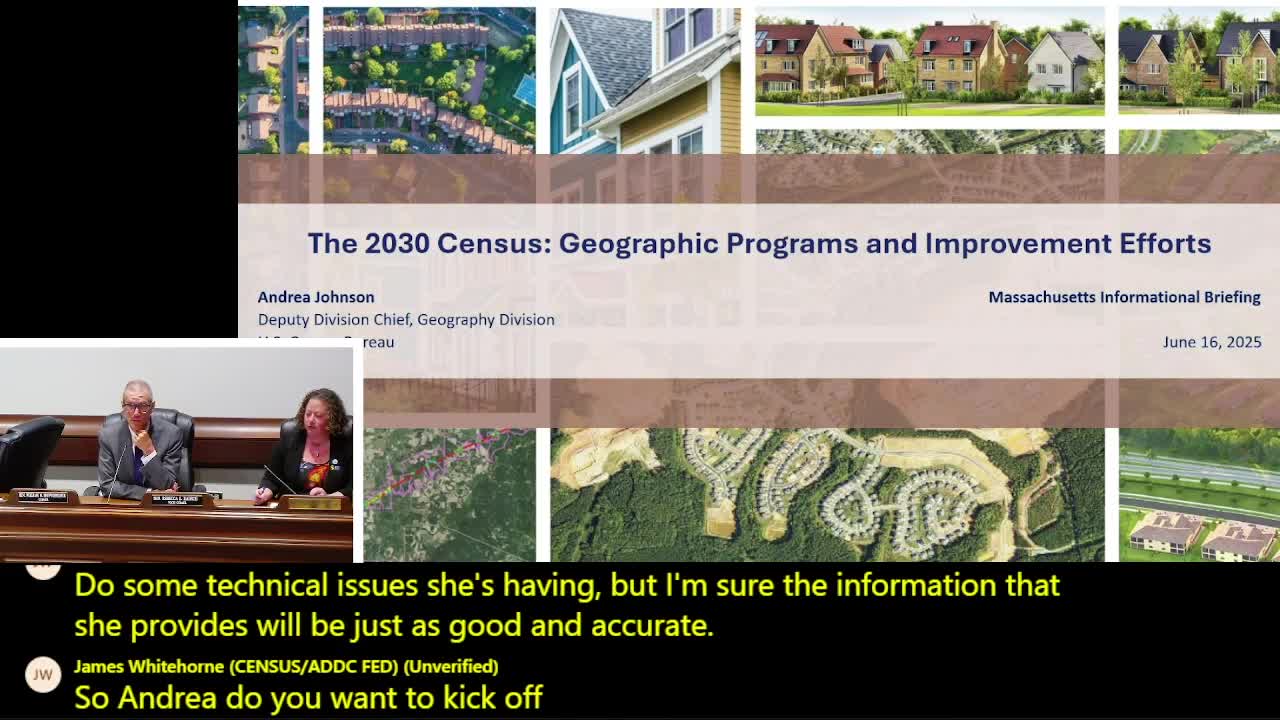
The Census Bureau’s James Whitehorn, chief of the Redistricting and Voting Rights Data Office, and Andrea Grace Johnson, deputy division chief of the bureau’s Geography Division, described a multi-phase program that includes block-boundary review, voting-district collection and the once-a-decade Local Update of Census Addresses (LUCA).
"LUCA is the only opportunity to have to look and see what we have and provide feedback, whether that's adding missing addresses, deleting addresses that don't exist, or identifying when something's in the wrong spot," Andrea Grace Johnson said. She told the committee LUCA will begin in early 2027 and that the bureau wants jurisdictions to prepare well in advance.
Whitehorn said the redistricting program follows five phases: prototype block development and the Block Boundary Suggestion Project, voting-district collection (beginning in 2028), data delivery, post‑census district collection, and continuous improvement of programs. He stressed the legal and operational need for high-resolution data: "Everything comes from blocks. That's what all geographies have in common."
The bureau reminded officials that the law requires delivery of redistricting counts within one year of Census Day; for 2030 the statutory deadline is April 1, 2031. Whitehorn also told legislators that changes to how race and ethnicity are collected and reported — driven by the Office of Management and Budget’s revision to Statistical Policy Directive No. 15 — could affect the content of legacy redistricting tables.
The geography division described investments in an automated change‑detection pipeline that uses imagery, building footprints and machine learning to flag site-level change. Johnson offered an example in Massachusetts where the bureau’s tracking showed housing-unit counts rising from 568 to 817 in a developing area outside Worcester after automated detection and integration with other data sources.
Officials outlined the bureau’s recurring programs: the Boundary and Annexation Survey (annual), the School District Review Program (annual, run with NCES), the Participant Statistical Area Program (PSAP; starts for this decade in 2028), and LUCA (opens in early 2027). They urged Massachusetts municipalities and state partners to use the tools provided and to submit updates within program windows so the bureau’s frames and address lists are current before address canvassing and mailings begin.
Whitehorn noted states appoint nonpartisan liaisons who work with the bureau through the decade; Massachusetts’ Secretary of the Commonwealth has historically filled that role. He emphasized that the redistricting data program must be run in a nonpartisan way and that the bureau will work with designated state liaisons on criteria and delivery.
The bureau also signaled technical and policy changes to watch: OMB’s new guidance merges race and ethnicity into a single question and adds a Middle Eastern/North African category, a change the bureau said it will coordinate with state liaisons to ensure resulting tables meet redistricting needs.
Details and links to program pages, prototype maps and contact rosters were offered; bureau staff said they will provide the presentation materials to the committee for follow-up.