Get Full Government Meeting Transcripts, Videos, & Alerts Forever!
Get email alerts on the School Budget topic
No spam. Unsubscribe anytime.
West Milford board approves preliminary $82.97 million budget, proposes 4.77% general‑fund tax levy increase
Summary
The West Milford Township Public School District board received a presentation on the proposed $82,970,002.23 budget for the 2025–26 school year, approved preliminary budget items and personnel motions, and discussed cuts, grant losses and a township‑funded turf field at Diagos Field.
The West Milford Township Public School District Board of Education on March 11 approved motions advancing the district’s preliminary budget for 2025–26 and several personnel items after a presentation from Superintendent Dr. Brian Kitchen and Business Administrator William (Billy) Schultz.
The board’s proposed total operating budget is $82,970,002.23 for the 2025–26 school year, a 3.84% increase over the current year. The school district is proposing a 4.77% general‑fund tax levy increase (reported as the general‑fund component of the levy); after a small decrease in debt service the board said that nets to a 4.73% overall tax‑levy change. The board voted in favor of the preliminary budget items and personnel motions by roll call.
Why it matters: District leaders said the increase is driven largely by rising benefits, salaries and utilities and by reductions in state and grant aid over multiple years. Board approval of a preliminary budget begins a county review process and sets the public‑hearing schedule; the district said the county must receive the budget by March 19 and the board plans a public hearing April 29 with final adoption to follow.
Board presentation and key numbers Dr. Kitchen and Schultz led a detailed budget presentation, emphasizing efforts to preserve current programs despite multi‑year cuts in state aid. “We’re maintaining all of our current program offerings,” Dr. Kitchen said, noting the district’s priority was to limit direct classroom impacts as much as possible.
District officials said the budget totals $82,970,002.23, with 82.5% of revenue coming from the local tax levy and roughly 8.6% from state and federal aid. The board highlighted: - A proposed overall budget increase of 3.84% (all funds). - A proposed general‑fund tax‑levy increase of 4.77%; with a small debt‑service decrease this nets to a 4.73% overall levy change. - Salaries and benefits together make up roughly three‑quarters of the budget (salaries about 54%, benefits about 24%). - Projected use of limited reserve withdrawals: $175,000 from maintenance reserve and $30,000 from capital reserve for security work on doors in a few elementary schools.
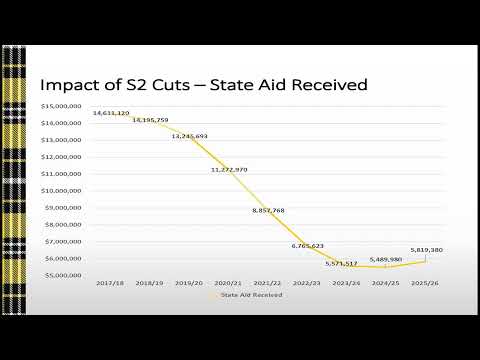
Officials described multi‑year losses in state aid as a central challenge. The presentation traced a roughly $9 million reduction in state funding since 2017–18 and said that, if state aid had remained at 2017–18 levels, the district would have had about $45 million more overall across the intervening years. The board also highlighted grant reductions: title I funding fell by about $231,000 this year and roughly $2,696,000 in categorical grants expired in September, officials said.
Offsets, programs and capital items District leaders outlined revenue‑offset steps: maximizing outside grant funding, increasing tuition enrollments in special‑education programs (Highlander Academy), using food‑service and SAC program revenue to offset operating costs, and securing higher interest on multi‑year banking agreements. The board said Highlander Pathways at the high school will expand industry‑credential opportunities without increasing district operating costs by reorganizing existing course offerings.
The board also noted capital items in the budget. Officials reported a township commitment to fund the Diagos Field turf and lighting project; the district must budget the project because it is district property, but said the township will provide approximately $2.7 million to cover the work so the project is net zero to the district’s operating budget. The district said $30,000 from capital reserve is budgeted for security door work at several elementary schools.
Discussion and public comment Public comment included taxpayer James Foodi urging a broader review of facility consolidation to reduce costs. Foodi criticized the district’s facility utilization and suggested consolidating buildings to save “probably close to $6 to $7,000,000,” arguing the high school is operating at roughly half capacity.
Board members pressed staff for clarifications during discussion. They asked about the components of the levy change, how the 3.84% overall increase relates to the 4.77% levy figure, facility‑line fluctuations driven by the Diagos Field project, and a projected benefits increase that administrators said could be in the low double digits (the presentation used a 10% planning figure; administrators noted actual quotes from benefit providers vary).
Formal actions taken - Personnel motions (agenda items 10.1–10.12) were moved by Board Member Reccano and approved by roll call. Recorded roll‑call votes in the minutes show Missus Dwyer, Missus Jorgensen, Mister Lippy, Missus Lockwood, Missus Reccano and Missus Van Dyke voting “Yes.” - The board advanced the preliminary budget (operations & finance item 12.2) for county submission and scheduled public‑hearing steps after a motion by Miss Delope. The board recorded the same roll‑call members voting “Yes” on the budget motion; the administration said the budget would be submitted to the county by the March 19 deadline for county review and possible approval by April 21.
What did not change tonight No final tax rates or the final adopted budget were set tonight; the board approved items necessary to advertise and submit the preliminary budget and to proceed with the public‑hearing timeline. Final adoption will occur only after the county review and the April public hearing. The board also did not adopt any new long‑range facilities plan tonight; administrators said that plan is being updated and will be discussed separately.
Next steps If the board’s preliminary budget is accepted through the county process and the board votes final adoption after the public hearing, the district will post the user‑friendly and adopted budget to the district website within 48 hours as required. Administrators said they will continue to pursue extra revenue (tuition, grant maximization and extraordinary aid) and monitor utilities, benefits, and enrollment trends as the budget process continues.