Get Full Government Meeting Transcripts, Videos, & Alerts Forever!
Get email alerts on the Affordable Housing topic
No spam. Unsubscribe anytime.
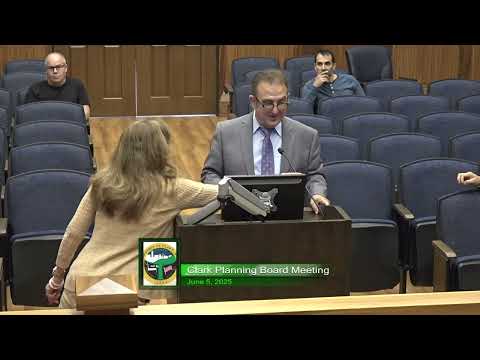
Clark Township planning board adopts Round 4 housing element and fair-share plan
Summary
The Clark Township Planning Board voted to adopt a housing element and fair-share plan intended to secure immunity from exclusionary-zoning lawsuits and to provide overlay zoning and programs to address a 166-unit Round 4 obligation, while a vacant‑land adjustment lowered the township—s realistic development potential to zero.
The Clark Township Planning Board on June 5 adopted a housing element and fair‑share plan intended to meet state Round 4 affordable‑housing requirements and preserve the township—s ability to seek court approval and immunity from exclusionary‑zoning lawsuits. The motion to approve the plan, with minor editorial changes discussed at the meeting, passed on a roll call vote.
The plan responds to a 166‑unit Round 4 prospective need for 2025–2035 and a separate 71‑unit rehabilitation obligation. Paul Rickey, the township planner, said the board—s vacant‑land analysis produced a realistic development potential (RDP) of "0 units," leaving the township to address an unmet need rather than zone for the full 166 units.
Why it matters: under the amended Fair Housing Act process, municipalities that adopt a binding resolution and file a court application can obtain immunity from builder—s‑remedy lawsuits; the township must file its affordable‑housing plan by the June 30 deadline to preserve that pathway.
The adopted plan relies largely on overlay zoning applied to existing, developed sites rather than rezoning large vacant parcels. Rickey identified five overlay candidate sites and estimated the potential yields if each redeveloped at the proposed density of 16 units per acre: Grand Centurions (about 70 age‑restricted units potential), Clarkton Shopping Center (potentially 48 total units, 10 affordable), Clark Village (approx. 25 units, 6 affordable), a Raritan Road strip between Friendly—s and Momotoro (potential for roughly 40 units, 8 affordable), and a site on Bridal (potentially 55 units, 11 affordable). The plan assumes a 20% affordable set‑aside on redevelopment projects that opt into the overlay, which produces an estimated minimum of about 50 new affordable units if all sites redeveloped exactly as modeled.
Rickey told the board, "The vacant land analysis indicates that the township has a realistic development potential of 0 units," and described the overlay approach as an option property owners may choose when they redevelop. Board members and staff emphasized the overlays would not force current businesses to close: existing operations may continue until a property owner chooses redevelopment.
The plan also addresses the township's 71‑unit rehabilitation obligation. Rickey said the township will fund a local rehabilitation program and "for the first three years, the township's gonna dedicate monies from its affordable housing trust fund of a minimum of $20,000 per year" to the program; the chair asked that language be clarified to show the $20,000 figure applies per unit in the program description. The plan further designates up to $300,000 from trust funds to encourage development of group homes in partnership with local providers.
Public commenters raised infrastructure and housing‑mix concerns. John Greaves of Parkway Drive asked whether the township—s RDP and the plan—s 50‑unit estimate were final, and Rickey replied, "It's our proposal...that the realistic development potential for the township is 0," and outlined the state review process, including a 60‑day objection period and possible mediation or litigation. Delia Collins, a township resident, asked speakers to identify sites by landmarks; Rickey clarified which third‑round sites remain active and that contamination has been a factor at the CVS area site previously identified in the plan.
Board members and the attorney for the township explained the rationale for filing and seeking court approval. Jeff Surenian, the township's affordable‑housing attorney, said the amended Fair Housing Act abolished the Council on Affordable Housing and established a new process that lets municipalities secure immunity by filing a housing element and fair‑share plan. He warned that failing to act leaves a municipality vulnerable to a builder—s‑remedy lawsuit and the concessions such litigation can produce.
Formal action: the chair moved to approve the housing element and fair‑share plan with the minor clarifications discussed; the motion was seconded by board member Lance and passed on roll call with all members present voting yes.
Next steps: the chair will sign the memorializing resolution and staff will file the approved plan and resolution with the court and town records. Rickey asked for permission to submit the corrected plan text tomorrow so the secretary can include the revised package in the filing.
The board opened the hearing to public comment before voting and closed it after public remarks. The board noted the June 30 filing deadline under the state process and described the 60‑day objection period and subsequent mediation/litigation procedures if an objection is filed.