
Ohio officials defend single PBM after three years of implementation; state, vendor and outside reviewers cite savings and operational challenges
Get AI-powered insights, summaries, and transcripts
Subscribe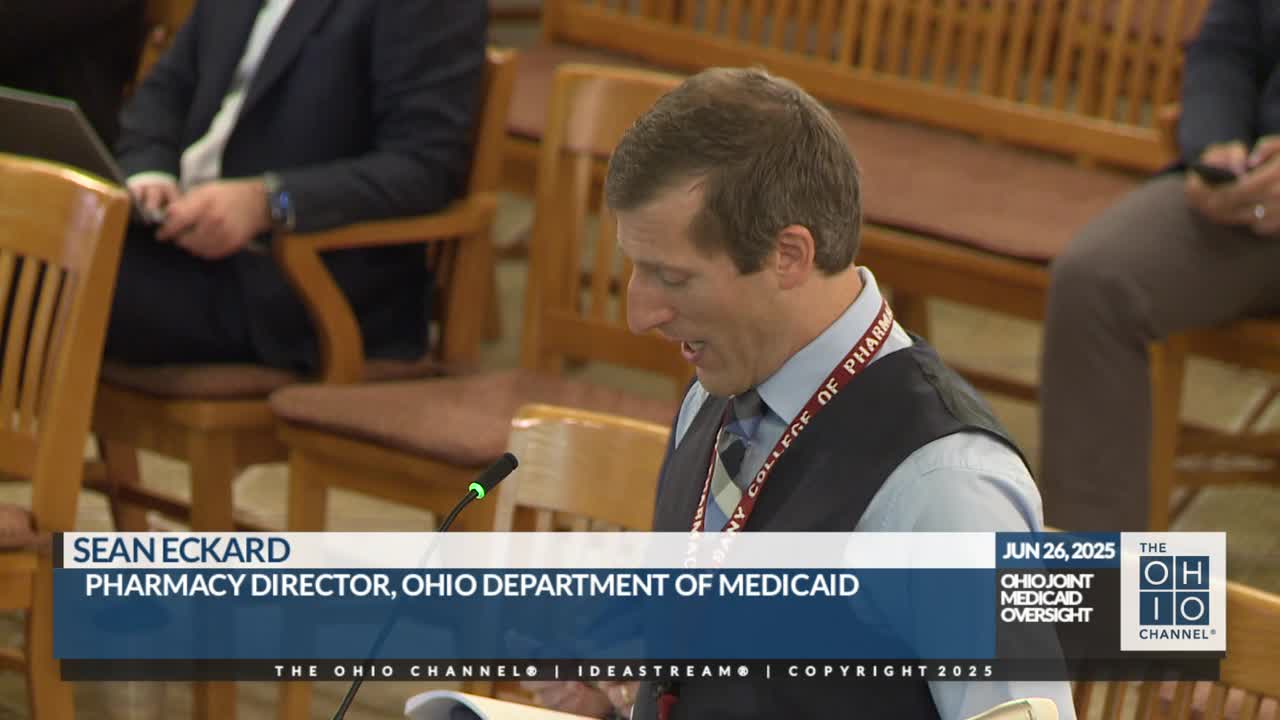
Summary
State Medicaid officials, the SPBM contractor and outside experts described the single pharmacy benefit manager (SPBM) model implemented for Ohio Medicaid, saying it improved pricing transparency, raised dispensing fees for pharmacies and produced mixed fiscal estimates; independent actuary Milliman and state analysis were cited during testimony.
Chairman Holmes opened the Joint Medicaid Oversight Committee meeting by framing a multi-panel discussion of Ohio’s single pharmacy benefit manager program and invited Ohio Department of Medicaid officials and independent experts to summarize implementation, performance and lessons learned.
Director Corcoran, director of the Ohio Department of Medicaid, said the single PBM contract covers all Medicaid beneficiaries and nearly all Ohio pharmacies, and that the program was designed to reduce conflicts of interest, end spread pricing and increase transparency. "We now pay pharmacies a fair rate for the acquisition of drugs using a survey based tool that looks specifically at what Ohio pharmacies pay to acquire medications," Director Corcoran said.
The nut graf: Committee testimony and independent reviews presented three types of findings — operational problems during rollout that were subsequently mitigated, measured increases in pharmacy reimbursements and supplemental rebates, and differing fiscal estimates about net savings depending on modeling assumptions. The department and its contractors said the program improved provider relations and pricing transparency; an independent actuary found savings were modest under its baseline scenario.
Sean Eckert, pharmacy director for the Ohio Department of Medicaid, described the program’s procurement and implementation timeline and identified two early technical problems at the Oct. 1, 2022 go‑live: elevated call volumes at the PBM’s call center and a surge in prior‑authorization rejections caused by incomplete data transfers. To mitigate those problems, the department and vendor implemented a transitional pharmacy benefit beginning Oct. 3, 2022, paused new prior authorizations temporarily and phased prior‑authorization reimplementation through May 2023. Eckert told the committee the SPBM has since decisioned more than 99% of prior authorizations within the statutory 24‑hour window.
Eckert also described the pharmacy pricing and audit consultant (PPAC) role — a separate contract that the department said sets reimbursement inputs and audits the SPBM — and said the SPBM vendor GainWell is not responsible for setting reimbursement rates, processing manufacturer rebates, or administering the unified preferred drug list (UPDL).
On fiscal results, Eckert presented two sources: the department’s projection and Milliman’s independent analysis. Milliman compared actual SPBM experience to modeled managed‑care scenarios and produced three scenarios; its baseline scenario estimated a $19 million net savings over the SPBM’s first two years. The department cited a larger projection, describing roughly $140 million in program savings over two years as its working estimate. Eckert emphasized the complexity of attribution and told the committee the Milliman report examined managed‑care experience only and did not include pharmacy fee‑for‑service populations that were added to the SPBM later.
Witnesses and staff also discussed program milestones and metrics: GainWell’s full SPBM implementation date (Oct. 1, 2022); GainWell assuming fee‑for‑service pharmacy benefits on July 1, 2023 (about 10% of members); implementation of electronic prior authorization in 2024 through Surescripts and CoverMyMeds; and successful renewal of a Section 1915 waiver in 2024 to continue mandatory SPBM enrollment. Eckert said supplemental rebate collections rose from about $246 million in 2022 to about $424 million annually in the most recent four quarters, and that the state now sees approximately 94% adherence to the unified preferred drug list (about 80% of drug spend).
Outside expert Antonio Chacha (3 Access Advisors / 46 Brooklyn Research) and David Burke (executive director, Ohio Pharmacists Association; former legislator and pharmacy owner) provided historical and market context. Chacha recounted how investigative work in earlier years identified spread pricing and other practices and argued that removing spread pricing alone does not guarantee lower costs because the market can respond with other mechanisms (for example, reconciliations or changes in per‑drug margins). Burke, who helped create the Joint Medicaid Oversight Committee, said the SPBM returns aspects of pharmacy administration to a third‑party administrative model and that state control over drug pricing and the UPDL explains how the program could raise dispensing fees while moderating drug acquisition costs.
Committee members asked operational and fiscal questions. Representatives requested service‑level metrics for the PBM call center; Eckert said the contract requires 90% of calls answered within 30 seconds, a first‑call‑resolution requirement of 99% and an abandonment rate no greater than 5%. Members also requested the exact contract amount paid to GainWell; department staff agreed to provide the precise figure after the hearing. Chair and members discussed the interaction of 340B claims, supplemental rebate collections, and Senate Bill 263, which Eckert said limited state control over certain 340B‑related utilization and contributed to the decline in rebate collections as a percentage of spend.
No formal votes on the SPBM policy were taken at the meeting. The committee approved the previous meeting minutes by unanimous voice approval earlier in the session. Staff were asked to provide follow‑up materials, including the exact GainWell contract amount and the Milliman report (both referred to in testimony).
Ending: Committee leaders said they would continue oversight; no new committee action to alter the SPBM contract or its waiver was taken at the meeting.