Get Full Government Meeting Transcripts, Videos, & Alerts Forever!
Get email alerts on the IGaming topic
No spam. Unsubscribe anytime.
Senate gaming panel adopts substitute for SB 197; operators back legalization but warn high fees, tax structure could limit legal market
Summary
The Select Committee on Gaming adopted a substitute to Senate Bill 197 and then heard testimony from casino operators and industry trade groups that said legal iGaming can curb illegal offshore sites and raise revenue but warned the bill's licensing and tax terms could limit competition and reduce the state's ability to capture unchecked online wagering.
The Select Committee on Gaming adopted a substitute to Senate Bill 197 during a second hearing and then heard testimony from casino operators, industry trade groups and other interested parties about a proposed regime for legal internet casino gaming (iGaming) in Ohio.
The substitute requires that any Internet gambling game using physical equipment be conducted by persons physically located in the state, aligns multiple gaming licenses to a single renewal schedule, loosens restrictions on Internet lottery offerings and adds or strengthens responsible-gaming protections, proponents said. The committee adopted the substitute without objection and kept SB 197 open as a second hearing for additional work and scheduling.
Why it matters: supporters told the committee legal iGaming would move Ohioans away from unregulated offshore sites, produce new tax revenue, and create consumer protections not available on illegal platforms. Opponents and some witnesses warned that high licensing fees and the bill's current tax structure could effectively exclude many operators, reducing competition and limiting the state's ability to convert illegal play into taxable, regulated activity.
Trevor Hayes, with Caesars Entertainment's online division Caesars Digital, told the committee his company's experience in other states shows iGaming increases visitation to physical casinos. "We have the proof of concept. We've been doing this in New Jersey since 2014," Hayes said, adding that Caesars' Scioto Downs employs about 455 people and that the company believes iGaming is "additive" to brick-and-mortar visits. Hayes told senators offshore operators currently accept wagers with "no ability to see if they're minors betting, if there are people betting using fake IDs, if they're money laundering," and said a regulated market would allow the state to require age verification and other safeguards.
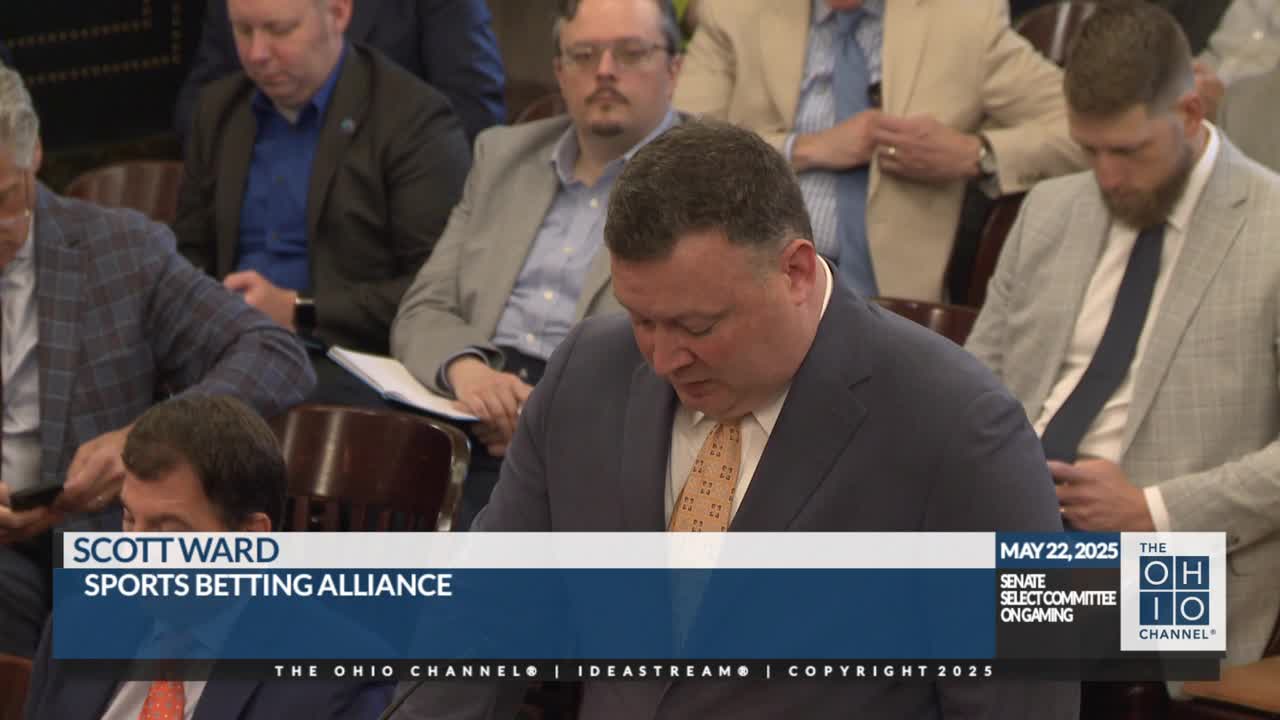
Scott Ward of the Sports Betting Alliance, representing major regulated online brands including FanDuel and DraftKings, backed legalization as a way to "stamp out that illegal online gaming that is rampant in the state." Ward cited a study estimating roughly $5 billion in illegal online casino wagering in Ohio annually and said legalization could generate between $410 million and $676 million a year in tax revenue depending on tax rates and market maturity. Ward and other witnesses urged a tethered model linking online platforms to in-state casinos and racinos and warned that a patchwork of tax and licensing rules would undercut the market's ability to draw players from illegal sites.
Industry witnesses also identified several provisions in the substitute that they said merit change. Multiple witnesses criticized proposed licensing fees and tax tiers in SB 197 that, as described in testimony, set different license fees and tax rates for operators depending on factors such as ownership or whether an operator is characterized as "in-state" or "out-of-state." Ward said the draft's $50 million and $100 million license-fee figures and 36%/40% tax rates (as described in testimony) are far above other states and risk "punish[ing] success" and creating constitutional concerns under interstate commerce principles; he asked lawmakers to consider flatter tax treatment and lower upfront fees. John Pappas of IDEA (an industry trade association) and Ryan Soltz of Boyd Gaming similarly said Ohio's fees and proposed tax rates are higher than national norms and noted that Pennsylvania and Michigan achieve substantial revenue with lower or graduated tax rates and more moderate license fees.
Several lawmakers pressed witnesses about specific local impacts. Ranking Member DeMora asked whether revenues from video lottery terminals (VLTs) and other gaming currently support race purses and how SB 197 would affect those payments; Trevor Hayes said he did not have the precise figures at hand and would find them. Senators also asked whether iGaming proceeds that would otherwise be part of lottery revenue could reduce funding for education; witnesses declined to recommend revenue destinations, saying that allocation decisions were for the legislature.
Witnesses described consumer-protection tools available in regulated online markets. John Pappas said online platforms can trace player activity and intervene when "triggers" indicate potentially harmful behavior: "Everything is traceable and digital and digitized," he said, and that feature allows operators to detect and address markers of harm that are difficult to spot in brick-and-mortar settings. Proponents said a legal market also permits coordinated self-exclusion lists and enforcement against offshore operators through cease-and-desist actions and other regulatory tools.
Points of disagreement included the number of mobile "skins" (distinct online brands/platforms) the state should permit, whether promotions should be limited to drive patrons to the physical property, and whether the fee and tax structure should treat different brands differently. Proponents generally supported a tethered model (online platforms tied to licensed in-state casinos or racinos) but urged lower entry costs and flat or more moderate tax rates so more brands will compete and draw players away from illegal sites.
What the committee did: members adopted the substitute measure for SB 197 and kept the bill open for further amendments and scheduling. The hearing concluded with the committee noting written testimony from other industry parties and setting the bill for continued consideration.
What remains open: SB 197 was not reported out of committee in final form. Lawmakers and witnesses indicated forthcoming negotiations over license fees, tax rates, the number of permitted skins, how iLottery proceeds are allocated, and the balance between consumer protections and market competitiveness. Several witnesses and some senators also raised possible legal questions about how the bill would interact with Ohio's constitution and federal commerce principles; those issues were flagged for further review.
Sources: remarks and exchanges at the Select Committee on Gaming second hearing on Senate Bill 197, including testimony from Trevor Hayes (Caesars Digital), Scott Ward (Sports Betting Alliance), Ryan Soltz (Boyd Gaming), and John Pappas (IDEA).