
House approves supplemental budget adding raises for private bar advocates and funding for public defenders
Get AI-powered insights, summaries, and transcripts
Subscribe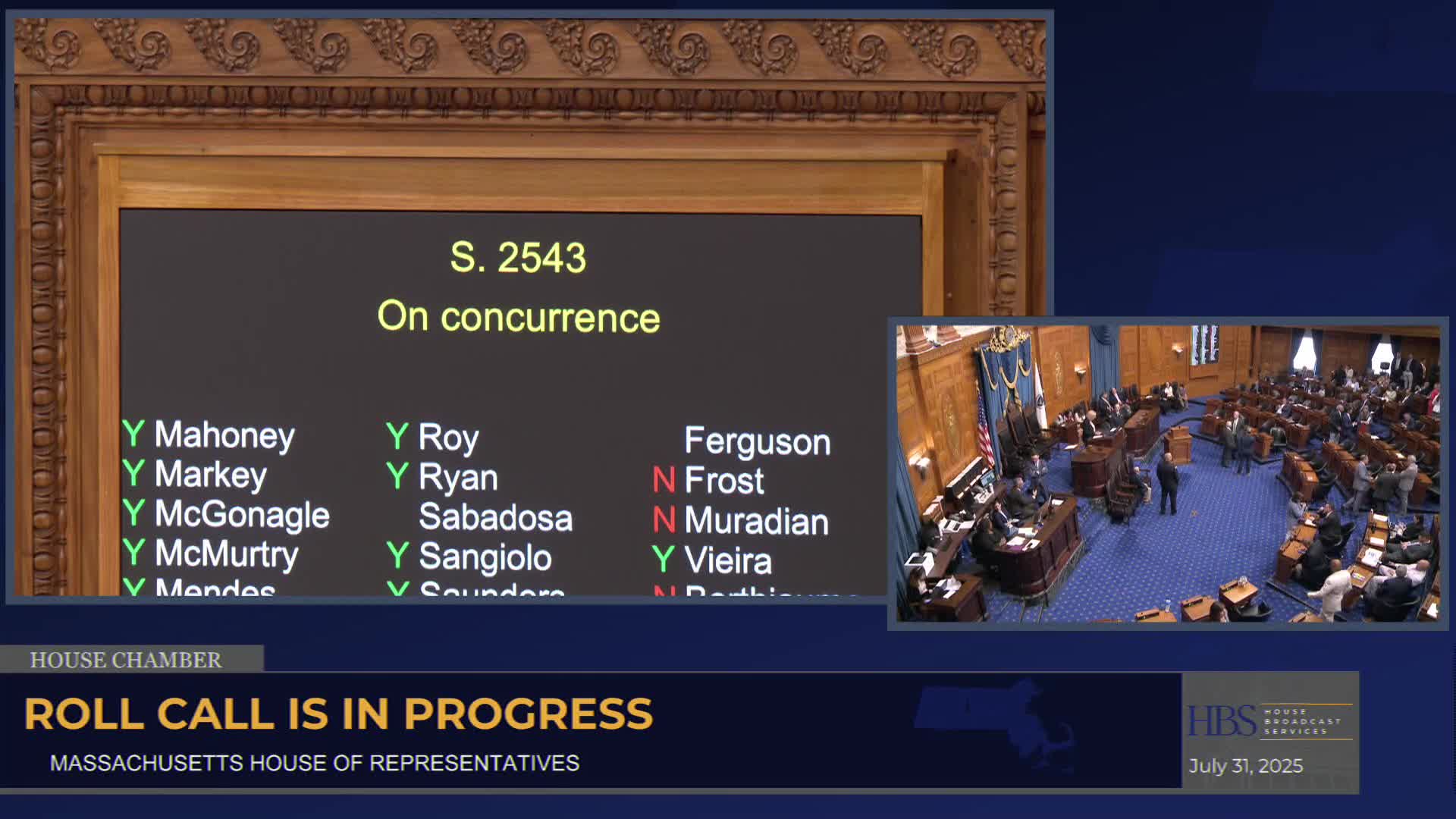
Summary
The Massachusetts House accepted a conference report on a $259 million supplemental appropriation that includes phased raises for private bar advocates, $40 million to the Committee for Public Counsel Services to hire public defenders, new contracting and antitrust language, and other program funding.
The Massachusetts House accepted a conference report on a supplemental appropriations bill that adds $259,000,000 in spending for fiscal 2025 and includes an immediate plan to raise pay for private bar advocates and expand public defender staffing. Representative Mike Wits of Boston presented the conference report and asked the House to approve it.
The measure matters because it couples a short-term response to a labor stoppage affecting indigent defense with longer-term investments in public defender staffing. Supporters said the package is intended to restore representation for people who rely on court-appointed counsel and to reduce reliance on private contractors.
Representative Mike Wits of Boston, speaking for the conference report, said, “this legislation that is before you today makes timely investments that will better position the Commonwealth in the coming weeks and months ahead.” He described the agreement reached with private bar advocates as a phased pay increase and other reforms to stabilize indigent defense services.
Under the terms laid out on the House floor, private bar advocates would receive an immediate $10-per-hour increase effective Aug. 1 and an additional $10-per-hour increase on Aug. 1, 2026. Wits characterized that schedule as “an immediate 15% raise and a 30% raise after it is fully implemented.” The House discussion included budgetary cost estimates provided by proponents: an additional $27,000,000 in fiscal 2026 and $55,000,000 in fiscal 2027 associated with the rate increases.
The supplemental also allocates $40,000,000 to the Committee for Public Counsel Services (CPCS) to staff up public defenders, with a stated goal of hiring about 320 new attorneys by the end of fiscal 2027. The conference report includes a new contracting policy requiring private bar advocates to sign biannual contracts with CPCS that set minimum coverage and availability standards.
The bill also contains language intended to address organized refusals to accept appointments: it would allow evidence that private bar advocates who “refuse to compete for or accept new assignments” constitute possible violations of the Commonwealth’s antitrust laws where refusal reaches a specified county-level threshold (the conference language cited 25% as the county threshold). Proponents said the clause is modeled on existing federal precedent.
Representative Maki of Dartmouth, who spoke during debate, framed the pay request from some private attorneys as sudden and, in his view, unreasonable. “We cannot afford to give people $35 an hour raise. It is not going to happen overnight. It is a ridiculous request,” Maki said, arguing the phased increases were the responsible course.
Supporters emphasized that the package also includes funding for other programs and 30 collective bargaining agreements attached to the legislation. Wits said the combined actions—rate increases, CPCS hiring funds and contracting standards—create roughly $95,000,000 in new resources directed to indigent defense when taken together.
The House moved to accept the conference report, ordered a roll call and the report was accepted on the House floor. The House adopted the supplemental appropriations conference report and instructed the clerk to enroll the bill for transmission to the Senate and the governor.
Background and next steps: The conference report resolves differences between House and Senate versions of the supplemental budget; final enactment requires completion of the legislative process and the governor’s signature. The measure includes emergency preamble language for parts of the bill to take effect promptly once enacted.