Get Full Government Meeting Transcripts, Videos, & Alerts Forever!
Get email alerts on the State Budget Projections topic
No spam. Unsubscribe anytime.
Legislative budget office flags $130M shortfall in 2027; five‑year outlook worsens without policy changes
Summary
The Joint Legislative Committee on the Budget reviewed updated five‑year baseline projections showing a roughly $130 million imbalance in fiscal 2027 that could grow to hundreds of millions in later years because of federal policy changes, tax rededications and potential teacher pay stipends.
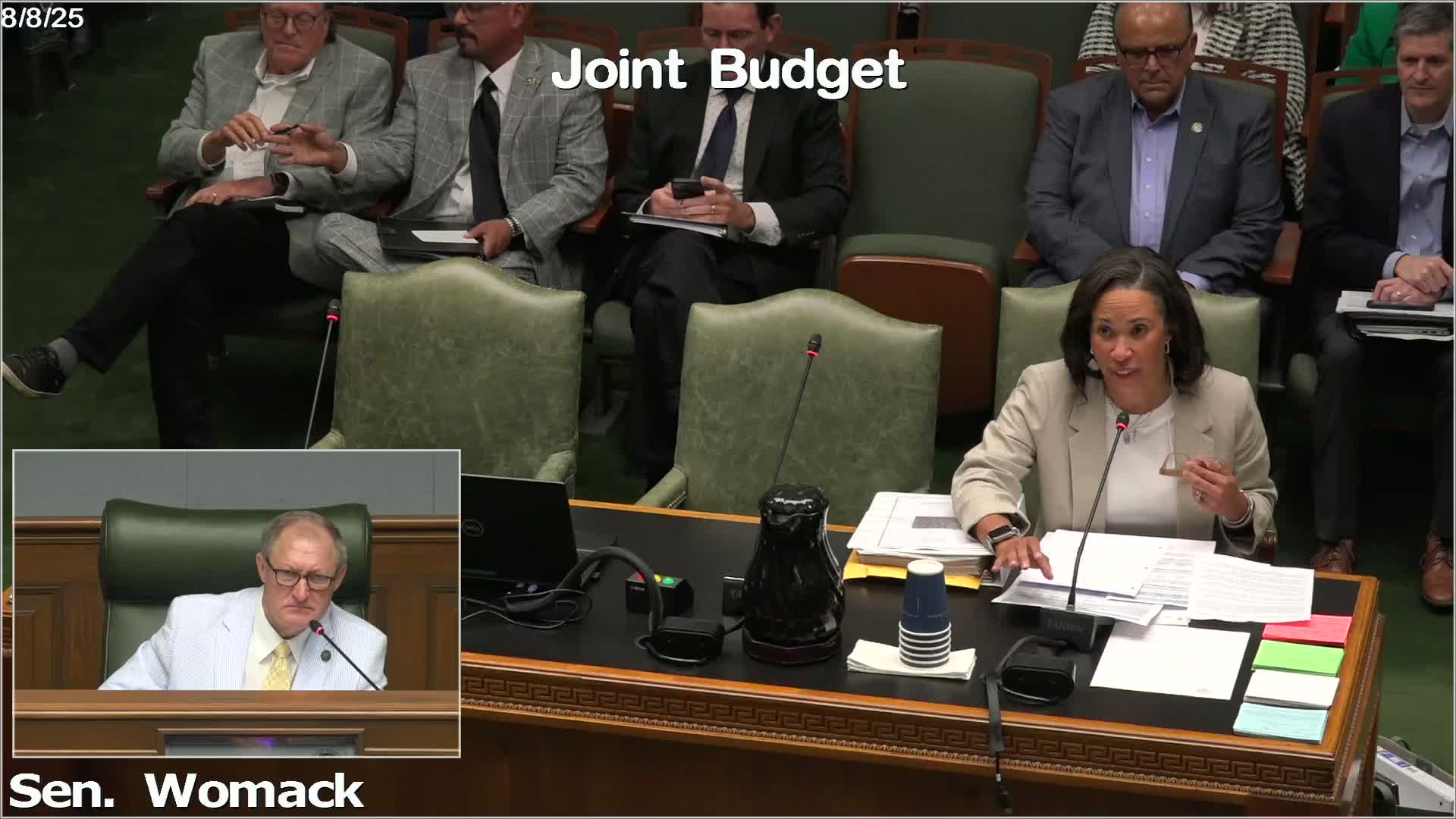
Ternisa Hutchinson, an analyst with the Office of Planning and Budget, told the Joint Legislative Committee on the Budget on Aug. 8 that the five‑year baseline projections updated for 2025 appropriations show small near‑term reserves but mounting imbalances beginning in 2027.
Hutchinson said, "the general fund remaining balance is about $89,000 for the current fiscal year." She told the committee the projection shows ‘‘about $130,000,000 projected to be out of balance in '27’’ and that the imbalance increases in subsequent years.
Nut graf: The committee heard that the projected gap in 2027 is driven largely by increases tied to Medicaid managed care payments and provider rate changes, a federal shift in SNAP liability for states, and a redirection of motor vehicle sales tax to transportation funds — changes that reduce general‑fund capacity and could be magnified if a teacher pay stipend is funded.
Hutchinson said the projected 2027 shortfall is “primarily due to, changes in the MCO payments, the managed care organization for the, Medicaid increases for, the nursing home, rebase, the physician rate increase.” She also told members the state has factored a possible timing item: “There's funding in the 5 year for GOSEP for the Katrina closeout. It's estimated to, potentially happen in '27.”
On SNAP, Hutchinson explained a federal change could shift partial responsibility for benefits to states: "another impact of the federal changes were about $95,000,000 associated with the SNAP where the states, based on their error rates, will have to pay a portion of their the benefits ... and then it's estimated to be about $95,000,000."
Committee members pressed for clarifications about specific line items and contingencies. Representative Marcel asked whether the Department of Children and Family Services (DCFS) would pick up added general fund costs; Hutchinson said the baseline includes “about $50,000,000 of general fund that will be needed” in 2027 because an administrative match is estimated to shift from 50% federal/50% state to 75% state under federal legislation referenced in the meeting.
Hutchinson cautioned that some costs were not included in the baseline because they are outside statutory continuation guidelines: "What's not factored into the 5 year because it is not part of the continuation guidelines that's in law is the teacher pay stipend. That's, approximately about $200,000,000. So if that was to be factored in, that was funded, your imbalance for '27, '28, and '29 go up approximately 200,000,000." Representative and Senator members acknowledged the magnitude of the gap and the need to address the drivers.
The committee did not take formal action to change baseline assumptions during the meeting; members asked for follow‑up detail and said staff would return with additional analysis.
Ending: Committee staff and members indicated they will continue to refine the projections and report back. Hutchinson and Office of Planning and Budget staff said they would provide supporting detail on line items and the potential fiscal impact if the teacher stipend were funded.