Get Full Government Meeting Transcripts, Videos, & Alerts Forever!
Get email alerts on the Transportation Funding topic
No spam. Unsubscribe anytime.
House approves $1.2 billion transportation bonding bill to finance municipal roads and bridges
Summary
The House passed House Bill 4307, a bonding package that would provide approximately $1.2 billion for municipal roads and bridges and additional funds for lifecycle asset management, culverts and small bridges, and congestion-reduction projects; the roll call showed 156 yeas, 0 nays.
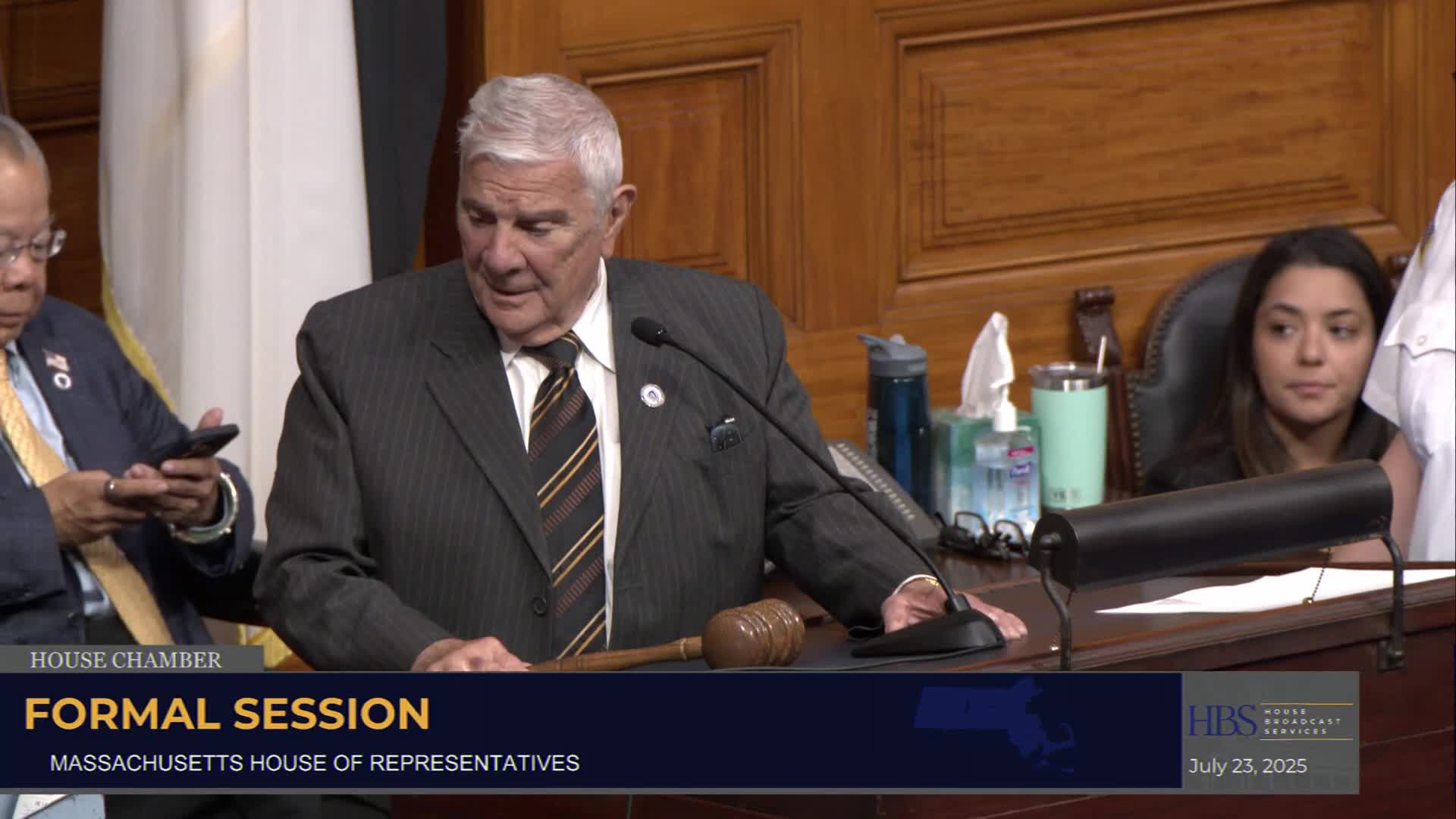
Representative John Arciero of Westford presented House Bill 4307, “An act financing long term improvements to municipal roads and bridges,” arguing it would provide a historic increase in funding for local transportation needs.
The bill proposes approximately $1,200,000,000 in bonding for the Chapter 90 program and three related programs. Arciero said the package includes a one-year Chapter 90 authorization of $300,000,000 — a 50% increase over historical levels — with $200,000,000 distributed under the standard Chapter 90 formula (58% road mileage, 21% population, 21% employment) and $100,000,000 distributed based on local road mileage to support rural communities. He also outlined $500,000,000 for a life-cycle asset management program for non‑federally aided roads, $200,000,000 for a culvert and small-bridge repair program targeted at structures under 20 feet, and $185,000,000 for capital projects to reduce congestion and support shared-use paths, intersection improvements, grade crossings and sidewalks.
“By all measures, this was the right move,” Representative Finn of West Springfield said in support, endorsing the bill’s funding structure and the administration’s flexibility to use general or special obligation bonds. Arciero and Finn emphasized the bill’s fiscal rationale, noting bond ratings cited during debate (S&P, Fitch, Moody’s) and describing the Commonwealth Transportation Fund (CTF) as a financing vehicle that can yield lower borrowing costs.
The House considered and adopted an amendment to the committee-reported bill; the amendment was approved before the bill advanced. After debate, a roll call was ordered and the voting machines were opened. The clerk later reported a tally of 156 yeas and 0 nays; the bill was passed to be engrossed.
The debate focused on funding levels, equitable distribution formulas, and the use of CTF borrowing capacity. Speakers framed the bill as a response to municipal infrastructure needs and climate-resilience concerns, particularly the vulnerability of local roads to storm-related washouts when culverts and small bridges fail. The presenters repeatedly described the funding figures as approximate and tied the bill to recent increases in the Commonwealth Transportation Fund’s borrowing capacity.