Get Full Government Meeting Transcripts, Videos, & Alerts Forever!
Get email alerts on the Legislative Structure topic
No spam. Unsubscribe anytime.
Senator Blessing backs constitutional amendment to increase size of General Assembly
Summary
Senator Blessing testified in a first hearing for SJR 1, a proposed constitutional amendment that would raise Ohio’s Senate to 51 members and House to 153 members, arguing smaller districts improve representation and reduce the influence of money; committee took testimony but took no vote.
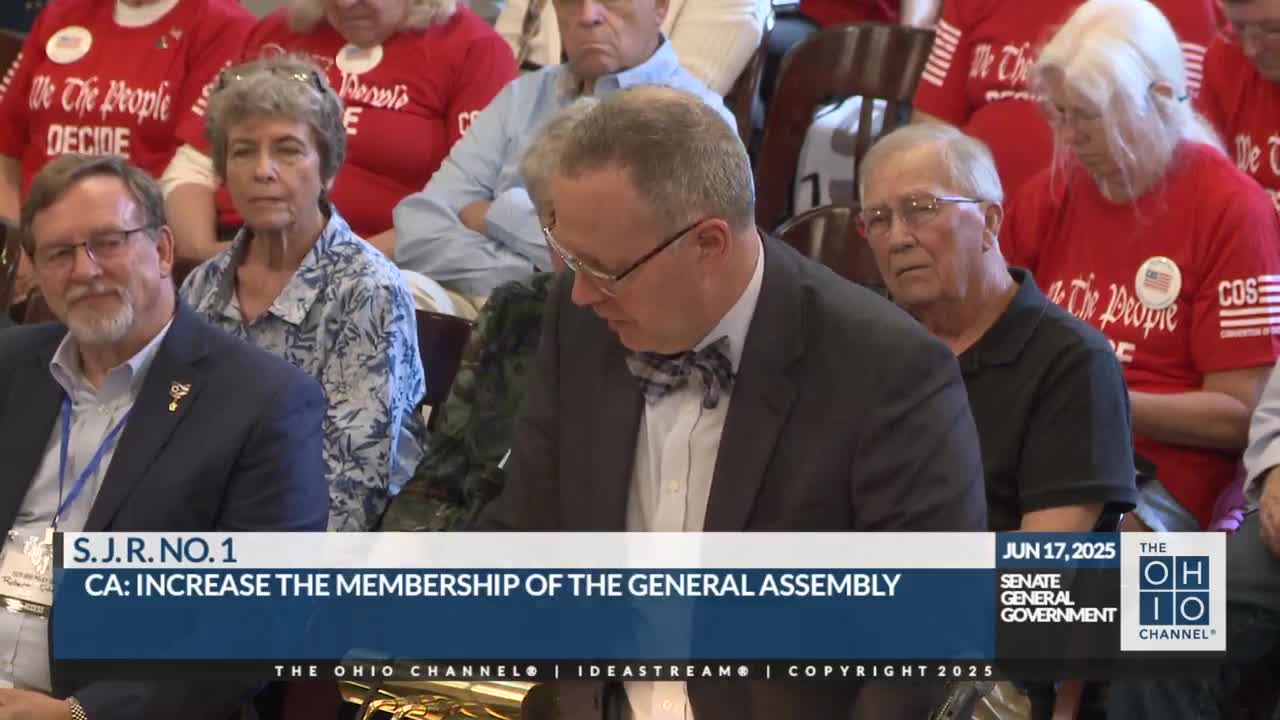
Senator Blessing testified before the Senate General Government Committee in favor of Senate Joint Resolution 1, a proposed constitutional amendment that would expand the General Assembly to 51 state senators and 153 state representatives, arguing the change would create smaller legislative districts and improve proportional representation.
Blessing, a sponsor of SJR 1, told the committee, “Smaller districts more firmly anchor legislators to their districts. They would represent fewer communities and constituents and could devote more time to them.” He said the change would roughly reduce district populations from about 358,119 to about 232,077 per seat under current census figures, and described the proposal as a “conservative” alternative to formulas such as the population cube-root approach.
The resolution is a first hearing item. Blessing framed the proposal as addressing long‑standing questions about optimal district size and representation, citing historical changes to the size of the U.S. House of Representatives and saying Ohio’s current chamber sizes put its districts among the largest nationwide. He said the change could reduce the power of money in politics by making many races smaller and less expensive to contest.
Committee members asked procedural and fiscal questions. A senator asked for an estimate of the fiscal impact, naming salaries, benefits and office space as components to consider; Blessing characterized the expected cost as “low tens of millions” relative to the state’s overall budget but did not provide a formal fiscal note. Members also asked about office space and timing; Blessing replied the change would take effect after the next redistricting in 2031 and that state and private commercial space could house additional members, saying, “we're only talking about 18 more members here, so I do not believe that it would be that big of a deal.”
This hearing did not produce a committee vote or formal action. The measure remains under review and may return for additional hearings or amendment. The senator said he was open to adjustments to thresholds and timing in the resolution and invited committee questions.
Details from the hearing: the sponsor emphasized historical context for the proposal and comparative district sizes; pro forma cost estimates were discussed but no official fiscal analysis was presented; the committee did not vote on SJR 1 at this hearing.
A next step would be additional committee consideration or a formal fiscal analysis if members request one.