Get Full Government Meeting Transcripts, Videos, & Alerts Forever!
Get email alerts on the Veterinary Telemedicine topic
No spam. Unsubscribe anytime.
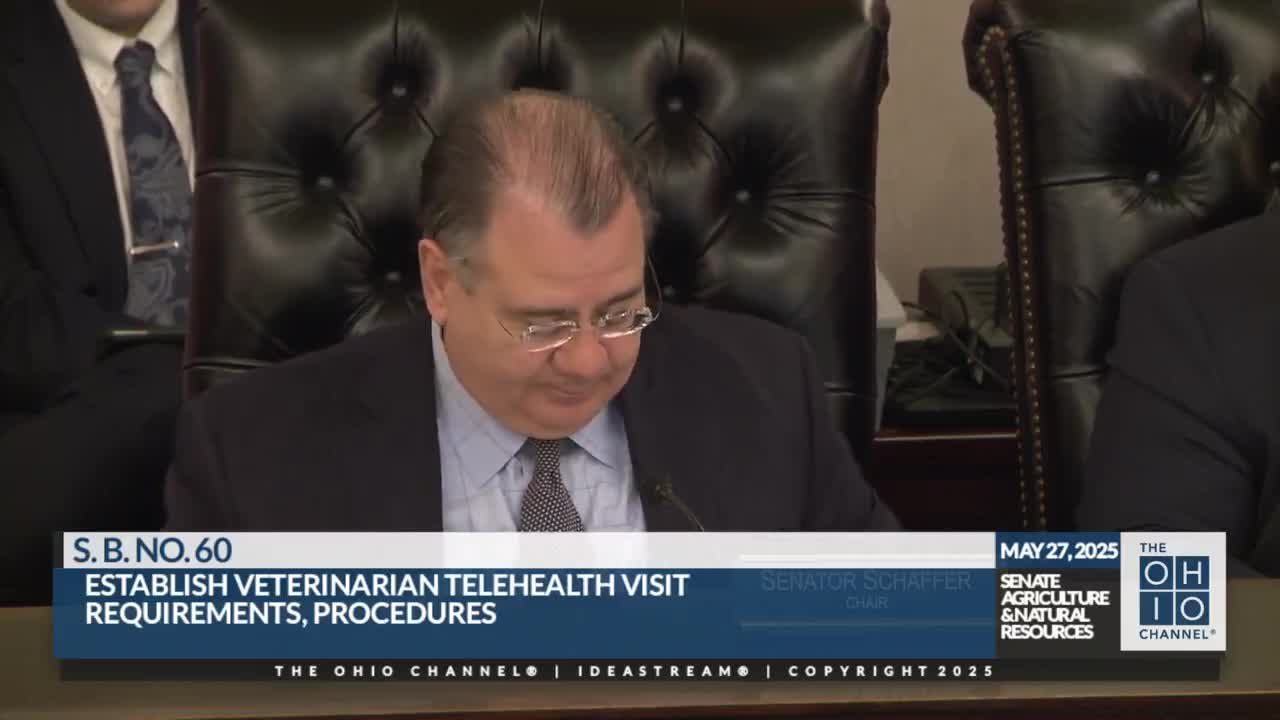
Senate panel hears proponents on veterinary telemedicine bill; substitute clarifies livestock rules and teleadvice
Summary
Proponents including animal-welfare groups and practicing veterinarians told the Agriculture and Natural Resources Committee that substitute Senate Bill 60 would expand telemedicine for veterinary care while protecting public-health livestock rules; the committee accepted a substitute as the formal vehicle and heard multiple proponent witnesses.
The Ohio Senate Agriculture and Natural Resources Committee accepted a substitute for Senate Bill 60 and heard proponent testimony on expanding veterinary telemedicine, with witnesses urging that licensed veterinarians be allowed to establish veterinary-client-patient relationships (VCPRs) via telehealth in appropriate cases and to use teleadvice where federal law permits.
Vice Chair Kaler described the substitute as making four changes to the introduced bill: prohibiting telehealth for animals raised for human food (porcine, bovine, caprine, ovine and poultry) unless an in-person VCPR is first established; allowing teleadvice prior to an in-person VCPR if federal law permits; affirming that the substitute does not override Chapter 5956 (commercial breeding) requirements such as mandated in-person exams; and clarifying that veterinary practice occurs in the state where the patient is located.
Proponents told the committee the bill would increase access to care. Mark Finner, testifying for Humane World for Animals, said telemedicine eases barriers that keep people from bringing pets to clinics: transportation, time, mobility and cost. "Allowing VCPRs to be established via telemedicine with the proper guardrails means that more pet owners, no matter their circumstances, will be able to access vital services and help assure the health and well-being of their pets," Finner said.
Dr. Zeke Zekeff, a practicing veterinarian with more than 40 years of experience, told the committee SB 60 "does not eliminate or replace in-person veterinary care. It simply provides veterinarians with another tool in the toolbox." He and other witnesses cited rural access and a national shortage of veterinary professionals as reasons to allow telehealth tools for triage, follow-up and chronic-disease management.
Dr. Laura Advent, testifying for Columbus Humane and the Ohio Animal Welfare Federation, said telemedicine proved valuable in human health care during the COVID-19 pandemic and would bring similar benefits to veterinary medicine, including triage, rapid point-of-care response and reduced transportation barriers for seniors, people with disabilities and low-income residents.
The substitute explicitly prohibits telehealth for animals intended for human food unless an in-person VCPR is established first; it also allows teleadvice (non-diagnostic guidance) before an in-person VCPR if federal rules change to permit it. The substitute preserves existing commercial-breeding requirements under Chapter 5956, including in-person exams between breeding cycles.
Committee members heard multiple proponent witnesses in person and were informed of written testimony from additional veterinarians and groups. The substitute was accepted as the vehicle without objection; no final committee vote on the bill was taken at this hearing.
The testimony included numerical estimates from witnesses: Finner said at least 850,000 pets live with families in poverty in Ohio and 1.4 million live in asset-limited, income-constrained households; Dr. Advent cited national access shortfalls and workforce shortages. Those figures were offered by witnesses as context for access concerns and should be verified if used as factual bases for fiscal or policy analysis.
Next steps: the substitute serves as the committeevehicle and the bill will return for further consideration, amendment and possible votes in later committee business.