Get Full Government Meeting Transcripts, Videos, & Alerts Forever!
Get email alerts on the Mining Regulation topic
No spam. Unsubscribe anytime.
Ohio Senate committee hears debate on bill to authorize underground limestone mining; residents warn of local impacts
Summary
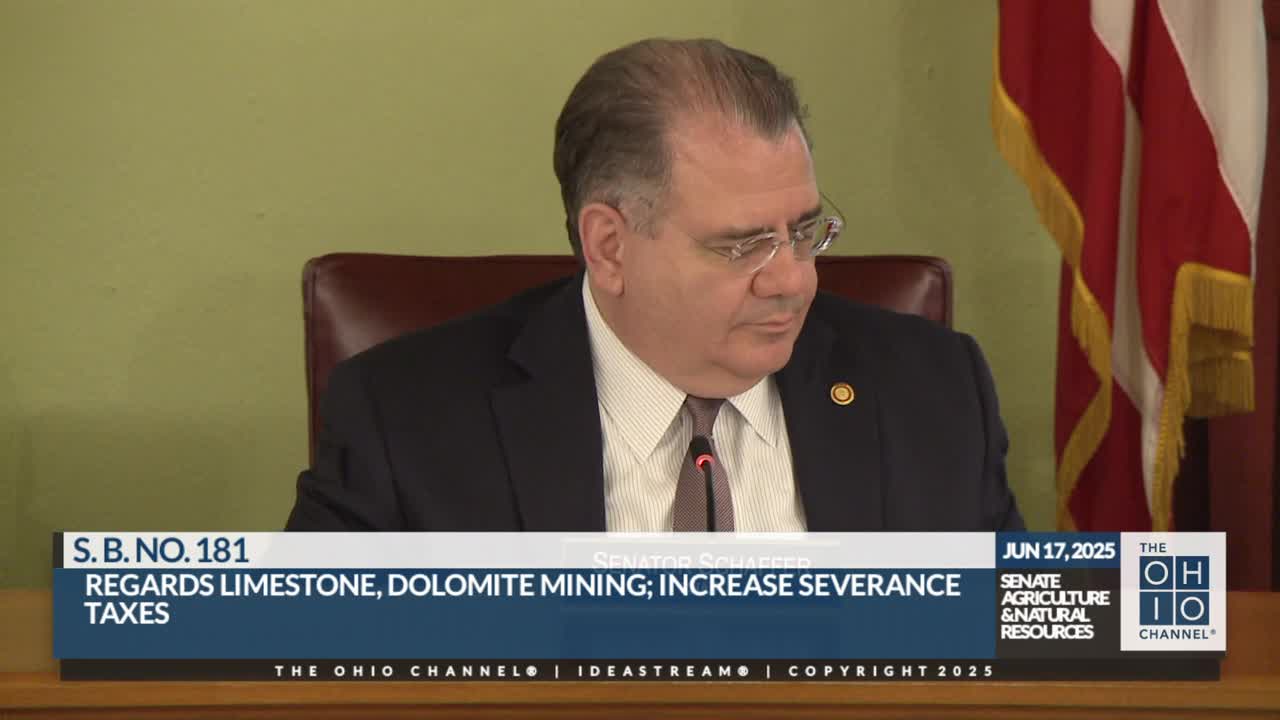
The Senate Agriculture and Natural Resources Committee on Oct. 12 heard competing testimony on Senate Bill 181, which would establish a process for authorizing underground limestone mining and make other changes to how mining permits and permit amendments are reviewed.
The Senate Agriculture and Natural Resources Committee on Oct. 12 heard competing testimony on Senate Bill 181, which would establish a process for authorizing underground limestone mining and make other changes to how mining permits and permit amendments are reviewed.
Kathy Estep, a Mad River Township resident and representative of Citizens Against Mining, told the committee she and neighbors oppose provisions in the bill that they say would reduce local control over permit changes and allow large expansions without adequate new review. “It is not reasonable to reduce opportunities for regulation, oversight, and accountability in an industry that swiftly changes the landscape forever,” Estep said. She told senators that within a two-mile radius of the site near Enon there are “more than 700 homeowners” who could be affected if a small gravel pit were expanded to a 420-acre limestone operation.
The testimony focused on three recurring concerns: risks to private wells from dewatering, possible subsidence and structural damage from underground workings, and limits on local zoning and review when permits are amended. Estep said the group’s hydrogeologist reached different conclusions about the expected cone of depression around the quarry than the consultant used by the operator and that the Ohio Department of Natural Resources (ODNR) accepted the company’s experts in earlier proceedings.
Kathleen Matthews, president of the Mud Run Conservancy, described potential geologic hazards tied to underground limestone mining and cited a recent federal study showing several pillar collapses at U.S. underground mines. “What I really would like you to picture is a tremendous game of Jenga,” Matthews said, describing how removal of supporting stone can risk collapse. She also said language in the bill appears to bar the ODNR chief from ordering an operator to repair or compensate for off-site subsidence damage and asked who would pay in that event.
Industry counsel Brian Barger, legal counsel for the Ohio Aggregates and Industrial Minerals Association, disputed characterizations that the bill would be a rubber stamp for operators. Barger said the bill sets up a framework and that detailed technical requirements would be developed through ODNR rulemaking. “This is not some two-page rubber stamp process that just goes through wham bam,” he said, describing a multi-step modeling and review process in which ODNR or retained experts analyze hydrology and other technical inputs and the chief can impose conditions or halt operations for noncompliance.
Barger also said ODNR’s groundwater-modeling program — under which operators must predict the cone of depression and accept responsibility for impacts within that area — has provided a predictable mechanism for replacing affected water supplies. He told the committee the bill requires minimum insurance and that operators commonly carry more than the $1 million minimum referenced in testimony.
Committee members asked detailed questions about the timeline and history of the Enon-area permits that several witnesses referenced. Witnesses said an original permit for about 21 acres dated decades earlier was administratively merged with a larger permit and later amended to allow blasting and dewatering; opponents said that history left homeowners unaware that an expanded operation could be proposed nearby. Barger said the amendment and subsequent Reclamation Commission hearing and court reviews demonstrated the permitting and appeal processes were used in that case.
No committee vote was taken. Witnesses who submitted written testimony in opposition included Karen Diebel, Sheila Drennan and Carol Culbertson; the record also includes written testimony from Kathleen Matthews. The hearing concluded with no action recorded and no rulemaking schedule announced.
Discussion points: opponents asked the committee to preserve or strengthen local zoning and permit-review rights, require stricter reclamation and repair obligations for off-site damage, and mandate clearer notice to neighboring property owners. Industry representatives emphasized rulemaking as the venue for technical safeguards (roof control, hydrologic modeling, insurance and monitoring) and noted existing review steps, inspection frequencies and appeal avenues.
The committee did not adopt or reject amendments to the bill at the hearing and did not set a follow-up date; the sponsor listed for the item is Senator Shane Wilkin. The committee record includes both oral testimony and multiple written submissions opposing the bill.