
Arkansas workforce leaders brief legislators on WIOA funding, possible federal shift to ‘Make America Skilled Again’
Get AI-powered insights, summaries, and transcripts
Subscribe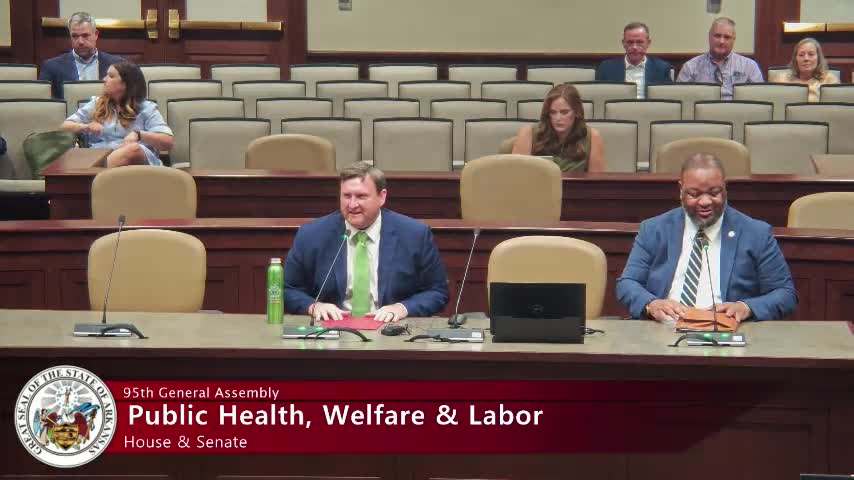
Summary
State workforce officials told an Arkansas legislative committee that projected WIOA funds for program year 2025 are rising after several years of decline, described how current WIOA service delivery operates in Arkansas, and outlined potential impacts if Congress consolidates programs under the proposed “Make America Skilled Again” model.
Cody Waites, executive director of Arkansas Workforce Connections, and Eddie Thomas, director of the Office of Employment and Training at the Arkansas Department of Commerce, told members of a legislative committee that projected federal workforce funds for program year 2025 are expected to rise after a multi-year decline and that federal proposals could alter how the state delivers services.
The presentation Thursday described the current Workforce Innovation and Opportunity Act structure in Arkansas, how funds flow from the U.S. Department of Labor through the governor and state workforce board to 10 local workforce development areas, and the state’s 23 physical workforce centers (branded nationally as American Job Centers). Waites and Thomas said the change would affect training, wraparound supports and reporting.
Why it matters: federal reauthorization could consolidate multiple grant programs into a single block grant, shifting reporting, service design and local funding flexibility and imposing a 10% minimum for registered-apprenticeship expansion. That could change how local areas target funds for youth, adults and dislocated workers and how the state monitors compliance and outcomes.
Waites described recent internal reorganization at the Department of Commerce that moved several workforce-related divisions under Arkansas Workforce Connections, including the Arkansas Manufacturing Solutions Group and the business resource division, to centralize strategy and employer engagement. Thomas said program delivery remains mixed between comprehensive centers, affiliate sites and virtual services to reach rural areas.
Thomas explained the current federal-to-local flow: “Funds start at the United States Department of Labor, flow down to [the] governor, who then appoints [the] Arkansas Workforce Development Board, who has the duties and responsibility of the vision and oversight for the workforce development system,” and then to the state workforce agency and local chief elected officials. He and Waites said the system’s complexity sometimes creates administrative burden.
State officials showed participant counts from program years 2021–2024 and said some large aggregate figures reflect self-service activity (people using online job-search tools) rather than in-office services; staff are working to disaggregate those counts. Waites said the program-year 2025 allocation for Arkansas is projected at about $16.2 million, after several years of declining allocations at the federal-formula level. He said local areas use funds for three primary buckets: training costs, supportive (“wraparound”) services — such as childcare and transportation assistance — and administrative costs for local operation.
On the federal proposal commonly called “Make America Skilled Again,” Waites summarized the model his office is tracking: a consolidation of roughly a dozen federal programs into one block grant. He said that, if enacted, local areas would receive a single pool of funds rather than separate youth, adult and dislocated-worker buckets and that the federal proposal includes a requirement that at least 10% of those consolidated funds be used for registered-apprenticeship expansion. “WIOA funds moving forward or Make America Skilled Again funds would have to have a minimum of 10% allocated toward registered-apprenticeship expansion,” Waites said.
Legislators asked about specific program areas. Representative Anthony Richardson asked whether funding goes to prison reentry programs; Thomas said Arkansas Workforce Connections partners with correctional agencies but that the WIOA pool itself does not directly pay the Department of Corrections (DOC). “We have provided funding in the past, not necessarily out of this money,” Waites added, citing prior partnerships using TANF funds and other grants for CDL training for incarcerated individuals.
Senator Love asked whether the projected rise to about $16.2 million represents a break in the recent downward trend; officials confirmed it is an uptick tied to the federal allocation formula. Representative Bentley and others asked about outcomes tracking; Thomas said federal performance measures include second-quarter and fourth-quarter employment earnings after exit and measurable skills gains, and the state is working on dashboards to provide more real-time outcome data.
Officials also highlighted local service changes: a reduction in the number of physical centers over time, increased virtual services, mobile units that visit communities and a Connect Employment Services hotline launched in September to link callers to local boards and partners such as Goodwill and community action agencies.
What was not decided: no formal votes were taken. Waites and Thomas said the state is reviewing internal WIOA policies, working with the U.S. Department of Labor and peer states, and continuing conversations with the Department of Human Services on possible work requirements and coordination should federal or state rules change.
The presentation concluded with an offer to provide additional data on sector-specific training (for example, nursing, CDL and manufacturing apprenticeships) and on local center coverage and mobile-unit schedules.
Officials said they will continue stakeholder conversations and monitor federal reauthorization developments.
Less critical detail: presenters noted a reduction in overdue monitoring reports from 30-plus to two after internal work with local areas and auditors; they also said many participants counted in statewide totals are self-service users accessing online job tools rather than in-person services.