
Arkansas panel adopts interim study to update Domestic Abuse Act after survivor testimony
Get AI-powered insights, summaries, and transcripts
Subscribe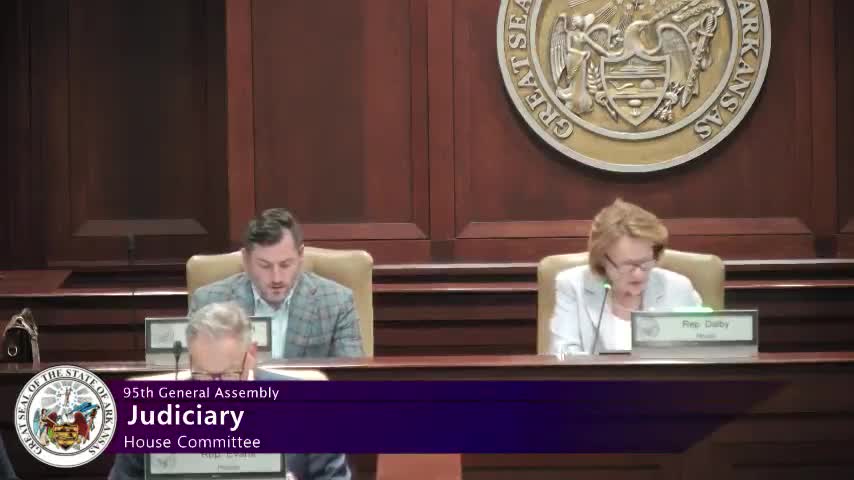
Summary
The House Judiciary Committee voted to adopt an interim study to revise the state's Domestic Abuse Act of 1991 after a survivor described years of harm to her child; judges and advocates urged changes including automatic ad litems, expanded protection for children and clearer definitions.
The Arkansas House Judiciary Committee adopted an interim study to revise the state's Domestic Abuse Act of 1991 and to prepare related legislation after testimony from a survivor and legal and judicial witnesses.
The study, tied to House Bill 18 29, was approved by the committee by voice vote after members heard from Lindsay Duncan, a mother who described years of abuse and the effects on her 12-year-old son. Duncan urged automatic appointment of attorneys ad litem for children, court-monitored communication apps in suspected domestic-violence cases, recognition of prior patterns of violence, and automatic extension of protection orders to children.
The interim study is intended to bring the bill back in the next session in a revised form. Chairman Dolby told the committee he expects the interim work will be used to refine the bill so "when it goes to the Senate, there will be no one who can stand up with a straight face and fight against a bill of this importance." The committee set plans to continue work over the fall.
Why it matters: Witnesses said current practices leave children without a meaningful voice in custody and protection proceedings and that inconsistent procedures across Arkansas produce uneven outcomes. Judges and advocates told the committee a clearer statute and additional resources could speed protection orders, improve accountability for violations and expand remedies for financial and coercive control.
What speakers said and recommended
Lindsay Duncan, who testified about 12 years of her son's exposure to domestic violence, said existing court processes do not reliably protect children. "Please help kids like me. We deserve rights too. We need to have an opinion. And if we don't want to go on a visit, listen to us," she said, addressing the committee.
Beth Sanders, executive director of the Arkansas Coalition Against Domestic Violence, told lawmakers the experience Duncan described is widespread and noted the coalition represents 27 emergency shelters serving all 75 counties. "The story that she told you this morning . . . could be echoed and magnified and multiplied many, many times," Sanders said.
Judge Amy Moore, a circuit judge who handles orders of protection and custody cases, urged adoption of clearer statutory language and pointed to research linking childhood exposure to domestic violence with later harm. "Any intervention that you as our legislative body can create to stop that cycle will save lives," she said, and recommended including coercive or "course of control" behavior in the definition of domestic abuse so judges may consider it on the front end.
Laura Calhoun, staff attorney with the Administrative Office of the Courts, described implementation constraints: the judicial office's current fiscal appropriation for domestic-relations attorney ad litems is $396,750 and the ad litem fee had been $90 per hour and was recently increased to $125 per hour, with a per-case cap reported during testimony. She told the committee there are not presently funds to appoint ad litems in every domestic-violence case statewide and that rural counties sometimes lack available attorneys.
Legal counsel Barbara Mariani described a Pulaski County pilot that provides free legal counsel and electronic filing improvements; she said that program handled 524 clients in fiscal 2024 and filed 304 orders of protection in three courts, with those cases involving 196 children in that sample.
Committee action and next steps
Committee members voted to adopt the interim study. Chairman Dolby said the committee will continue work during the interim, solicit input and aim to return a strengthened version of the bill in the next legislative term. Members also discussed resource questions including funding for ad litems and domestic-violence intervention programs and encouraged coordination with the judicial branch and advocacy groups.
Votes at a glance
- Approval of Sept. 23, 2024 meeting minutes: motion made by Representative Beatty; second by Speaker Evans; outcome: approved by voice vote (record: "ayes have it").
- Authorization to approve committee special expenses incurred during the interim: motion made by Representative Hudson; second by Speaker Evans; outcome: approved by voice vote (record: "ayes have it").
- Motion to adopt the interim study for House Bill 18 29 (Domestic Abuse Act amendments and related clarifications): motion mover not specified on the record; second by Representative Springer; outcome: approved by voice vote (record: "ayes have it").
What the bill and study would address
Testimony and the draft provisions discussed in committee would: explicitly add "course of control" (coercive control) into the definition of domestic abuse, permit judges to order communication through court-monitored apps in appropriate cases, authorize or encourage appointment of attorneys ad litem for children, require expedited hearings for alleged violations of protection orders, clarify financial-exploitation remedies and streamline notice processes to criminal background/records systems. Several witnesses said many of those changes are technical clarifications and implementation matters, while others are substantive and will require further discussion.
Funding and capacity concerns
Witnesses repeatedly raised the need for funding: a Pulaski County pilot was cited as a model but cannot be expanded statewide without additional appropriations or grant support; judges and the Administrative Office of the Courts said current ad litem budgets and per-case caps limit appointing counsel broadly; advocates said rural areas lack advocates and lawyers available to assist victims.
Closing
Committee members thanked the witnesses and the survivor who testified. Chairman Dolby closed the session with an expectation that the interim work will guide a revised bill next session and that the committee will reconvene this fall to continue work on interim studies.