Get Full Government Meeting Transcripts, Videos, & Alerts Forever!
Get email alerts on the Immigration Detention topic
No spam. Unsubscribe anytime.
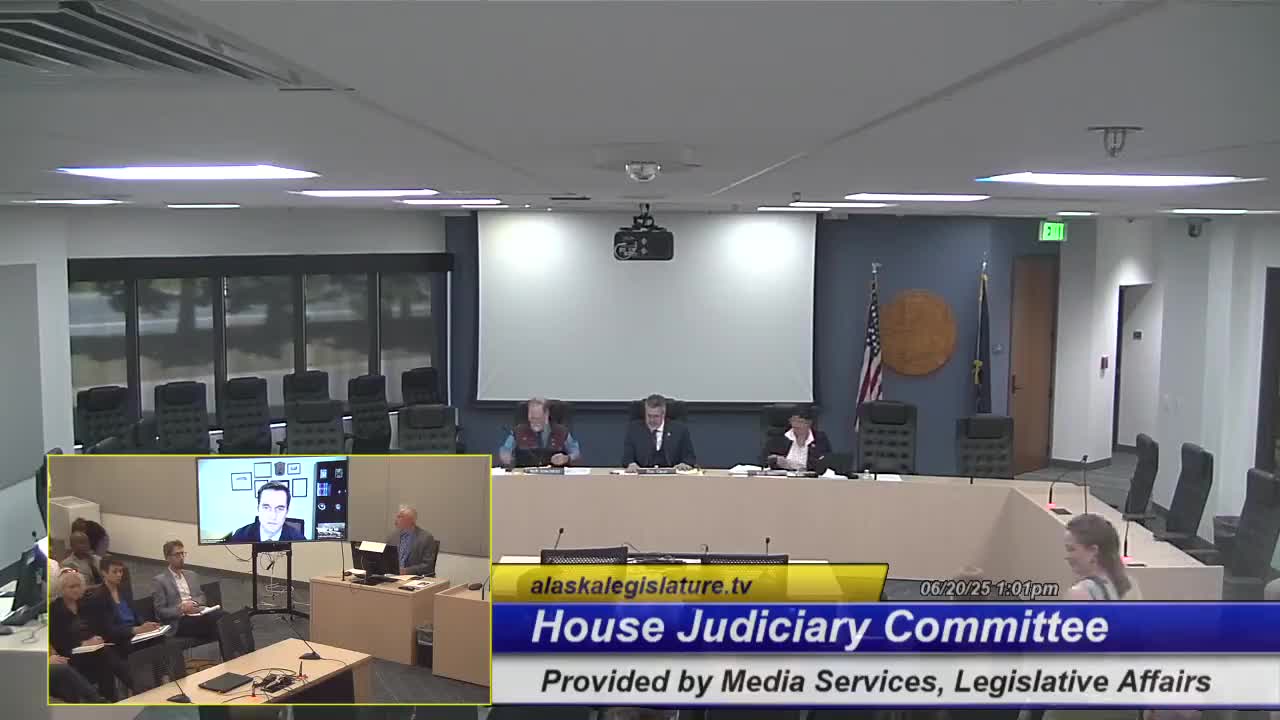
House panel questions Alaska DOC on housing of ICE detainees at Anchorage Correctional Complex
Summary
A House Judiciary Committee fact‑finding hearing reviewed why Alaska's Department of Corrections accepted dozens of immigration detainees transferred from Washington, the terms of the federal contract, reported conditions at the Anchorage Correctional Complex and access to lawyers, translation, medical care and personal property.
Representative V. Gray (Chair) opened a June 20, 2025, House Judiciary Committee informational hearing in Anchorage to examine the status of immigration detainees held at the Anchorage Correctional Complex (ACC) under a contract with U.S. Immigration and Customs Enforcement (ICE).
The committee heard from Alaska Department of Corrections (DOC) Commissioner Jen Winkleman, attorneys who have met with detainees, and an ACLU immigration fellow. Winkleman said DOC has had a contract with federal authorities since 2013 and described the current agreement as “effective until it is terminated in writing.” She told the committee ICE contacted ACC on June 4 to ask how many people the facility could safely house; 41 detainees arrived on June 8 and, as of the hearing, 35 remained in DOC custody after some transfers out.
Why the hearing matters: the committee framed the discussion as a financial and legal risk to Alaska and as a question about whether a state prison can meet standards and detainees’ needs when used to hold people in civil immigration custody rather than a federal ICE facility.
Most important facts
- DOC contract and payments: Winkleman said the DOC–federal contract predates the current administration and that Alaska bills the federal government a daily cost‑of‑care (per‑diem) rate for housed detainees; committee testimony recorded the federal per‑diem cited as about $223 per day. Winkleman said DOC seeks to recover costs through that rate and has asked ICE for medical abstracts and medication lists before transfers.
- Numbers, timing and selection: DOC leadership told the committee ICE asked on June 4 how many detainees ACC could safely accept; 59 was the capacity figure agreed locally, 41 were transported to ACC on June 8, the commissioner later picked up two of those and four others left, leaving 35 at the time of the hearing. Winkleman said DOC did not select which individuals ICE transferred and that Anchorage is the only Alaska DOC facility certified to hold ICE detainees longer than 72 hours.
- Conditions and reported incidents: attorneys and an ACLU representative described cramped housing, limited phone access, language‑access problems, restricted legal access early in the placement, and delays in return of personal property and legal documents. The ACLU witness said detainees were held “2 to 3 in a cell with 1 open air toilet” and reported limited showers and limited working telephones. Commissioners and attorneys disagreed about some specifics of practices; Commissioner Winkleman confirmed one use‑of‑force incident in which oleoresin capsicum (OC) was “deployed in the area” on June 12 to secure a unit and said no individual was directly sprayed in the face.
- Legal access and property: attorneys testified some lawyers were not notified promptly when clients were transferred and that at least one client’s legal papers and court filings were seized during transfer and not returned as of the hearing. Commissioner Winkleman said DOC had requested detainees’ identifying and medical information in advance and that ICE reissued detainee handbooks after transfer.
- Standards and oversight: the committee repeatedly cited the National Detention Standards for Non‑Dedicated Facilities (2019) (the transcript referred to this as the “Trump guidance”), noting provisions on legal visitation, consular access, medical review before chemical agent use and property transfer. Commissioner Winkleman said ICE certifies a facility’s meeting of ICE standards and that DOC uses its own policies while cooperating with ICE certification.
What witnesses said
- Representative Gray (chair): opened the hearing, framed the issue as a question of legal rights and potential liability, and emphasized the committee’s fact‑finding role. Gray read constitutional context about due process, saying, “The Fourteenth Amendment applies to all persons physically in The United States.”
- Commissioner Jen Winkleman (Alaska Department of Corrections): described the long‑standing authority under state statute to enter contracts with federal agencies, confirmed the DOC–ICE contract has been in place since 2013 and is effective until terminated in writing, and said Alaska is reimbursed at a daily cost‑of‑care rate. She said ACC is certified for stays over 72 hours, that ICE provided medical abstracts and medications before the June transfers, and that DOC is working to resolve early operational “bumps” including scheduling calls and visits.
- Sydney Woods (ACLU of Alaska): summarized interviews and letters from detainees and said the settings described to the ACLU did “not comport with the standards” cited by the committee. She said detainees reported shared cells, restricted showers, limited working phones, limited legal access initially, loss of personal property and threats or reports of chemical‑agent use.
- Nicholas Alano (immigration attorney): said holding civil immigration detainees en masse in a criminal jail setting is “not” the same as civil immigration detention and told the committee the ACC environment is designed for criminal confinement, not prolonged civil detention.
- Sean Quirk (attorney, pro bono immigration work): described being unaware of his client’s transfer until after it occurred, difficulty scheduling confidential attorney‑client calls, and the client’s report that the Anchorage conditions were “worse than Tacoma.”
Committee findings and next steps
The session was explicitly fact‑finding; no formal votes were taken. Committee members pressed DOC about notification, medical care, legal and consular access, language services and whether DOC had discretion to refuse ICE requests. Winkleman said the request to host the cohort was handled at the facility leadership level after ICE asked about capacity and that the state contract and a working relationship with ICE informed the response. Lawmakers and witnesses flagged potential legal liability for the state if standards are not met and noted reported gaps in practice compared with the National Detention Standards cited during testimony.
Ending
Committee members asked DOC to follow up on specific allegations (for example, the reported lack of replacement underwear and the sequence of medical review before OC use) and encouraged site visits; Winkleman invited legislators to tour the facility. The committee did not adopt any changes during the hearing but left open follow‑up requests to DOC and an offer by staff to supply written materials and documentation. The committee record includes written responses from the Department of Law and the DOC contract materials uploaded to the legislature’s BASIS system.