
Assembly budget staff outline how appropriations, categories and transfers work
Get AI-powered insights, summaries, and transcripts
Subscribe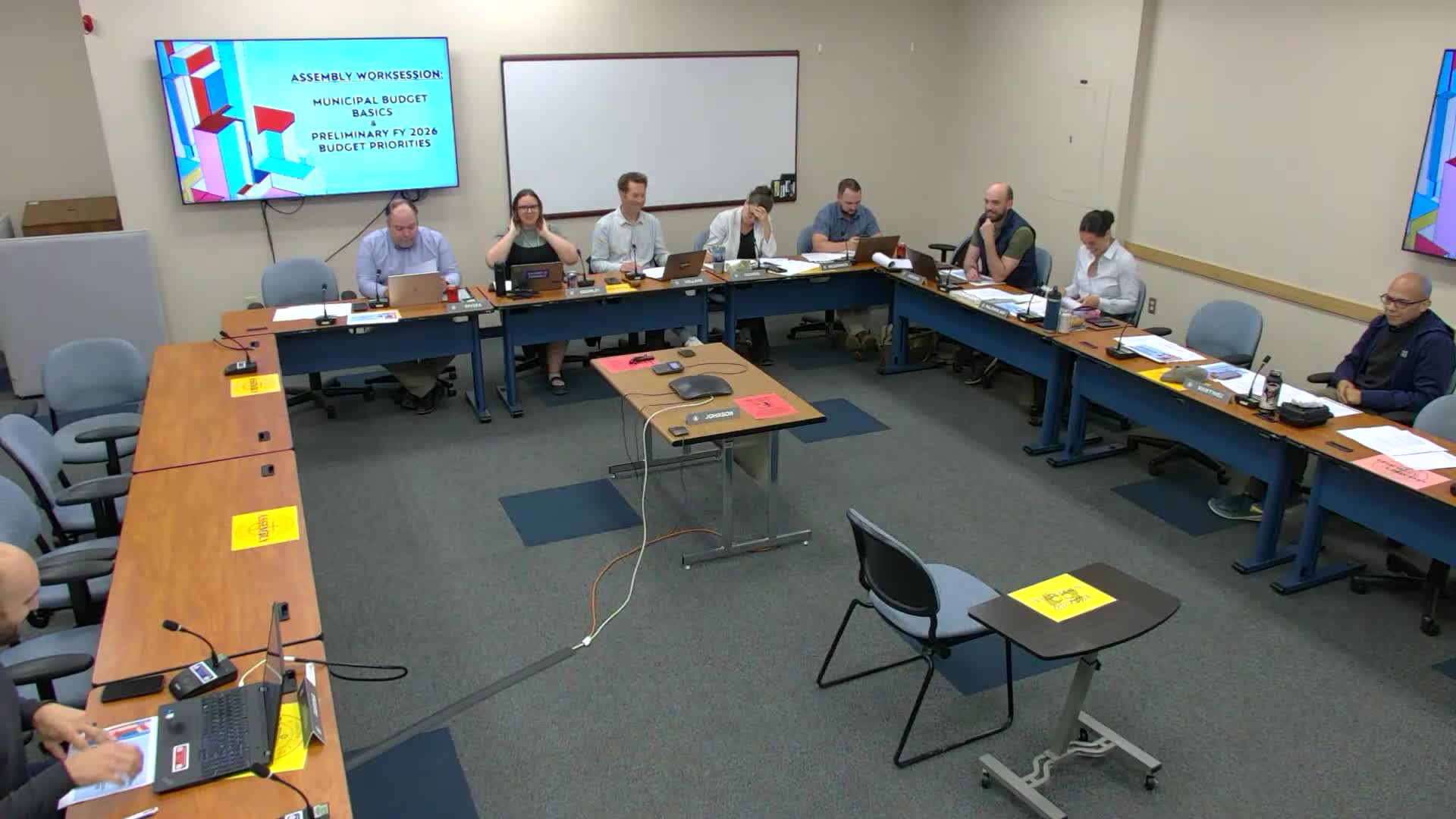
Summary
Assembly budget staff and the Office of Management and Budget reviewed the municipality's budget mechanics — what an appropriation is, how categories and cost centers relate, and when the assembly or the mayor may move funds — during a one-hour work session.
The assembly’s budget analyst and the Office of Management and Budget framed the basic rules that govern the municipal budget and how the assembly and mayor can move money during a work session on municipal budgeting. Matt Greeno, the assembly budget program and budget analyst, briefed members on charter and code provisions and timing requirements for the annual budget and supplemental appropriations.
Greeno said an appropriation is “an authority to spend money,” and explained that appropriations give a department its budget while expense categories inside an appropriation (for example labor versus nonlabor) are the normal management units. He told members the assembly can appropriate to a broad department level or down to a single project code and that the mayor may move money between categories within executive-branch appropriations unless the assembly explicitly narrows the authority.
The presentation reviewed statutory timing obligations: the municipal fiscal year runs Jan. 1–Dec. 31; the assembly must hold two public hearings on the proposed annual budget (one at least 21 days after submission and a final hearing within 14 days before approval); and supplemental appropriations above certain thresholds require additional public process. Greeno noted that, unless otherwise specified (capital projects or multi‑year grants), appropriations lapse at year end and unspent, unencumbered authority returns to the originating fund.
Members asked for a clearer hierarchy of terms. Assembly Member Aaron Baldwin Day summarized his understanding after the presentation: “So categories exist inside of appropriations. The mayor can move things within categories, but not appropriations. The assembly can move things between appropriations. I’m clear.”
The session included practical examples: how an appropriation can be shifted between departments (referred to in the meeting as a reappropriation), how the municipality records one‑time items and project codes in the annual appropriation document, and the use of forms and ordinance language that specify whether contract payments are “subject to annual appropriations.”
No formal action was taken; the briefing was informational and intended to prepare assembly members for later budget deliberations.