Get Full Government Meeting Transcripts, Videos, & Alerts Forever!
Get email alerts on the Ohio Defense Commission topic
No spam. Unsubscribe anytime.
Committee hears bill to create Ohio Defense Commission, fund SCIF space and grants for small defense firms
Summary
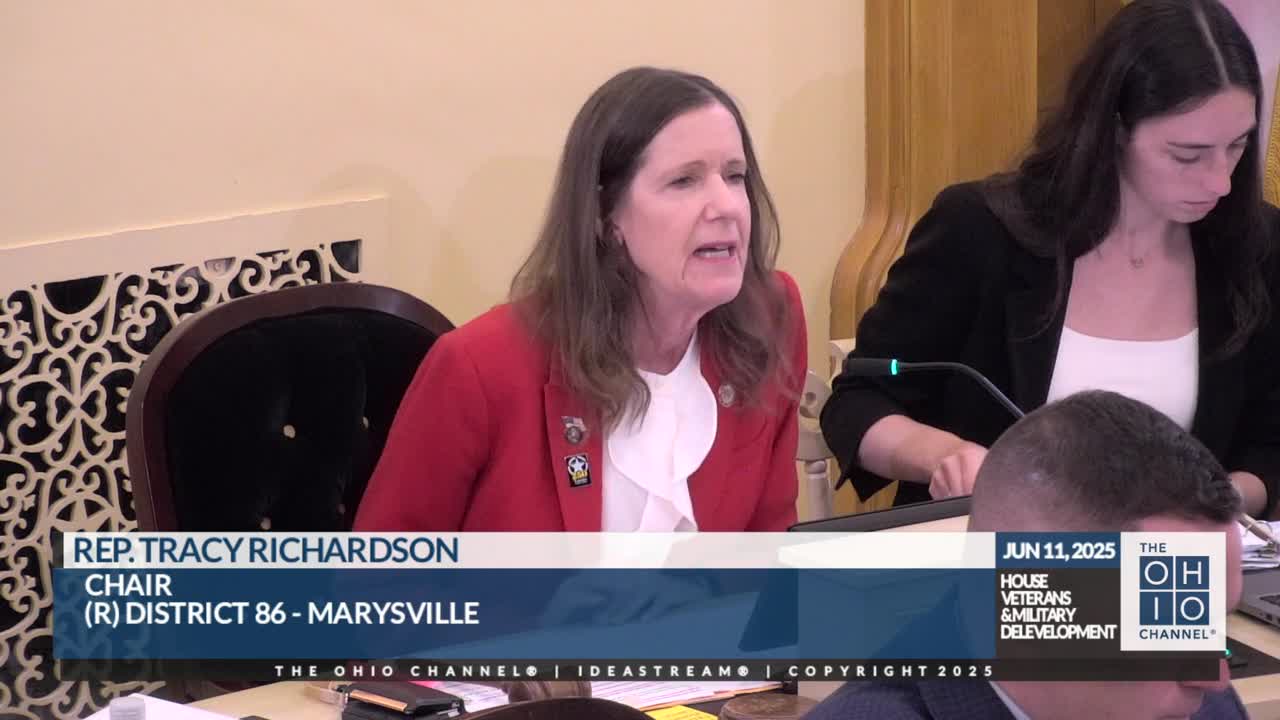
At a House Veterans and Military Development Committee hearing, sponsors introduced House Bill 292 to create an Ohio Defense Commission and an Ohio Defense Fund to promote the state’s defense industry, support secured classified workspaces known as SCIFs and provide grant and matching funds to small- and medium-sized defense companies.
At a House Veterans and Military Development Committee hearing, sponsors introduced House Bill 292 to create an Ohio Defense Commission and an Ohio Defense Fund to promote the state’s defense industry, support secured classified workspaces known as SCIFs and provide grant and matching funds to small- and medium-sized defense companies. Vice Chair Matthews and Representative Nick Santucci presented sponsor testimony and answered questions from committee members.
The bill’s sponsors told the committee the commission would develop a statewide defense strategy, encourage collaboration among stakeholders and recruit domestic and international defense investment. "We will provide grant dollars and matching dollars for SCIF space development across Ohio," Vice Chair Matthews said, using the SCIF acronym and explaining it refers to a Secured Compartmented Information Facility for work on classified material. Matthews described three focus areas for the proposed Ohio Defense Fund: SCIF space development, grants or matching funds to small- and medium-sized defense firms, and a capital stack of federal and nonfederal match dollars to help recruit bases, missions or manufacturers.
Why it matters: sponsors and several members framed the proposal as an economic development and national-security measure intended to grow jobs and connect regional defense suppliers to larger prime contractors. Matthews said the fund could help companies demonstrate technologies to the Department of Defense and commercial markets and that a successful program could attract additional state line-item funding in future budgets.
Key facts and sponsor estimates - Funding source discussed: Matthews said initial liquidity for the fund in its first iteration would come from interest earned on state-held Israel bonds, which he estimated in committee testimony at approximately $225,000,000,000 in holdings and suggested could yield an initial $5,000,000 per year (or $10,000,000 over a biennium) if approved. He described that figure as a current estimate and said he would provide clarifying research to the committee. - Commission composition as described by sponsors: Matthews said the commission would include voting legislative members and regional representatives; sponsors stated a total of "13 voting members" and separately referenced "7 regional representatives" and nonvoting/ex officio subject-matter members such as representatives from JobsOhio and the Ohio Chamber of Commerce (sponsors characterized the latter as providers of recommendations and subject expertise). - Examples and precedents mentioned: sponsors and members referenced other states with similar entities (Lucas of neighboring states), a recent Michigan funding example, local pilot activity in Dayton described as "SCIF hotels," and Boeing as a local precedent for SCIF facilities.
Questions and concerns raised - Foreign-linked funding: Representative Gambari said he had "a little bit of hesitation with any funding coming from a source that has any kind of foreign connections," noting that SCIFs and classified work often have limits on foreign access. Matthews responded that commission decisions and existing SCIF sponsorship requirements should allow guardrails and that he would seek clarification and possibly tighten statutory language to ensure protections. - Appointment and governance clarity: multiple members asked how regional commissioners would be selected. Matthews said the general-assembly appointees would take recommendations from nonvoting ex officio members and that sponsors planned to refine statutory language to make the appointment and chair-selection process clear. - Project selection and scale: members asked whether the bill’s annual funding level would be sufficient and whether the fund would be regionally distributed rather than centralized in Columbus; sponsors said the model anticipates multiple regional projects and recommended further committee review on prioritization.
Formal actions recorded - Vice Chair Matthews moved to amend House Bill 292 with a circulated sub-bill during the hearing; the chair stated the sub-bill was in order, and "without objection, the motion is agreed to, and the amendment shall become part of the bill." - The committee approved prior meeting minutes "without objection" at the start of the session.
Next steps and context Sponsors said they will refine bill language based on questions about funding sources and appointment processes and provide follow-up research on whether the state currently uses bond interest for other programs. The committee concluded the first hearing on House Bill 292; sponsors and members indicated additional technical changes and further hearings are likely before the bill moves forward.