Get Full Government Meeting Transcripts, Videos, & Alerts Forever!
Get email alerts on the Property Tax Complaints topic
No spam. Unsubscribe anytime.
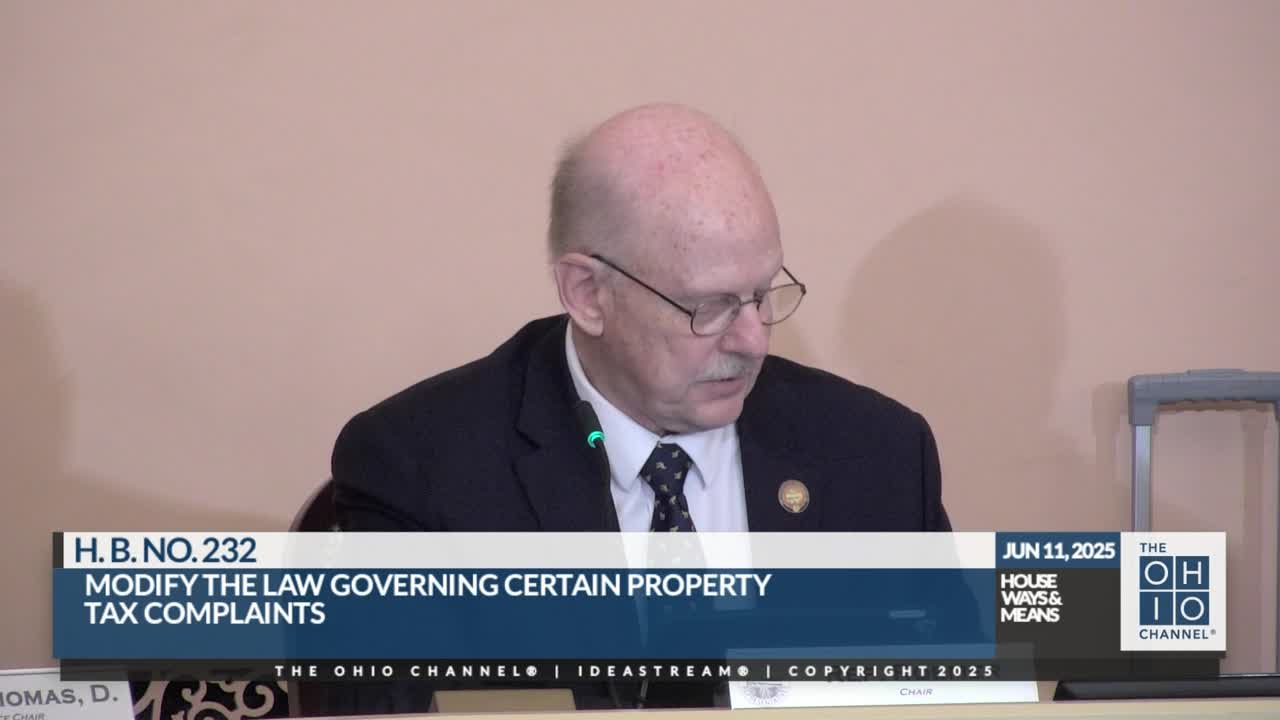
Ways and Means amends property tax complaint rules; board of revision raises discovery, appeal and penalty concerns
Summary
During a fourth hearing on House Bill 232, the Ways and Means Committee adopted and tabled amendments to property tax complaint rules while the Cuyahoga County Board of Revision warned the bill limits discovery power, could leave sales by LLCs hidden, and urged changes to appeals and penalty language.
The Ohio House Ways and Means Committee considered changes to the law governing property tax complaints during its fourth hearing on House Bill 232, including adopted amendments intended to clarify retroactivity and expand permissible evidence in valuation appeals.
Representative Troy offered two amendments during the hearing. One amendment (AM508) sought to limit retroactivity so that HB 232’s retroactive effect would apply only to pending complaints and appeals rather than re‑opening settled complaints. The committee voted 8–4 to lay that amendment on the table. A subsequent amendment (AM509) broadened what qualifies as evidence of a qualifying sale by allowing other evidence (beyond just conveyance fee statements) when certain sale thresholds are met; the committee accepted AM509 without objection.
Representative Thomas offered AM1360663‑1 (accepted without objection), language prompted by the prosecutors association that would require outside counsel or collection agencies where a prosecutor has a conflict related to collecting attorney fees for schools.
Ron O’Leary, administrator of the Cuyahoga County Board of Revision, testified as an interested party and described several substantive concerns with HB 232 and related legislation. “One of my office’s main responsibilities is to hear valuation complaints regarding real property,” O’Leary told the committee. He said several provisions in HB 232 and prior bills (notably House Bill 126 of the 130th General Assembly) limit the Board of Revision’s ability to determine true market value.
O’Leary identified five specific issues: (1) an LLC “conveyance” loophole that can hide property sales when ownership transfers are executed by purchasing an LLC rather than the property directly — an issue that a later amendment aimed to address; (2) the board’s limited statutory power to issue and enforce discovery orders for documents (transcript referenced “revised code 50 seven‑fifteen‑ten” and a defective enforcement cross‑reference in the draft); (3) restrictions preventing a legislative authority (for example a school board) from appealing a Board of Revision decision, which removes an important step in establishing market value; (4) statutory authorization for boards to impose costs and attorney fees against improperly filed complaints — a provision O’Leary’s office opposed unless it were structured as a separate court cause of action; and (5) the absence of procedures allowing boards of revision to refer conflicted cases to another county board when multiple members have conflicts.
Committee members asked O’Leary questions about uniformity and the role of the Board of Revision; several said they will continue negotiations on discovery and conflict provisions. The hearing concluded with the committee accepting some amendments and leaving the bill under further committee consideration.
Ending: Committee accepted AM509 and AM1360663‑1, laid AM508 on the table (8–4) and left HB 232 pending further work and clarifications on discovery and penalty enforcement.