Get Full Government Meeting Transcripts, Videos, & Alerts Forever!
Get email alerts on the Property Tax Reform topic
No spam. Unsubscribe anytime.
House Ways and Means panel hears sweeping property tax reform that would remove inside millage; local officials warn of service cuts
Summary
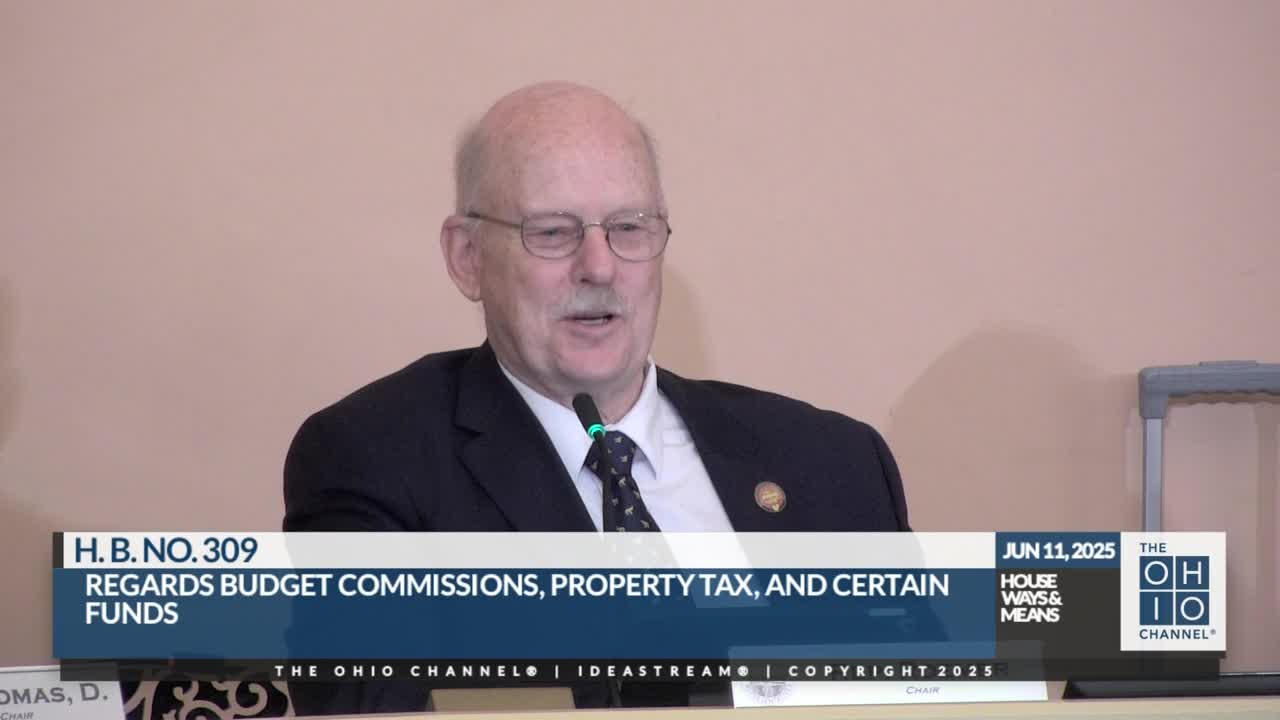
The Ohio House Ways and Means Committee on Wednesday heard extensive testimony on bills that would eliminate unvoted inside millage and expand county budget commission authority, with sponsor Representative Thomas calling the package transformational and local officials warning removal of inside mills could force cuts to police, fire, libraries and schools.
The Ohio House Ways and Means Committee on Wednesday heard extensive testimony on competing bills that would reshape how local governments collect property taxes, with sponsor Representative Thomas saying the plan would deliver an immediate, statewide cut and local officials warning the measures could strip revenue for police, fire and other local services.
Representative Thomas, sponsor of House Bill 335, told the committee, “It is clear. Ohio’s property taxpayers are at the tipping point,” and called HB 335 “the boldest, most transformational property tax reform package in half a century,” promising a January 2026 reduction by eliminating unvoted inside millage and mechanisms to limit future tax spikes.
Supporters described the package as a response to large, recent increases in property valuations. Thomas said the bill’s aims include separating property values from tax increases, rebalancing revenue sources at the local level, limiting growth tied to the 20-mill floor and offering a permissive local homestead ‘piggyback’ option targeted at seniors.
But opponents from counties, cities, parks, libraries and schools argued the proposals would shift or eliminate vital revenue and leave localities to choose between cutting services, asking voters for new levies or raising other local taxes. Summit County Executive Eileen Shapiro said the county faces downstream impacts for bonded debt and budgeted obligations if inside millage is removed, noting the county’s unique charter government structure. “We are concerned,” she said, urging lawmakers to “slow down and look at the downstream impacts.”
Carrie McCarthy of the Ohio Mayors Alliance warned that removing the largest municipality’s role in approving alternative Local Government Fund (LGF) formulas could re-open decades-old regional funding disputes and asked the committee to preserve the existing approval process for counties that use alternative LGF formulas.
Woody Woodward of the Ohio Parks and Recreation Association, speaking for parks, libraries and municipal groups, said the bill would allow a three-member county budget commission to overturn voter-approved levies and place the burden of proof on local entities to justify budgets that voters already approved at the ballot box. “The legislation gives a 3 member commission the opportunity to veto a decision made by the majority of the voters in the county,” he said, adding that many levies are used for long-term capital planning and year‑to‑year smoothing of costs.
School leaders and the Ohio School Boards Association raised concerns about school districts that cross county lines. Nicole Piscatani of OSBA noted that 255 districts span multiple counties and warned that if a single county commission can reduce mills for the portion of the district in its county, that would create uniformity problems for residents in other counties who also voted on the same levy.
Committee members questioned the proposals’ mechanics, tradeoffs and constitutional footing. Representative Thomas said the plan would “give the voters and the taxpayers the ability to actually have the say on that $3.5 billion that they currently have no say on.” Opponents countered that the change is effectively a tax shift that could require higher local sales or income taxes or force cuts to public safety, libraries and schools.
No votes were taken on HB 335 or HB 309 during the hearing. Committee members and witnesses repeatedly said they expect additional hearings and technical work as the bills move through Ways and Means.
Ending: The committee left the bills under active consideration and signaled follow-up work; Representative Thomas and opponents agreed more meetings would be needed before any formal committee votes.