Get Full Government Meeting Transcripts, Videos, & Alerts Forever!
Get email alerts on the Uav Regulation topic
No spam. Unsubscribe anytime.
Sponsor Tells Committee Bill Would Regulate Law‑Enforcement Drone Use and Update Ohio’s Aviation Definitions
Summary
A sponsor told the panel that House Bill 251 would generally require warrants for law‑enforcement UAV surveillance, allow limited warrantless exceptions, ban arming drones with lethal weapons and extend ODOT certification to seaplane bases, vertiports and spaceports; the bill received a first hearing.
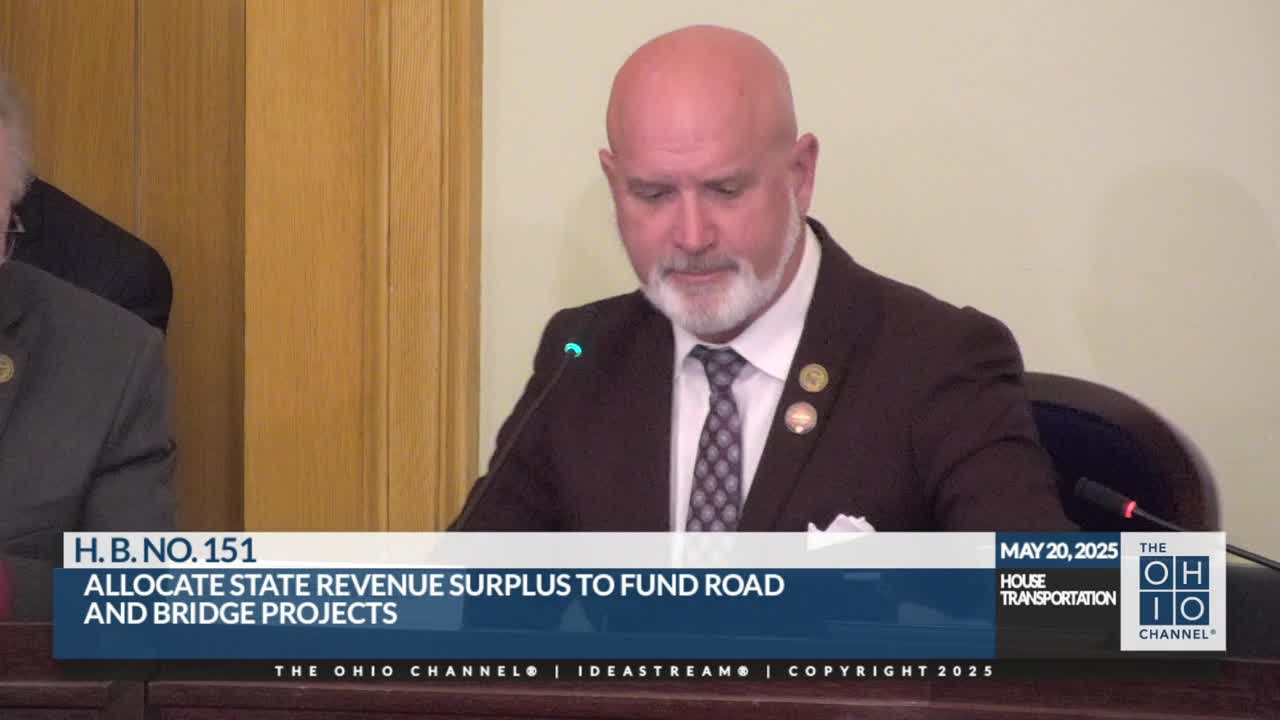
At a May 20 first hearing, a sponsor told the Ohio House Transportation Committee that House Bill 251 seeks to modernize state law on unmanned aerial vehicles (UAVs) used by law enforcement and to update Ohio’s aeronautics laws to recognize seaplane bases, heliports, vertiports and spaceports as aviation infrastructure requiring Ohio Department of Transportation (ODOT) approval for commercial use.
“The bill brings the use of UAVs into alignment with constitutional standards,” the sponsor told the committee, saying the measure would “generally require law enforcement to obtain a search warrant before using UAVs for surveillance purposes” while preserving carefully defined warrantless exceptions.
Exceptions and transparency
The sponsor said the bill would allow warrantless UAV use in narrowly described circumstances, including border security operations within 50 miles of an international border, exigent circumstances, disaster response, traffic and accident investigations, and for research, training and development. The bill would require law‑enforcement UAV flights to be documented, with records treated as public documents subject to existing exemptions under Ohio public records law, the sponsor said. The sponsor also said the bill explicitly would prohibit arming UAVs with lethal weapons.
Committee questions
Committee members asked about routine traffic monitoring and construction‑zone monitoring; the sponsor responded that the bill is intended not to impede current operational uses such as traffic monitoring, and noted the Ohio State Highway Patrol aviation branch had participated in drafting language to preserve effective current uses.
Law enforcement and private actors
Representative Mahomet asked whether the bill addresses non‑law‑enforcement users such as private investigators. The sponsor replied that the bill was tailored to law‑enforcement uses and that regulation of private surveillance would be addressed in a separate measure.
Action and next steps
House Bill 251 received a first hearing on May 20 and no committee vote was taken. The sponsor said the measure had passed unanimously out of the House Aviation and Aerospace Committee in the previous general assembly and asked for support from the Transportation Committee.
Ending
Committee members signaled further questions may follow as the bill proceeds; sponsors and staff will supply drafting clarifications as requested.