Get Full Government Meeting Transcripts, Videos, & Alerts Forever!
Get email alerts on the Transportation Funding topic
No spam. Unsubscribe anytime.
Rep. Stevens Urges Continued Funding for Connect for Ohio; Bill Would Tap Sales‑Tax Holiday Account
Summary
Representative Stevens told the House Transportation Committee that House Bill 151 would use excess state revenue to continue the Connect for Ohio rural corridor program, citing a potential $337 million available from the sales‑tax holiday balance and listing candidate projects across multiple counties; the bill received a first hearing.
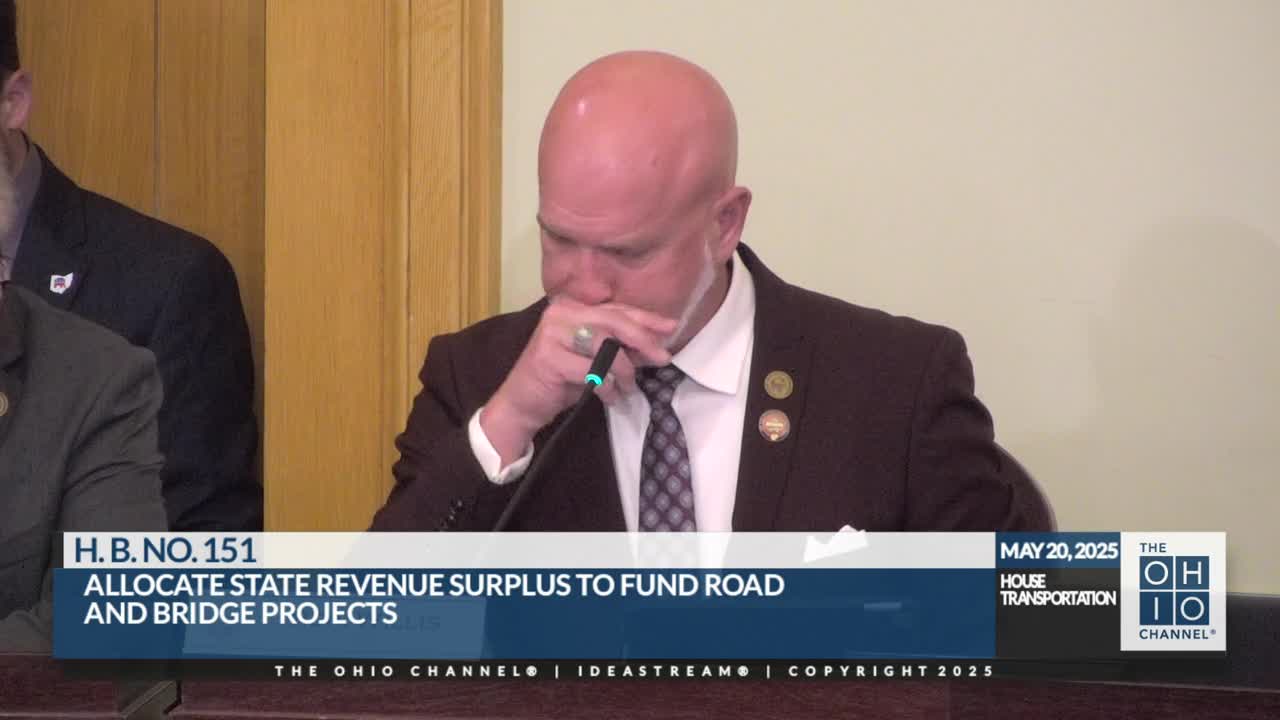
Representative Stevens told the Ohio House Transportation Committee on May 20 that House Bill 151 would allocate state revenue surplus to fund road and bridge projects under the Connect for Ohio program, arguing the measure would preserve a funding mechanism focused on rural corridor and non‑urban projects.
"House Bill 151 bolsters the continuation of the Connect for Ohio program," Representative Stevens said in sponsor testimony, describing the program as a two‑year initiative first implemented through the Ohio Department of Transportation (ODOT) in 2023 to help complete corridors between rural counties and to eliminate slowdowns on non‑interstate highways.
Stevens told the committee that Connect for Ohio can fund certain rural corridor projects at 100% of project cost when appropriate and can provide matching funds that allow projects to receive final TRAC approval. He said the bill would preserve those investments by using excess revenue after deposits to the budget stabilization fund and the sales‑tax holiday fund.
Funding details and projects cited
Stevens said the sales‑tax holiday fund currently holds about $587,000,000 in cash and that HB 151 would allow the fund to carry a reasonable maximum balance of $250,000,000, freeing approximately $337,000,000 for transportation projects. He listed several candidate projects on the TRAC track list that the bill could help fund, including a proposed interchange at U.S. 23 and State Route 762 in Pickaway County (the sponsor estimated that interchange at roughly $60,000,000), additional lanes on U.S. 22 in Harrison County, widening of State Route 48 in Warren County, an interchange and roadway improvements on U.S. 30 in Van Wert County, and a new interchange on U.S. 35 in Greene County near Factory Road and Orchard Lane.
Committee questions
Members from across the committee asked about program scope and prioritization. Representative Pazzulli asked how Connect for Ohio could support larger multi‑segment projects such as an I‑73 corridor; Stevens described the program as a way to fund incremental pieces that build toward larger corridors. Ranking Member Grimm asked whether HB 151 would rely solely on the sales‑tax holiday fund; Stevens said the mechanism channels excess receipts in strong fiscal years and is not an ongoing appropriation stream.
Action and next steps
House Bill 151 received a first hearing on May 20; no committee vote was taken. Stevens said the bill is intended to preserve Connect for Ohio as a targeted funding tool for rural corridors and to avoid competition between small rural projects and major urban interstate projects on the TRAC track list.
Ending
Committee members thanked Stevens for testimony and said they expect further hearings and analysis on funding mechanics and long‑term program structure.