Get Full Government Meeting Transcripts, Videos, & Alerts Forever!
Get email alerts on the Utv Road Policy topic
No spam. Unsubscribe anytime.
Industry, Insurers and Safety Groups Tell Ohio Panel HB 199 Would Raise Risks by Letting UTVs on Public Roads
Summary
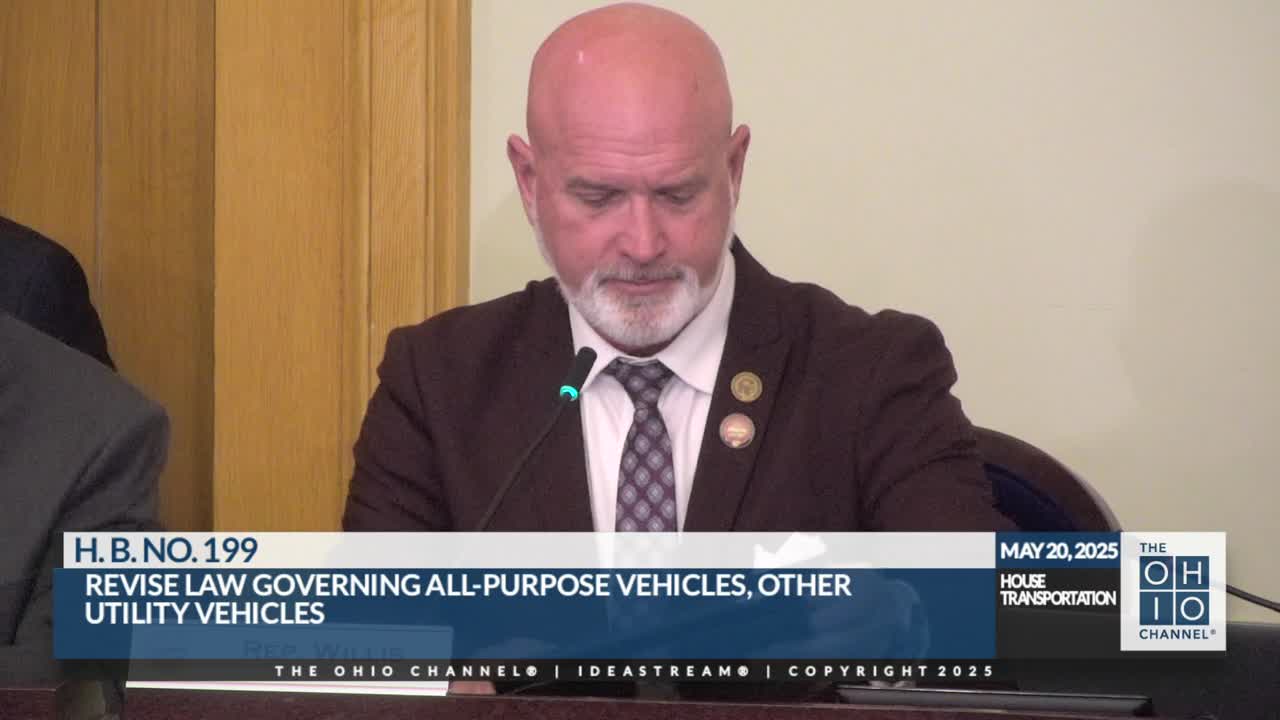
At a May 20 hearing, trade groups, an automaker and an insurer opposed House Bill 199, which would expand where utility terrain vehicles can be driven, citing safety gaps, regulatory limits and insurance exposure; the bill was the subject of a third hearing and no vote.
At a May 20 hearing of the Ohio House Transportation Committee, industry groups, automaker Honda and insurer Nationwide urged lawmakers to reject House Bill 199, which would expand where utility task vehicles (UTVs) and recreational off‑highway vehicles (ROVs) may be driven on public roads, citing safety, regulatory and insurance concerns.
The testimony came during the committee’s third hearing on HB 199. Dwayne Taylor, appearing for the Recreational Off‑Highway Vehicle Association (ROVA), said the association “opposes allowing ROVs on roads that are not part of a designated trail system” and warned the bill would ‘‘greatly expand the dangerous practice of operating OHVs on Ohio streets and roads.”
ROVA and other witnesses told the committee that UTVs are engineered for off‑road terrain, do not meet U.S. Federal Motor Vehicle Safety Standards (FMVSS) and lack standard on‑road crash protections such as airbags and stability control. Jeff Reid, government relations lead for Honda in Ohio, said the company’s safety and manufacturing teams “make very clear to our customers that these products are meant for off‑road use,” and warned that legalizing broader on‑road use could open manufacturers and dealers to liability.
Insurance provider Nationwide also opposed the bill. Devin Furman, Nationwide’s chief agriculture and sponsor relations officer, told the committee that standard auto policies typically exclude vehicles primarily intended for off‑road use and that expanding on‑road use “would increase safety risk to all consumers and expose members to increased premiums due to potential unplanned exposures.”
What HB 199 would change
Under current Ohio practice cited in testimony, some local jurisdictions have limited allowances for off‑road vehicles on certain roads. Witnesses said HB 199 would permit local authorities to allow ROVs/UTVs on streets carrying up to 55 mph (current practice cited in testimony often limits allowances to 35 mph), and add state‑level authorization that opponents say would broaden use statewide.
Testimony and evidence cited
- Dwayne Taylor (ROVA) cited NHTSA and manufacturer warnings and referenced reported increases in fatalities after expanded allowances in other states, including an Iowa example in which reported ATV/UTV fatalities rose from 4 in 2021 to 12 in 2022 and later to 20 in 2024. Taylor said the association’s model legislation favors prohibiting on‑road use.
- Jeff Reid (Honda) described separate design and testing tracks at Honda’s Ohio R&D facilities for off‑road and on‑road products and warned that UTV tires and vehicle structures are not engineered to withstand sustained highway speeds or collisions with passenger vehicles.
- Devin Furman (Nationwide) said UTVs “do not meet U.S. highway safety standards” and warned of coverage gaps: "today that would not be covered under our standard auto policy." He said insurers might limit or decline coverage if on‑road use becomes widespread.
Committee questioning and concerns
Committee members pressed witnesses on liability, enforcement and whether modifications or inspections could make UTVs safe for on‑road use. Witnesses uniformly said aftermarket add‑ons and inspections would not change the vehicles’ fundamental design differences from FMVSS‑compliant on‑road vehicles.
Action and next steps
HB 199 was the subject of a third hearing on May 20; no committee vote was recorded. Witnesses indicated they expect continued debate if the bill proceeds.
Ending
Committee members signaled they will seek more data and may revisit trade‑offs among rural mobility, safety and insurance availability as HB 199 moves through the legislative process.