Get Full Government Meeting Transcripts, Videos, & Alerts Forever!
Get email alerts on the Privacy And Deepfakes topic
No spam. Unsubscribe anytime.
Ohio committee hears bill to expand name, image and likeness protections to deepfakes
Summary
The House Technology Innovation Committee held the first hearing on House Bill 185, a sponsor-driven proposal to remove the commercial-purpose requirement from Ohio's name, image and likeness protections and to add language targeting AI-produced 'modified facsimiles' and malicious deepfakes while preserving First Amendment carve-outs.
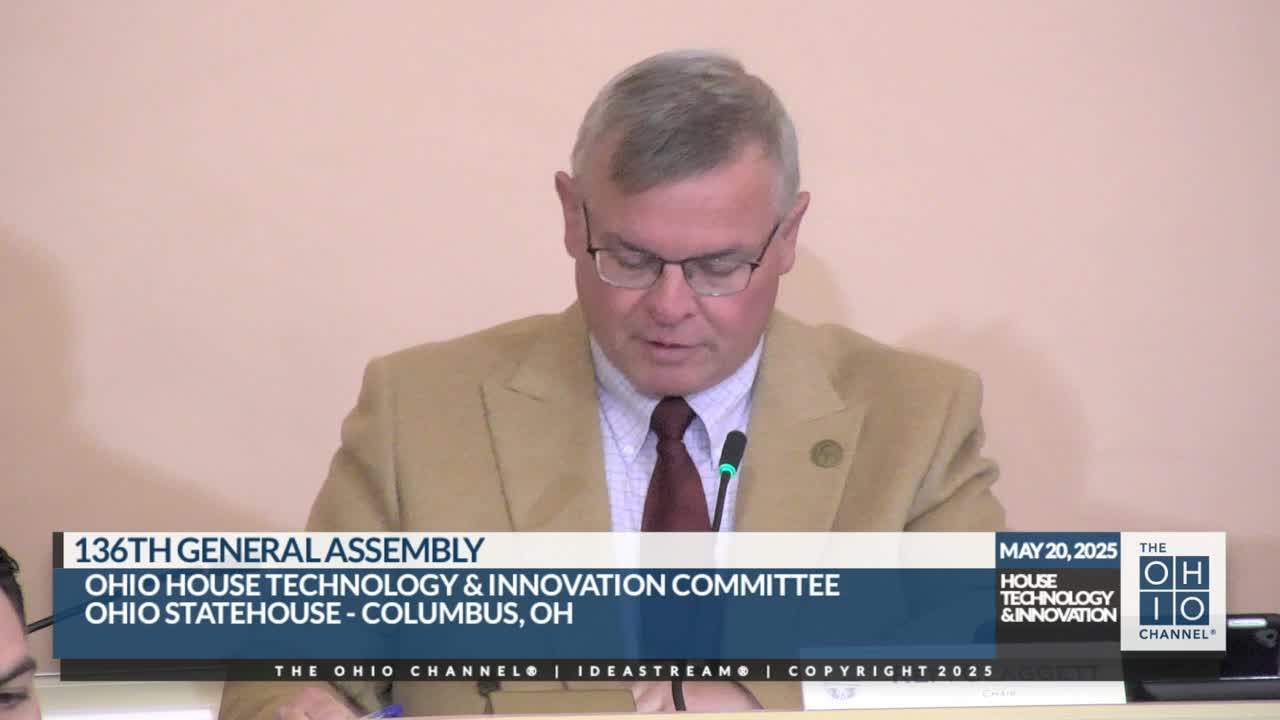
The House Technology Innovation Committee on an unspecified date heard sponsor testimony on House Bill 185, which would expand Ohio's name, image and likeness protections by removing the requirement that an unauthorized use have a commercial purpose.
Sponsor Representative Adam Matthews said the bill 'removes the requirement of having a commercial purpose to protecting an individual' and is intended to give 'all citizens the ability to protect against unauthorized uses of their identities.'
The bill would update Ohio's existing statutory framework to cover a person's 'persona' when a 'modified facsimile' of that persona is created and would be actionable where 'a reasonable trier of fact would confuse the modified facsimile and the individual,' the sponsor told the committee. Matthews said the change would apply to images, audio and video manipulations produced by traditional editing tools or by generative artificial intelligence.
Matthews also described a separate definition in the bill for 'malicious deep fake recordings' as a 'fixed and false video or audio that appears authentic' and is produced 'to intentionally harm another person.' Those recordings, he said, 'would most likely be used for defamation or extortion.' The bill would require conspicuous labeling for fabricated audio or video used in politically related contexts, using language modeled on existing campaign-finance disclosure rules, and would add email as an acceptable method of statutory notice.
The sponsor told the committee the measure is a reintroduction of House Bill 367 from the prior General Assembly and that drafters consulted with 'interested parties, including the attorney general's office.
Committee members asked how the bill would be applied. Representative Ferguson asked whether someone who merely re-shares manipulated media online could be liable under the bill's recklessness standard. Matthews said the recklessness standard would require that the person 'knew or should have known' the material was fake; mere sharing without such knowledge would not ordinarily meet that threshold.
Representative Conklin asked about a 60-year post-mortem protection period mentioned in the draft. Matthews said the bill follows the existing structure in Ohio's name, image and likeness law and that the timeframes and fines in the draft reflect the current statutory framework.
Representative McLean asked whether the 'conspicuous' disclaimer requirement was standardized. Matthews said drafters adopted the same conspicuousness threshold used for political 'paid for by' disclosures that have been litigated in the campaign-finance context.
Members also discussed the difference between the federal action referenced by the sponsor and the state bill. Matthews said the recently signed federal bipartisan measure (sponsored in the Senate by Senators Cruz and Klobuchar, as referenced to the committee) focuses on criminalizing certain obscene uses of images and, in the sponsor's description, targets some child-focused conduct; the sponsor said House Bill 185 would operate in the civil code, would not be criminal, and could be broader in scope (for example, applying to fabricated personas that are not derived from a particular real person).
Representative Conklin suggested an amendment to define 'reckless distribution' more precisely; Matthews said he was open to working on language and to consult precedent if the committee wanted to tighten that definition.
This was the bill's first hearing; the committee heard sponsor testimony and follow-up questions but took no vote or formal action on final passage.
The committee record shows the sponsor and multiple members discussed constitutional and practical limits; the sponsor repeatedly emphasized First Amendment carve-outs in the draft and said the bill's exemptions would preserve political speech and news reporting.
The committee concluded the first hearing without advancing the measure.