Get Full Government Meeting Transcripts, Videos, & Alerts Forever!
Get email alerts on the Right To Repair topic
No spam. Unsubscribe anytime.
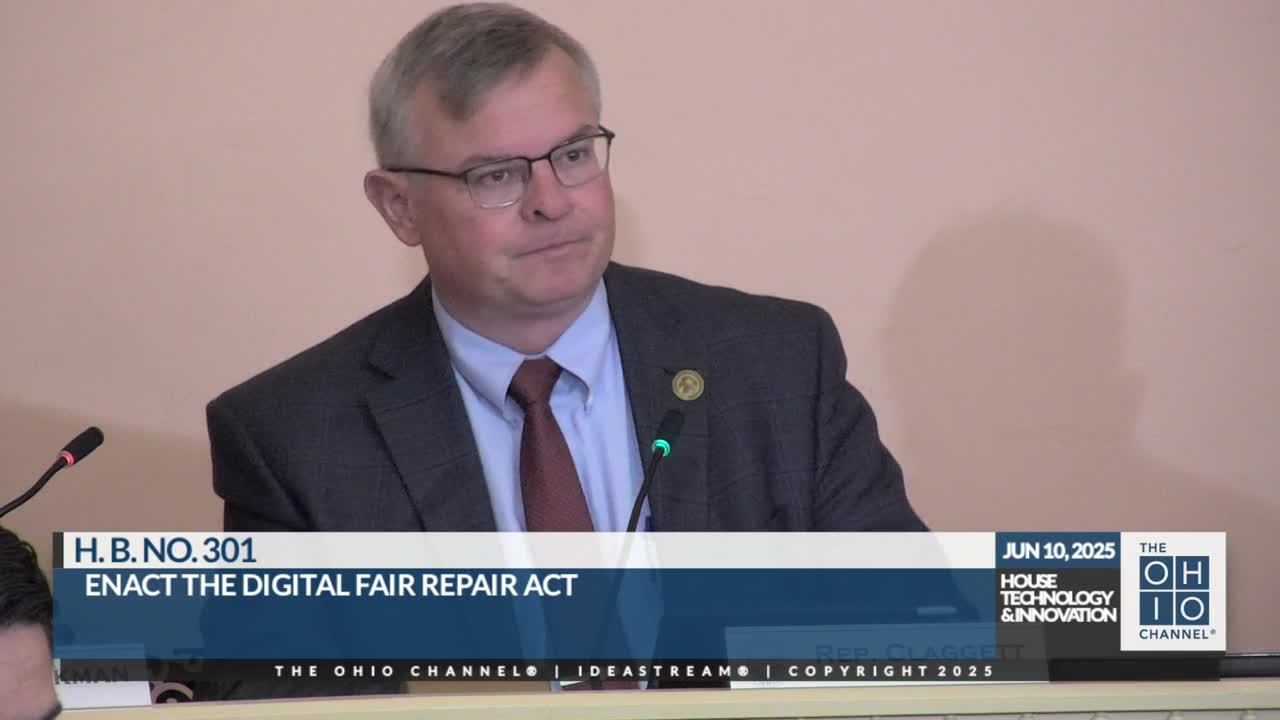
Ohio panel hears sponsor testimony on HB 301, a digital ‘right to repair’ bill
Summary
The House Technology and Innovation Committee held a first hearing on House Bill 301, which would require manufacturers of small-screen digital devices to provide documentation, parts and tools to owners and repair providers. Lawmakers questioned the bill’s scope, security implications and effect on repair markets; no vote was taken.
Representative Adam Matthews, sponsor of House Bill 301, presented sponsor testimony to the House Technology and Innovation Committee on a bill that would require manufacturers of certain small-screen digital devices to provide documentation, tools and parts to owners or third‑party repair providers.
The bill, Matthews said, would “require manufacturers of certain digital electronic equipment, specifically cell phones, laptops, or other small screen personal screens, to provide the documentation, tools and parts necessary for owners or repair providers to maintain and repair this equipment.” He told the committee the materials should be “made available, either at no cost or just at cost.”
The bill is modeled on New York’s Digital Fair Repair Act and is a companion to Senator Blessing’s Senate Bill 176, Matthews said. He and committee members repeated that HB 301 is limited to consumer digital devices and explicitly excludes motor vehicles, aircraft, and construction and agricultural equipment, which the sponsor described as having distinct safety concerns.
Matthews told lawmakers the measure is intended to preserve property rights and to support both independent repair shops and consumers: “It’s both pro business and pro consumer,” he said. He said the bill includes protections so manufacturers would not be required to disclose trade secrets or other unnecessary intellectual property beyond what is needed to allow owners to fix their own devices.
Committee members pressed the sponsor on several practical issues during question-and-answer. Lawmakers asked whether the bill would require manufacturers to continue producing software updates or security patches; Matthews said the bill does not require continued service or updates and that continued support is a market decision. He and members also discussed whether the law would principally benefit repair shops or individual consumers and whether costs for parts and documentation could be passed on to consumers.
During the hearing members repeatedly sought clarity about scope: whether embedded or connected devices—such as vehicle infotainment systems or appliances with software—would be covered. The sponsor reiterated that the legislation is narrowly drawn to cover small personal devices and not larger, safety‑critical machinery.
No committee action or vote was taken on HB 301 at the hearing; the committee concluded the first hearing and indicated the bill will return for further consideration and possible amendments at a later date.