Get Full Government Meeting Transcripts, Videos, & Alerts Forever!
Get email alerts on the Landfill Pfas topic
No spam. Unsubscribe anytime.
Canterbury Solid Waste committee and select board clash after citizen report flags PFAS in landfill wetlands
Summary
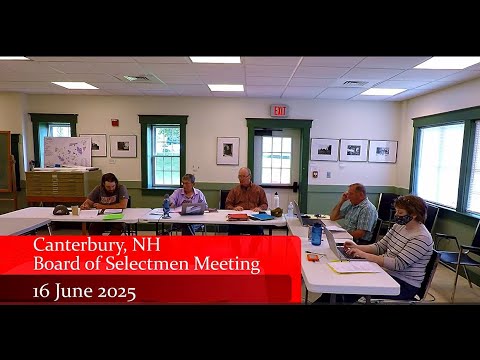
A volunteer report and subsequent committee presentation about decades of water testing at the town landfill prompted a contentious exchange between the Solid Waste Committee and the Board of Selectmen.
A volunteer report and subsequent committee presentation about decades of water testing at the town landfill prompted a contentious exchange between the Solid Waste Committee and the Board of Selectmen at the meeting.
The Solid Waste Committee chair, Richard (Rich) (Solid Waste Committee chair), opened the topic by asking the board to “set the record straight” about remarks made at a prior meeting and to address what committee members described as mischaracterizations of their work. Committee member Roy Bliscoe, who authored a risk-assessment report compiled from public DES filings and other records, said the document was his independent work and not directed by the committee: “This report was not tasked to me by the Solid Waste Committee.”
Why it matters: Bliscoe’s analysis highlights long-running monitoring data and asserts that PFAS compounds, lead and iron show up in groundwater and surface-water samples near the landfill and nearby wetlands. Committee members said the data support further study before the town spends money on infrastructure at the current transfer-station site. The select board said it wanted more clarity on process and minutes and declined to act immediately on committee governance.
What the record shows: Bliscoe told the board he reviewed nearly 20 years of ARES Engineering test results filed with the New Hampshire Department of Environmental Services (DES) and found elevated PFAS readings in wetland surface-water samples. He described a pattern in which wetland sediments and surface-water samples yielded concentrations that, in several samples, exceeded the state’s draft or existing guidance levels by large multiples. He said the committee had requested a feasibility and sustainability report on the existing transfer-station site; that report is expected soon, and that an independent sampling record should inform whether the town should continue investing at the current site or plan for relocation.
Engineering response and next steps: An ARES Engineering representative said the firm has monitored the site for about 20 years and described how wetland samples can vary because organic sediments bind PFAS. The engineer said off‑site sampling to date shows lower concentrations farther from the landfill and that “as you get further away from the landfill, the organic material in the wetlands tends to absorb that PFAS.” He told the board the firm was not seeing affected private drinking wells downgradient of the site and that the first off‑site residential well identified in prior work had a PFAS signature attributed to an on‑site septic system rather than the landfill. He said the next comprehensive sampling event — which the town’s engineer said is scheduled for November 2026 — will include residential wells, monitoring wells and surface-water samples and will be used to evaluate permit conditions and management zones.
Committee governance and public process: Committee members said they were surprised by public criticisms made at the May 19 select-board meeting and by suggestions that the committee had acted without process. Several committee members and some select-board members urged a cooling-off period and better two-way communication. The board said it will review the written statements from the Solid Waste Committee and asked staff to circulate all relevant minutes and documents to ensure the select board understands the committee’s process and findings before any governance decisions are made.
No formal action: The board did not dissolve the committee or remove its chair at the meeting. Several select-board members said they would rewatch the May 19 video and review committee minutes before taking any formal steps. The Solid Waste Committee members asked the board for a public apology for disparaging remarks; the board deferred that request and said it would first review the material and confer.
What’s next: ARES Engineering and the town administrator said the regular monitoring cycle will continue and the town will get the full feasibility/sustainability study the committee requested. Both sides urged continued public availability of records and clearer communication so future controversies do not arise from perceived gaps in process.
Ending: The board requested the committee supply any outstanding documents to the town office; the select board said it will not make governance decisions at a single meeting and will schedule follow-up after staff compiles the relevant minutes, reports and the upcoming feasibility study.