Get Full Government Meeting Transcripts, Videos, & Alerts Forever!
Get email alerts on the Public Safety Police topic
No spam. Unsubscribe anytime.
Riley County police present 2024 crime certification, expand camera use; jail overcrowding, hemp enforcement raised
Summary
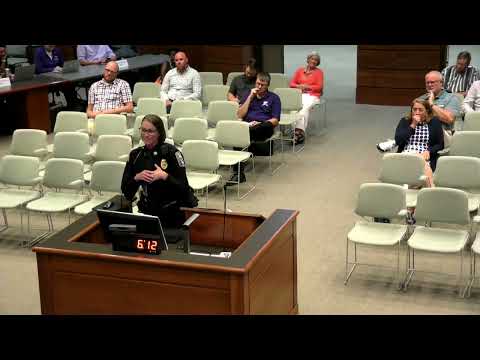
Riley County Police Department Deputy Director Erin Friedline updated the Manhattan City Commission July 22 on certified 2024 crime figures, an expanded camera program credited with solving crimes and corrections staffing and jail population pressures.
Riley County Police Department Deputy Director Erin Friedline updated the Manhattan City Commission July 22 on the county's certified 2024 crime numbers, the department's camera initiatives and license-plate readers, and operational pressures in corrections operations. Friedline said the department's violent-crime rate was 2.8 per 1,000 people and another rate cited was 14.2 per 1,000; she said Riley County was roughly 40% less violent and about 30% below the state average on comparable measures. "We continue to be a safe community," Friedline said. She cautioned that small raw counts can make percentage changes misleading. The department has expanded fixed and license-plate-reader cameras around Manhattan. Friedline said the camera systems, combined with an intelligence unit that monitors footage and radio traffic in real time, have helped solve more than 70 crimes year to date and speed responses to in-progress incidents. The system relies in part on business and municipal camera feeds; Friedline said the city has been a "great partner" and that an integrated software solution could help bring disparate camera systems into a single view. Friedline described enforcement related to Kansas hemp statutes after the department encountered court cases in which people believed they had purchased legal products but the items did not comply with state law. She said the department conducted business outreach and education; in one case it served warrants where that criminal information justified it. "Several of the businesses were selling the actual flower or bud type product. That is illegal in the state of Kansas," Friedline said, and she said the department encouraged businesses to consult legal counsel and remove noncompliant products. Commissioners pressed Friedline on staffing and targets. She said sworn patrol overtime remains under budget because the department uses squad-based patrol schedules, and that some investigative and data-mining functions can be handled by professional civilian staff rather than sworn officers. Friedline said overtime cost pressure is in the county jail/corrections division: the jail held 124 inmates the morning of the meeting and, because of classification and housing availability, the department sometimes pays overtime to transport inmates to other jurisdictions for court. "Where we are over budget on overtime is in our jail division and our correction section," she said. Members of the commission asked about strategies to reduce jail population. Friedline and others noted the loss of federal funding for a local drug court; Manhattan Mayor McCullough told the commission that Judge Bosch had reached out about the drug court losing federal funds and suggested using other opioid-related money to restart drug court options. Friedline said most pretrial inmates in the county are charged with felony offenses and that judges use a bond schedule; she also said delays in public defender availability contribute to lengthier stays. The commission did not take action on the update; Friedline's presentation was informational and commissioners said they wanted the public to understand policing's personnel and cost structure. Ending: The commission's discussion closed without votes. Commissioners thanked Friedline and staff; the commission moved on to the next agenda item.