
Snowline board holds goal-setting workshop; leaders prioritize student achievement, relationships and leadership development
Get AI-powered insights, summaries, and transcripts
Sign Up Free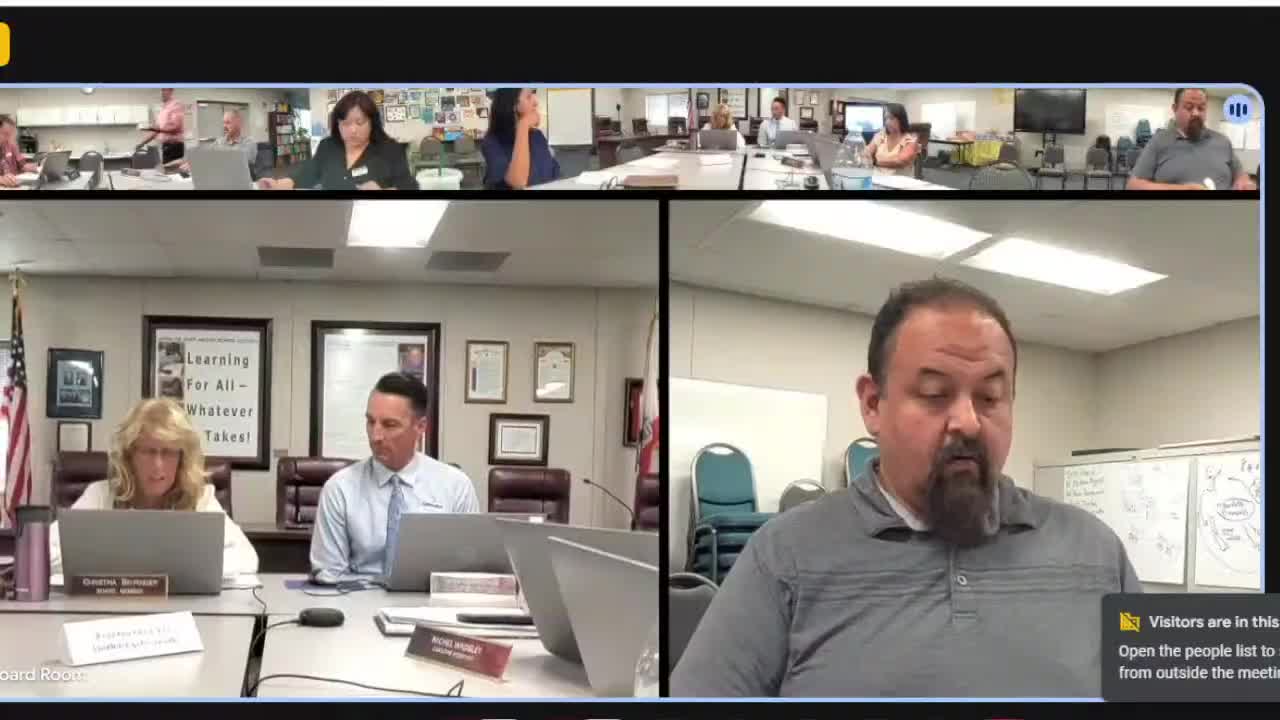
Summary
The Snowline Joint Unified School District Board on Aug. 27 held a three‑hour study session to translate leadership council feedback and district data into proposed multi‑year goals, emphasizing student achievement, relationships, leadership development, safety and fiscal responsibility.
The Snowline Joint Unified School District Board on Aug. 27 held a three-hour study session to translate feedback from district leaders into a set of proposed multi-year goals and next steps for aligning site and district work.
Board President Christina Behringer convened the workshop where district staff presented a nine‑page summary compiled from a session earlier that day with about 35 site and department leaders. The packet synthesized hundreds of responses about highlights, challenges and recommended focus areas and paired them with districtwide data points such as attendance trends, CAASPP and STAR assessment results and school‑climate survey findings.
The board and cabinet surfaced five recurring priority “pillars” from staff input: increased student achievement (with special attention to math and English learners), stronger relationships and engagement with families and community, leadership development and capacity building, safety and wellness, and fiscal responsibility tied to operational effectiveness. Rachel (district staff) and Resmaa Burney led the effort to collate leader responses for the board, which were then reviewed with facilitator Dr. Kent Beckler of Leadership Associates.
Why it matters: Board members and administrators said the exercise is intended to set enduring, high‑level district goals that will guide site objectives, the Local Control and Accountability Plan (LCAP) and the superintendent''s evaluation over the next three to five years. Several board members stressed the need to move from high‑level priorities to concrete end states and measurable objectives.
Key details from the session
- Data and scope: District staff said they gave leaders statewide assessment results (CAASPP), STAR assessments, school climate data (Hanover), attendance trends (P‑2 reporting) and a distilled set of leadership expectations (reduced from about two dozen to roughly 10 strands) to inform responses. Administrators asked that the board review pages 6–9 of the packet, which list highlights, challenges and suggested focus areas collected on chart paper during the leaders''s session.
- Attendance and funding: Staff displayed multi‑year average daily attendance (ADA) trends and noted a roughly 3 percentage‑point decline from pre‑COVID levels (from about 95% to the low 90s). The district said that drop corresponds to roughly $4.8 million in state funding at current rates and reminded the board that P‑2 ADA is the attendance measure used for payment.
- Academic priorities: Math proficiency and English learner outcomes were raised repeatedly; several administrators and board members urged that math be a top district priority. Board members also urged clearer end states for goals ("what does success look like?") and close alignment with the LCAP, which carries specific measurable targets.
- Leadership development and supports: Administrators reported burnout and spread among site leaders and asked for greater capacity building and operational systems to free time for instructional leadership. Dr. Beckler and staff described plans for cohort leadership training led by Leadership Associates; the district indicated that the training would be proposed for the 2025–26 budget cycle.
- Instructional coherence and PLCs: Board members and staff emphasized continued rollout and fidelity of Professional Learning Communities (PLCs) and district instructional strategies (the district has invested in Solution Tree supports). Several participants urged stronger mechanisms for closed‑loop accountability so principals and teachers receive regular follow up and support.
- Facilities and extracurriculars: Passing the recent bond, following the facilities master plan, and maintaining competitive extracurricular and arts programs were also listed as priorities tied to student engagement and enrollment.
- Community engagement, marketing and transparency: Board members repeatedly urged more active marketing of district programs and clearer, public‑facing data (some noted the district website still displays older proficiency reports). Several trustees described traveling board meetings, parent outreach and other tactics to increase visibility and trust.
What the board asked staff to do next
District administrators will take the board''s expressed priorities and the leadership‑council input and produce a set of proposed district goals and objectives. Those pillars and draft objectives will be returned to the board for review; staff said those district goals will cascade to site plans and teacher objectives and be reflected in the superintendent''s evaluation protocol. Dr. Kent Beckler advised the board that the process must include clear accountability and that the superintendent''s office should assign responsibility for each focus area to a cabinet member.
Quotes from the meeting
- "If you want the status quo, don't hire me, because I'm not gonna do that," said Dr. Kent Beckler, the session''s facilitator, urging that change requires sustained leadership and accountability.
- Resmaa Burney, who organized the leadership feedback, said the leaders were given data so "they weren't just picking items from their gut," a point offered to stress that recommendations were evidence‑informed.
- Board member Nathan (speaking from the board) said the packet "is missing for me the end state," urging that each goal include a clear description of the intended outcome.
Next steps and timeline
Staff recommended that the board take time to read the pages that summarize leader input (pages 6–9) and reconvene to select the pillars the board will adopt. The district expects administrators to draft aligned site goals and objectives and to present progress updates in a meeting where board members will hear from each administrator about progress on the selected goals. Leadership associates and cabinet members will return with a proposed schedule and the cohort training plan for board approval; staff indicated some items will be proposed for the 2025–26 budget.
The board did not take formal votes in the study session. The session closed with agreement on next steps to convert the priorities into measurable goals and to align those goals with the LCAP and superintendent evaluation timeline.