Get Full Government Meeting Transcripts, Videos, & Alerts Forever!
Get email alerts on the Economic Development Wareham Hall topic
No spam. Unsubscribe anytime.
Commission approves IRB abatement for Wareham Hall, clears path to federal tax-credit financing
Summary
The Manhattan City Commission on July 15 approved a resolution enabling Wareham Hall to pursue an industrial revenue bond property‑tax abatement and federal historic tax‑credit financing, voting 5‑0 to authorize an economic development agreement.
The Manhattan City Commission on July 15 approved a resolution authorizing an economic development agreement that would allow Wareham Hall to use an industrial revenue bond property‑tax abatement and pursue federal historic tax‑credit financing. The vote on the resolution was 5‑0.
The action lets the nonprofit operator move forward with a development agreement that staff described as a 10‑year, 100% property‑tax abatement tied to performance metrics, and preserves Wareham Hall’s ability to pursue federal historic tax credits. Stephanie Peterson, the city’s director of community development, told commissioners the packet includes an amended sales‑tax exemption request and a proposed development agreement with performance tiers based on total investment and ticketed patrons.
Peterson said the abatement would operate on tiers that begin when a minimum investment threshold is met; she used $33,000,000 as an example threshold for the top tier. Ticketed patrons — defined in the development agreement as people who buy a ticket for a show (not private rentals) — and a separate metric for nonlocal patrons (defined as people living more than 25 miles away) are the primary performance metrics. “It’s our recommendation to use the economic recovery and relief sales tax at 70% for public infrastructure,” Peterson said when commissioners asked staff for a funding recommendation for the requested $350,000 reimbursement for public infrastructure.
Blaine Majes, executive director of Wareham Hall, summarized the project and financing plan and urged commission approval so the nonprofit could preserve federal tax credits that Majes estimated would “conservatively bring 4 and a half to $6,000,000.” Majes described a fundraising stack that he said already includes more than $20,000,000 in philanthropic and grant commitments, private investment sourced through historic tax‑credit equity, and other private sources for the roughly $40,000,000 project. He told the commission that the project expanded from roughly 18,000 to 36,000 square feet during design and that a portion of the increase paid for accessibility improvements, office space for staff, restrooms and other features intended to support the venue’s long‑term financial sustainability.
Majes and Peterson described two public‑infrastructure areas under discussion: (1) a sidewalk/threshold “put back” where the building footprint interacts with public right‑of‑way to provide an improved drop‑off area and accessibility; and (2) alley improvements, including consolidated trash enclosures, elevation work for ADA access and a tabletop in the alley to speed loading and unloading and reduce safety hazards. Majes said the alley work would reduce the number of parking stalls removed for touring buses and would consolidate trash service from multiple haulers into a single enclosure, which he said would reduce vehicular traffic and wear in the alley. Majes told commissioners civil plans are still pending and staff expects them in the next few weeks; the development agreement would be brought back for final action once the scope is clarified.
Commissioners asked for more precise cost‑benefit tables and requested staff to clarify several line items in the consultant’s report; Majes and staff said the applicant provided the cost estimates and the city’s consultant assembled the summary tables. Several commissioners also asked staff to continue the discussion about decorative sidewalk inlays (the “Walk of Fame”) and maintenance responsibilities; Peterson said that element could be decided later and wouldn’t necessarily be part of the infrastructure reimbursement.
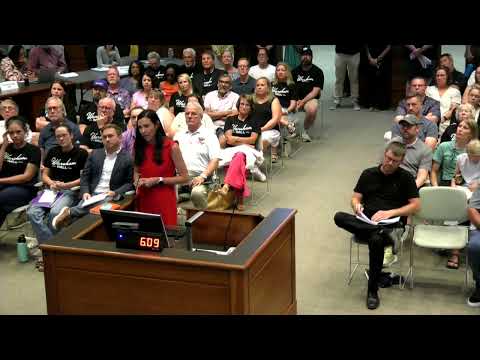
More than a dozen members of the public spoke in support during the public hearing. Speakers included Andrew Von Lintle, who said he had previously opposed the project but removed his opposition after the nonprofit structure was clarified; Frank Trace, who described community benefits and urged approval; Brian Pinkall, director of Kansas State University’s School of Music, Theater and Dance, who said the facility would provide internships and hands‑on training for students; and other downtown business owners, arts advocates and K‑State students who described the citywide and regional programming potential. A few speakers asked for continued scrutiny of details such as sales‑tax exemption calculations and the infrastructure reimbursement scope; Peterson and Majes acknowledged those requests and directed staff to follow up with more precise figures.
Formal action: Commissioner motioned to approve “resolution number 71525 (tech a) determining and authorizing execution of an economic development agreement for IRB property tax abatement.” The motion passed 5‑0 (Commissioners recorded in the roll call as: Commissioner Opelt — yes; Commissioner Mota — yes; Commissioner Minton — yes; Mayor Karen McCullough — yes; Commissioner Adamtract — yes). No amendments to the development agreement were adopted at the meeting; staff will return with a draft agreement after receiving civil plans and after the commission provides direction on the infrastructure funding source.
Next steps: staff will collect the civil engineering scope, refine cost‑benefit tables for the record, and return with a development‑agreement draft and an infrastructure‑funding recommendation (staff’s initial recommendation was the economic recovery and relief sales tax, with commissioners also discussing transient guest tax or TIF bond options). Majes said the project still depends on obtaining the federal historic tax‑credit equity and completing philanthropic fundraising.