Get Full Government Meeting Transcripts, Videos, & Alerts Forever!
Get email alerts on the Transportation Infrastructure topic
No spam. Unsubscribe anytime.
Commission adopts rule limiting heavy vehicles on designated residential access roads after public testimony
Summary
After public comment and debate, the board adopted Resolution 36‑25 to regulate heavy-vehicle use on certain residential access roads. The resolution initially listed about 26 candidate roads; commissioners amended who may make formal road-designation decisions and directed a public-notice process for additions or exceptions.
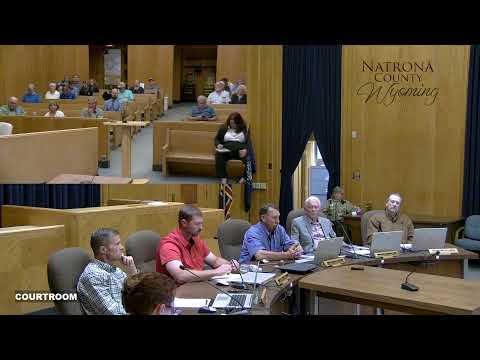
The Natrona County Board of County Commissioners adopted Resolution 36‑25 on Aug. 5 to regulate heavy-vehicle traffic on designated residential access roads in the county, after staff presented an initial inventory and residents gave extended public testimony. The action matters because heavy commercial truck traffic—most notably from gravel mining or industrial haul operations—can rapidly damage narrow, dead‑end or lightly constructed local roads, increase dust and safety risks for residents, and impose recurring repair costs on county taxpayers. Staff presentation and draft road list: Road and Bridge staff presented an initial inventory of roughly 26 residential roads that meet the draft policy’s criteria (residential function, limited access, dead ends, narrow geometry). Examples cited by staff included Henry Road, Lakeshore Drive and several Alcova-area roads, Coach Road and Squaw Creek on Casper Mountain, and local roads near Coats Road; staff said additional roads remained under review. Public testimony and concerns: dozens of residents — including homeowners from Coats Road, Webb Creek, Squaw Creek and other neighborhoods — urged the board to adopt restrictions, citing repeated damage from heavy trucks, safety concerns for children and older drivers, and the cumulative wear caused by quarry and haul traffic. One speaker quantified potential truck volumes and warned that a 17‑acre gravel operation could lead to many thousands of loads if exploited without controls. Commissioner discussion and amendment: commissioners debated scope and process. Some argued road‑and‑bridge staff should have the authority to identify roads that meet technical criteria; others said the board should be the final decision maker and that designations ought to follow notice and public hearing. Commissioner Nicholas moved to adopt the resolution and to modify the provision so that designations would be made by the Board of County Commissioners or its designee after notice and public hearing. That amendment passed and the commission approved the resolution with the identified roads as a starting point. Permitting and exceptions: the resolution establishes a permitting regime for heavy loads and grants the county a process to consider one‑time or limited exceptions; the board and staff discussed that exceptions should be rare and tied to transportation plans that avoid threats to residential roads. Road and Bridge staff said the permitting process would be part of standard project review and was not intended to be unduly burdensome but would include technical review. Next steps and implementation: staff will implement the resolution, post notice and publish the list of designated roads, and accept requests for modifications and permits. The commission indicated it will consider additions or removals to the road list following public notice and formal proceedings. The resolution passed on a recorded motion with commissioners debating the breadth of roads included and the proper balance between staff technical review and board-level decision making.