
Children’s Cabinet adopts FY27 budget recommendations; authorizes infrastructure funds for Office of Early Childhood transition
Get AI-powered insights, summaries, and transcripts
Subscribe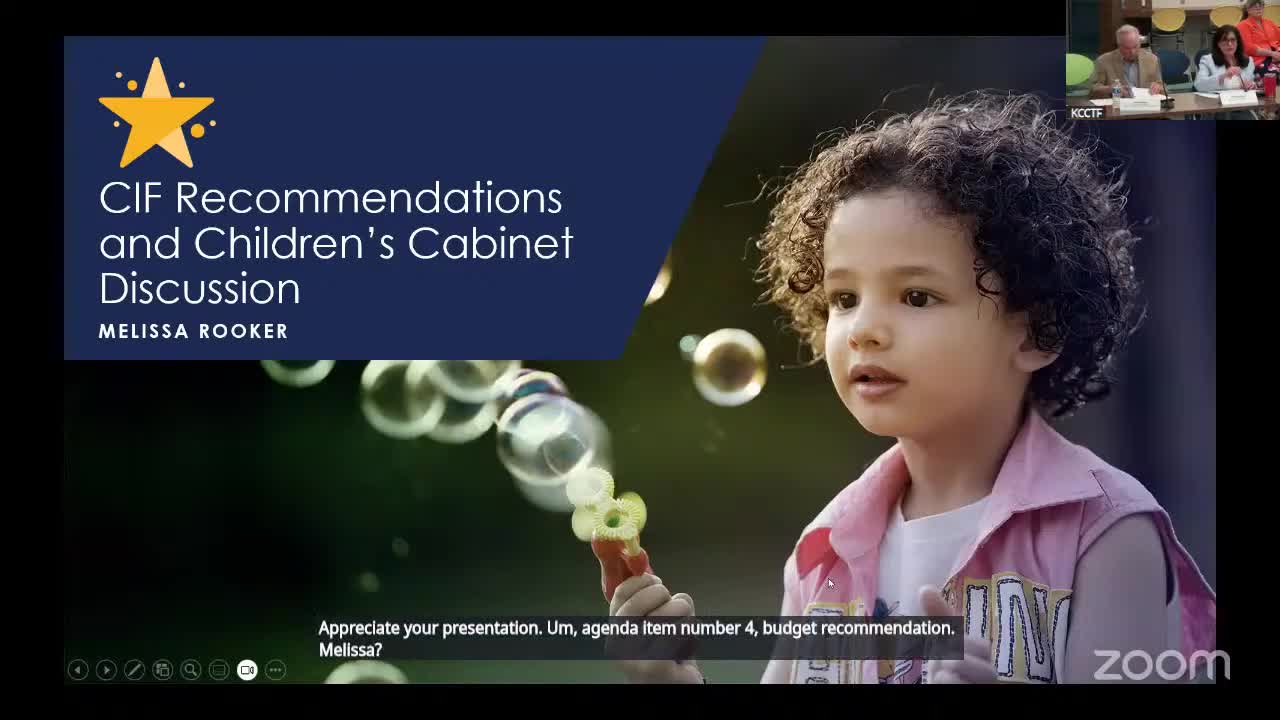
Summary
The Kansas Children’s Cabinet voted to adopt staff budget recommendations for the Children’s Initiative Fund and approved using a portion of the CIF infrastructure line item to support planning for the new Office of Early Childhood; the budget vote passed despite some members expressing philosophical objections to current funding structure.
The Kansas Children’s Cabinet voted in June to adopt the Children’s Initiative Fund (CIF) budget recommendations developed by staff and to authorize limited use of CIF infrastructure funds to support the state’s transition planning for a new Office of Early Childhood.
Budget adoption and board action
At the meeting, Melissa (budget lead for the Cabinet staff) presented the FY27 budget recommendation: largely flat funding for existing CIF programs, removal of the $1.4 million infrastructure line item from the CIF budget for FY27 as a recommended cut, and a one‑time FY25 appropriation (not recommended for FY27) to support a Southwest Kansas childcare accelerator project. The staff package also reflected prior legislative additions (including a $5 million endowment appropriation for a Northwest Kansas public‑private partnership) that affected available ending balances.
After discussion, a motion to adopt the recommendations was moved and seconded and was approved by the board. Several members voiced reservations about continuing to spend above projected tobacco annuity receipts and urged future additional reductions; Representative Christy Williams said she could not support the recommendation for philosophical reasons tied to funding structure. The transcript records a vote result of 5 in favor and 2 opposed; the board chair declared the motion carried.
Board authorization to fund Office of Early Childhood transition planning
Because the 2025 legislative session passed legislation establishing an Office of Early Childhood that takes effect July 1 and will change the cabinet’s structure, staff asked the board to authorize use of CIF infrastructure funds to support third‑party planning and transition activities. The request said planning will be collaborative across agencies and that staff estimated the need in the six‑figure range; staff also reported roughly $647,000 in FY25 infrastructure funds projected for reappropriation.
A motion to approve staff authority to use infrastructure funds for the transition planning was moved, seconded and approved by a voice or roll‑call vote. Several board members asked for tighter spending visibility and suggested a not‑to‑exceed cap; the board asked staff to report back with concrete dollar requests and periodic updates as planning proceeds.
Votes at a glance
- Motion: Adopt CIF FY27 budget recommendations as presented by staff. Outcome: Approved (vote recorded in transcript as 5 yes, 2 no). Key details: flat funding for most programs; recommendation to remove the $1.4M infrastructure line item for FY27; one‑time FY25 appropriation for a Southwest Kansas accelerator noted as not recurring. Discussion: multiple members urged further reductions in future years because the Key Fund (tobacco annuity) has a persistent downward trajectory.
- Motion: Authorize use of CIF infrastructure line item funds to assist in transition planning for the Office of Early Childhood. Outcome: Approved (unanimous or near‑unanimous voice/roll‑call recorded as carried). Key details: staff estimated planning costs in the six‑figure range; staff will supply itemized requests and periodic reporting to the board.
What the votes mean
Cabinet adoption of the staff package signals support for the recommended FY27 allocations and sends fiscal guidance to partner agencies (including Kansas Department of Education and KDHE) as they prepare their agency budgets. Board approval to use infrastructure funds allows staff to begin contracting or otherwise paying for external planning support, with the expectation of later, itemized reporting to the board.
Context and next steps
Board members and staff noted larger fiscal pressures: the Key Fund annuity is on a long‑term downward trend tied to changes in consumer tobacco product use and prior budget transfers; staff said the Cabinet is seeking embedded savings and structural changes as it prepares to consolidate many CIF line items into the new Office of Early Childhood. Members asked for follow‑up briefing materials on how administrative consolidation will create efficiencies and asked staff to return with specific dollar requests and regular updates on planning expenses.
Ending
The board carried both motions and directed staff to provide additional fiscal detail on planning costs and to report on budgetary impacts as the transition to the Office of Early Childhood proceeds.