Get Full Government Meeting Transcripts, Videos, & Alerts Forever!
Get email alerts on the Judicial Nominations topic
No spam. Unsubscribe anytime.
Supreme Court Nominating Commission sends three names to governor after interviews and balloting
Summary
After interviews and multiple balloting rounds, the Kansas Supreme Court Nominating Commission voted unanimously to forward three nominees — Amy Hanley, Christopher J. Ram and Larkin Walsh — to the governor. Commissioners also adopted a multi-round voting method and recessed into executive session to review applicant background materials.
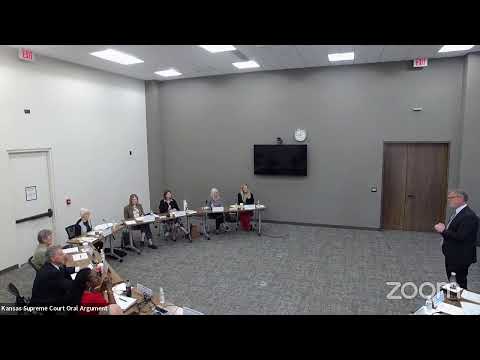
TOPEKA, Kan. — The Kansas Supreme Court Nominating Commission voted unanimously Tuesday to send three names to the governor to fill a vacancy on the Kansas Supreme Court, selecting Amy Hanley, Christopher J. Ram and Larkin Walsh after a sequence of public interviews, multiple rounds of secret-ballot voting and an executive-session review of candidate background materials.
The commission first adopted a multi-round voting procedure by motion, then conducted a series of five ballot rounds in public session. After the final tie-breaker ballot, a motion was made and seconded to forward the three nominees to the governor; commissioners voted in favor of the motion by voice. The commission also recessed into executive session to review sensitive information in applicants’ records and later returned to the open meeting and stated no formal action had been taken during that closed session.
Why it matters: The commission’s three names are the pool the governor will consider in making an appointment to the Kansas Supreme Court. That appointment will affect the court’s membership and may shape how the court rules on issues that come before it.
Most of Tuesday’s hearing time was devoted to public interviews with applicants for the vacancy. Applicants who appeared publicly included Larkin Walsh, who described “intellectual humility” as an important quality for an appellate justice; Johnson County Judge Robert Whannel, who described his work on behavioral-health dockets and specialty courts; Merrill Carver Olmant, who outlined years of capital and appellate defender work and court administrative experience; and Crystal Volkins, who emphasized outreach and public understanding of the judiciary.
Early in the meeting a commissioner disclosed a prior, limited connection to one applicant. The commissioner said that in 2019 a small group of judges and court staff had retained a private law firm to pursue litigation related to branch funding; an attorney who later became a partner at that firm was Larkin Walsh. The commissioner said the matter was dismissed, that there had been no subsequent contact with Walsh, and asked the panel whether that relationship represented a disqualifying conflict. Commissioners discussed the disclosure and continued with Walsh’s interview; the issue was presented to the body for its consideration but no formal disqualification was recorded in the public minutes.
Votes at a glance: - Motion to adopt the commission’s multi-round voting procedure: adopted by voice vote after a motion and second (no roll-call vote recorded in the transcript). - Motion to recess into executive session to review candidate background checks and personal records: moved, seconded and approved; commission reconvened publicly and stated that no formal action occurred during the executive session. - Final motion to submit to the governor the three names Amy Hanley, Christopher J. Ram and Larkin Walsh: passed unanimously by voice vote after the balloting rounds.
How the ballot worked: The commission initially cast up to six votes from a slate of 15 applicants. The field was narrowed across successive public ballots (rounds 1–4) to a final two-way tie that required a fifth round; that tie-breaker produced the final ordering that led to the unanimous motion to forward Hanley, Ram and Walsh. The transcript records nine ballots cast in each round (ballots 1–9), and the public tallying of votes at each stage.
Other business: Commissioners briefly discussed logistics for voting and the timing of a planned break. The meeting ended with the commission chair thanking members and staff; several commissioners thanked outgoing members for their service.
The commission’s submission of names to the governor starts the executive appointment process; the governor will choose one nominee from the list forwarded by the commission.